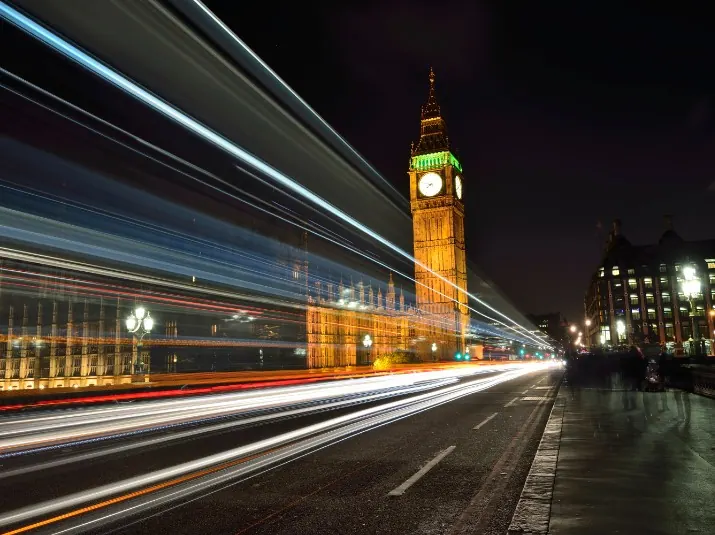
Light trails. 2016: Automated light trails in Nikon COOLPIX; long exposure is much older
Typeface · Gruppo
Nikon School: Nighttime light trails through long exposure. A contemporary teaching example.Nikon School / Neil FreemanView source ↗
Prompt
Apply a Light Trails effect, stretching moving or implied moving lights into continuous luminous paths with bright cores, colored halos, and smooth directional curves. Use long-exposure lighting, restrained highlight bloom, and crisp stationary details, keeping trails away from essential subject features. Keep the original subject and composition.
The [open shutter1collects light]along the movement.
Example
Traffic lights in the Nikon night photography example.
Try it out
Using atripod, photograph the same stretch of road with exposure times2of one and ten seconds.
Background
Light trails are aspecial form of motion blur: The light source itself traces its path. The surroundings can remain sharp with atripod. In 2016, Nikon introduced Multiple Exposure Lighten for several COOLPIX cameras: This function automatically combines images to create light trails. This is adated digital approach to amuch older image effect, not an invention of long exposure photography. Asingle long exposure and such an image series are different technical methods.
Distinction
The track shown is not areal, fixed line in space. It summarizes movement over the exposure time. Asafe, stationary position away from traffic is required for the experiment; adigital exercise will also work.
Aftermath
Astationary picture frame can make moving time visible.
Further examples · 9 images
02Lissajous-Figur -- 2020 -- 7766A complex golden Lissajous figure is shown against a dark background. It demonstrates light trails by tracing a repetitive oscillating path through a single long exposure.Dietmar Rabich · CC BY-SA 4.0 · Wikimedia Commons03Dülmen, Viktorkirmes auf dem Overbergplatz -- 2014 -- 3738 (2)A Ferris wheel at the Viktorkirmes features blue and white dotted light patterns. The circular motion of the ride's lamps creates concentric light trails during the exposure.Dietmar Rabich · CC BY-SA 4.0 · Wikimedia Commons04Münster, Schlossplatz, Frühjahrssend -- 2019 -- 4208A fairground scene features various amusement rides with overlapping pink, green, and yellow light paths. It illustrates how multiple moving light sources converge into continuous visual trails.Dietmar Rabich · CC BY-SA 4.0 · Wikimedia Commons05Ferry light trail, RostockParallel horizontal streaks of white and red light pass across a dark body of water. The ferry's movement is recorded as straight light trails past a lighthouse.Radomianin · CC BY-SA 4.0 · Wikimedia Commons06Münster, Schlossplatz, Herbstsend, Kettenkarussell -- 2024 -- 6459A chain carousel in motion displays pink and blue streaks above a illuminated carnival ground. The fast rotation transforms individual lamps into a translucent dome of light trails.Dietmar Rabich · CC BY-SA 4.0 · Wikimedia Commons07Light trails near Paris, 27 May 2022Stretched white and orange lines follow the curve of a road near Paris. The image captures the continuous paths of vehicle headlights and taillights over several seconds.Pierre Blaché from Paris, France · CC0 · Wikimedia Commons08Münster, Send, Riesenrad -- 2024 -- 6503Multiple intersecting colorful lines create a chaotic geometric pattern. This long exposure of a Ferris wheel illustrates light trails through intentional camera movement or complex rotation.Dietmar Rabich · CC BY-SA 4.0 · Wikimedia Commons09Light trails in Centro de Gramado at night (25415341663)White and red streaks represent traffic flow along a street in Gramado at night. The long exposure records vehicle paths as solid lines while the buildings stay sharp.Felipe Valduga from Porto Alegre, Brazil · CC BY 2.0 · Wikimedia Commons
Question
Why does the road remain sharp while the car headlights form lines?
Show possible answer +Hide answer −
The camera is stationary; only the light sources move during the exposure.