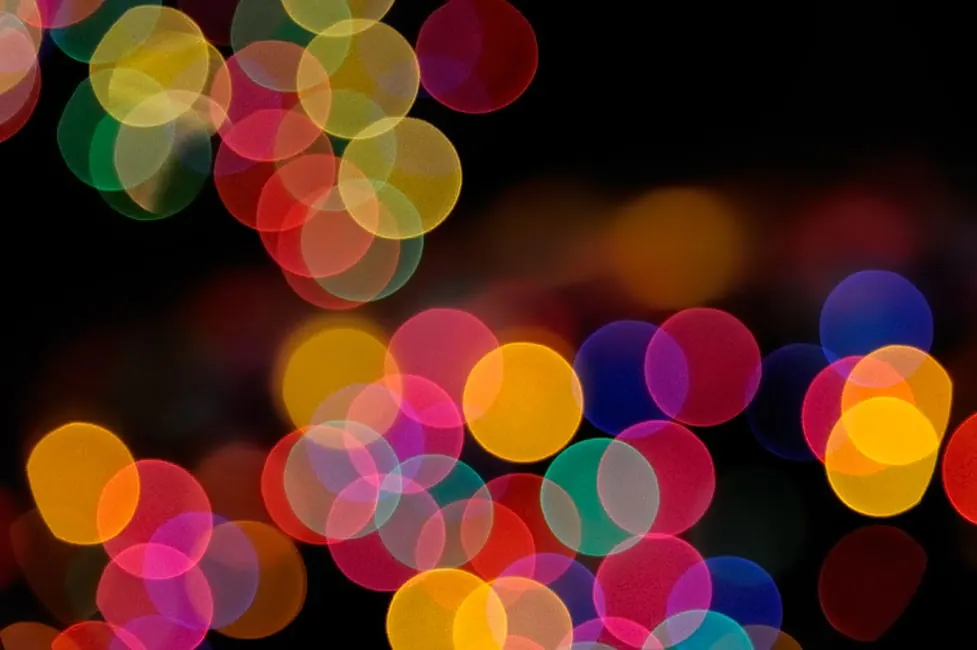
Apply a Bokeh effect with a sharply focused subject and strongly defocused background, turning distant light sources into soft luminous discs with gentle rims and occasional aperture-shaped highlights. Preserve natural foreground texture, realistic depth transitions, and warm or cool light colors without uniform blur. Keep the original subject and composition.
Photograph lights with an open and closed aperture.
Background
Lens culture discusses not only sharpness but also the character of out-of-focus areas. Round or angular light sources, soft transitions, and hard contours all influence the effect. In 2013, Nikon explicitly introduced the 58mm f/1.4G with its bokeh characteristics. This dated product example is not the origin of the phenomenon or the Japanese term. For aproper experiment, compare the same scene with the camera in the same position.
Distinction
Bokeh refers to the quality of the blur rendering, not simply any blurry image. Increasing the distance from the background also alters the effect. Artificial smartphone portrait mode can produce similar images, but additionally uses depth estimation.
Aftermath
Blurriness can be shaped and has its own character.
Further examples · 9 images
02CoucangA slow loris is perched on a branch against a leafy background. Light filtered through the trees creates soft, round white circles in the out-of-focus areas.Aprisonsan · CC BY-SA 4.0 · Wikimedia Commons03Josefina with BokehA young girl stands in profile in a wooded area. The bright sunlight behind her is rendered as overlapping soft discs of light, typical of shallow depth of field.carlosluis · CC BY 2.0 · Wikimedia Commons0420231223 una tazza di bokeh PD104696 1A single teacup sits below a vertical trail of colored lights. The lights appear as distinct, multicolored circular discs against a dark, featureless background.Paul Danese · CC BY-SA 4.0 · Wikimedia Commons05Love padlocks on the Butchers' Bridge (Ljubljana)Several metal padlocks are attached to a wire cable. Large, blurry yellow orbs in the background contrast with the sharp focus on the central red heart lock.Petar Milošević · CC BY-SA 4.0 · Wikimedia Commons06TAXIAn illuminated yellow taxi sign is sharp in the foreground. In the distance, streetlights are reproduced as soft red and white circles due to the lens aperture.Petar Milošević · CC BY-SA 4.0 · Wikimedia Commons07Raindrops on a window with vibrant bokeh lights creating an artistic, abstract effectWater droplets on glass remain in focus while streetlights behind are blurred into large, colorful circles. This illustrates how shallow depth of field transforms point light sources into soft shapes.DP Singh Bhullar · CC BY-SA 4.0 · Wikimedia Commons08Christmas Lights and BokehA pine branch features both sharp needles and out-of-focus Christmas lights. The lights appear as overlapping white discs, showing the interaction between foreground subjects and background bokeh.Thomas M Bishop · CC BY-SA 4.0 · Wikimedia Commons09Abstract bokeh lights (22142580635)This image consists entirely of overlapping, out-of-focus light circles. It shows the internal texture and hard edges of the blur circles, reflecting the specific optical characteristics of the lens used.Jim Killock · CC BY-SA 2.0 · Wikimedia Commons
Question
Why can blurry lights appear polygonal instead of round?
Show possible answer +Hide answer −
The aperture blades shape the opening and thus often also the blurred light disks.