H 016 / 3211840s

Harmonograph

1840s; invention often attributed to Hugh Blackburn in 1844
Typeface · IM Fell Double Pica

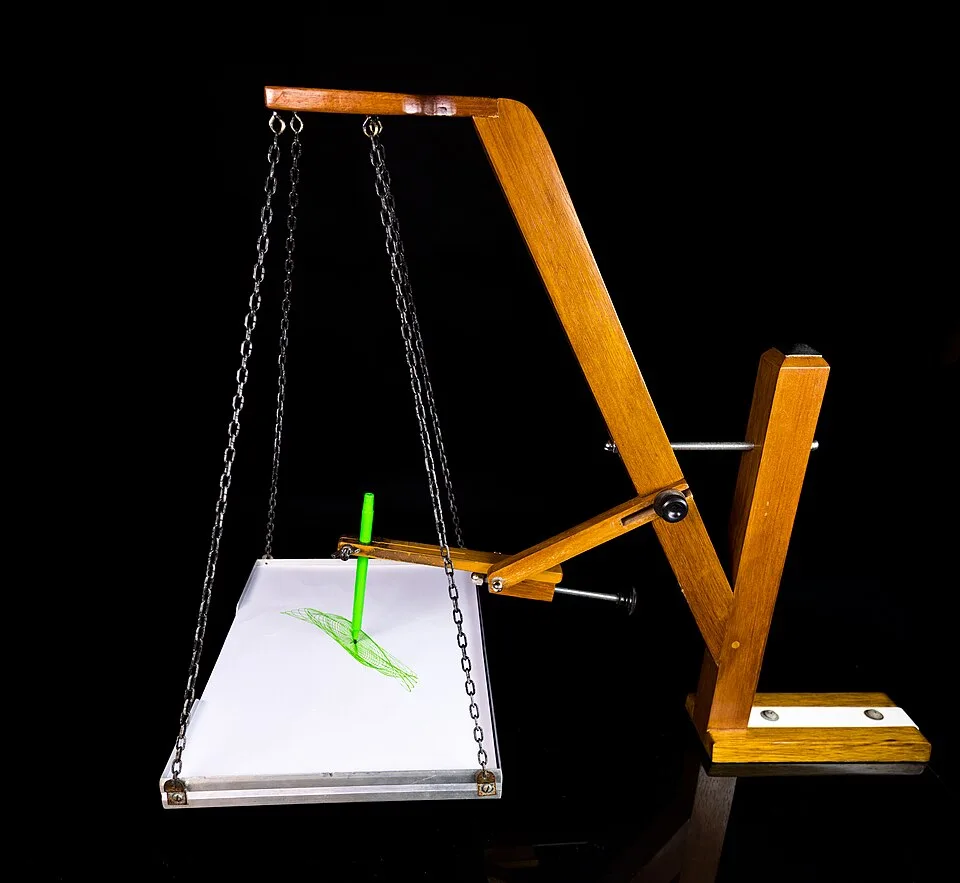
Harmonograph Tracing a Green Mesh. A green pen traces a fine, overlapping mesh on paper suspended by chains beneath a wooden mechanism.
Harmonograph Tracing a Green Mesh. A green pen traces a fine, overlapping mesh on paper suspended by chains beneath a wooden mechanism.Exhibit made by Estes Objethos Atelier photo by Rodrigo Tetsuo Argenton · CC BY-SA 4.0 · via Wikimedia CommonsView source ↗

Prompt

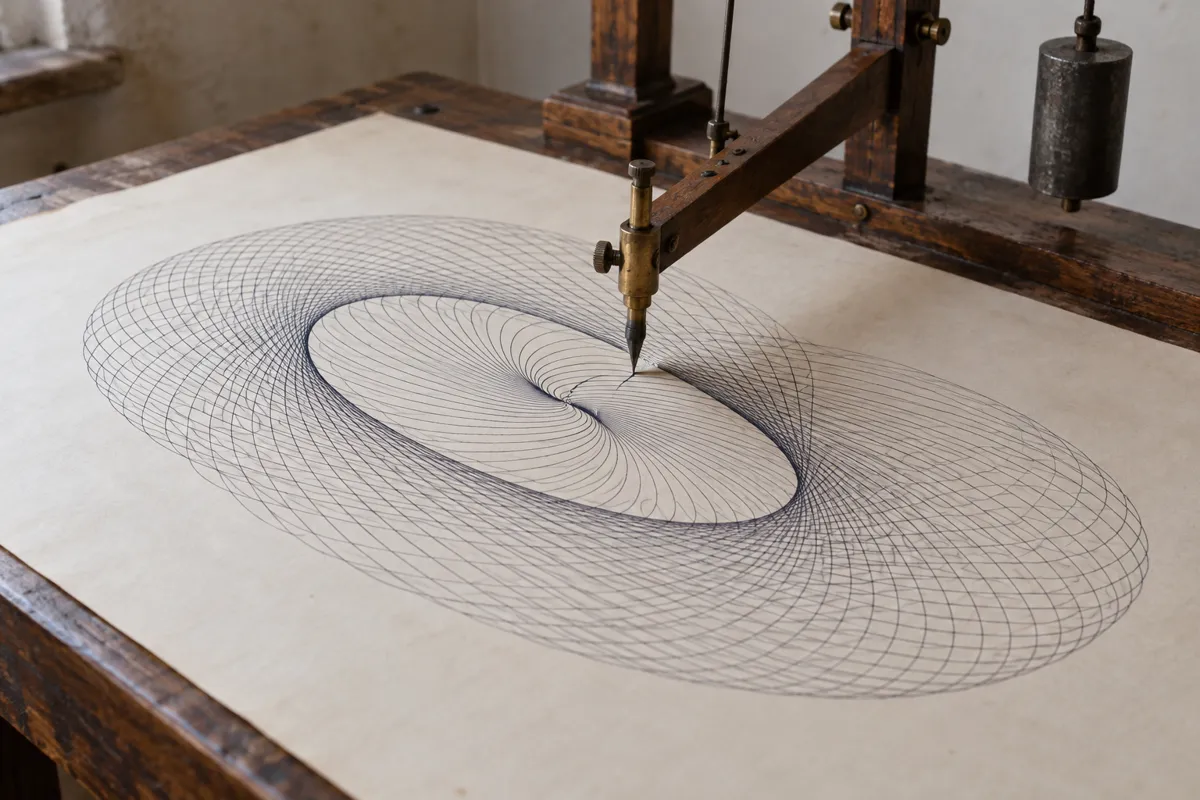
Transform this image into a Harmonograph drawing, rebuilding its recognizable shapes with fine continuous ink loops, nested oscillations, and gradually contracting spirals. Use repeated crossings to create dense shadow bands and airy open meshes for highlights, all on lightly textured ivory paper. Keep the original subject and composition.

Identify

Fine lines form nested loops, woven meshes, and narrowing spirals. Repeated crossings create dense bands as the drawing gradually contracts.

Principle

Combined pendulum motions move a pen relative to paper, producing curves related to Lissajous figures1. Mechanical damping2 reduces the swings, so successive loops shrink.

Example

Anthony Ashton: Harmonograph: A Visual Guide to the Mathematics of Music, 2003.

Try it out

Suspend a leaking sand cup over a tray, start an elliptical swing, and watch successive loops shrink as the motion fades.

Background

The harmonograph emerged in the nineteenth century, with its invention often attributed to Hugh Blackburn in 1844. Later makers developed several arrangements of pendulums, pens, and moving tables. Some machines move the pen in two directions; others also move the paper. Pendulum lengths help determine the frequency ratio3, which shapes the pattern. Simple ratios can produce orderly, repeating loops. Friction and air resistance gradually drain energy, drawing those loops inward. These machines connected demonstrations of vibration with decorative drawing, making relationships between rhythmic motions visible without photography.

Distinction

A Spirograph uses gears to constrain a tracing point, rather than freely swinging pendulums. Ideal Lissajous figures have constant amplitudes; harmonograph drawings usually show shrinking amplitudes.

Aftermath

The harmonograph shows how simple oscillations can combine into intricate patterns while recording the gradual loss of mechanical energy.

Further examples · 7 images

Red Harmonograph Loops
02 Red Harmonograph LoopsFine red curves form two opposing lobes, with repeated crossings gathering into a dense central junction. The nested, progressively changing loops illustrate the combined oscillations characteristic of harmonograph drawings.Simpsons contributor (talk) · Public domain · Wikimedia Commons
AI illustration: Traditional Elliptical Harmonograph Pattern
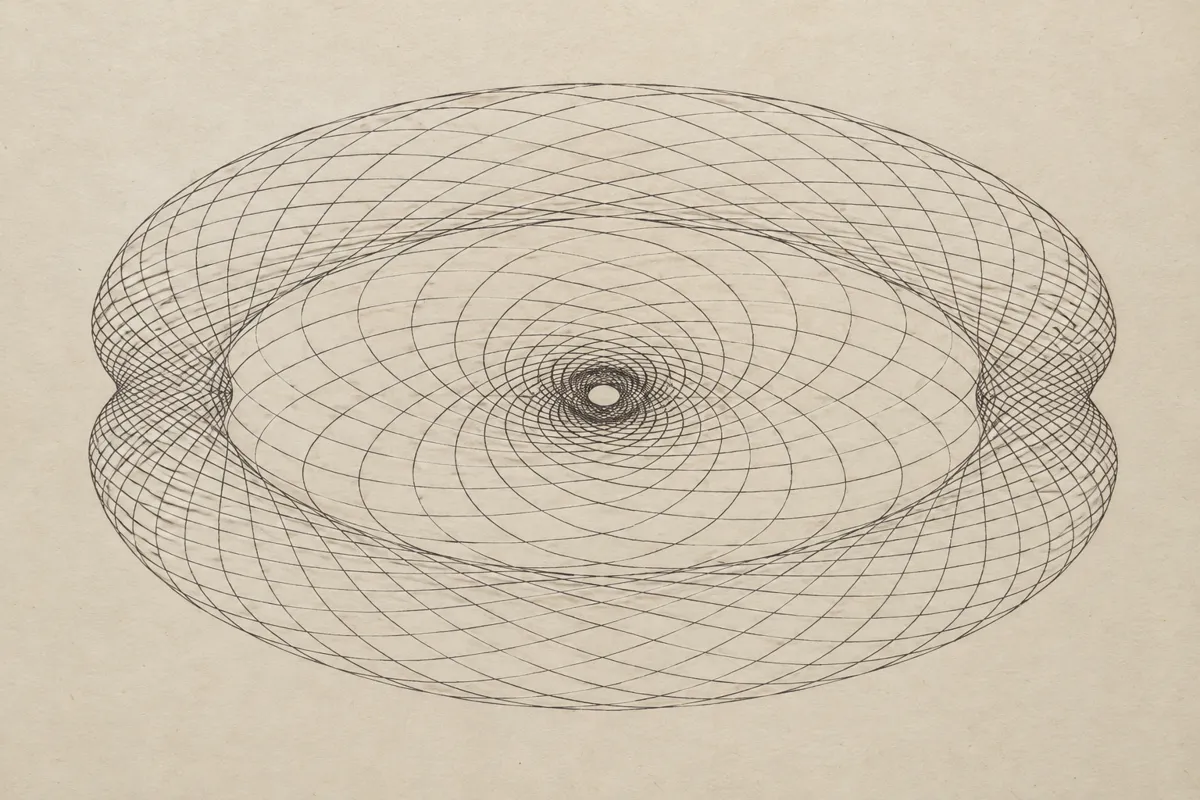
03 AI illustration: Traditional Elliptical Harmonograph PatternA complex lace-like pattern is rendered in ink, featuring infinite loops that converge toward a central point. The geometric precision originates from the interference of several harmonic oscillations that slowly decay over time.Illustration generated for the Atlas (AI)
AI illustration: Twin-Pendulum Harmonograph Mechanism in Operation
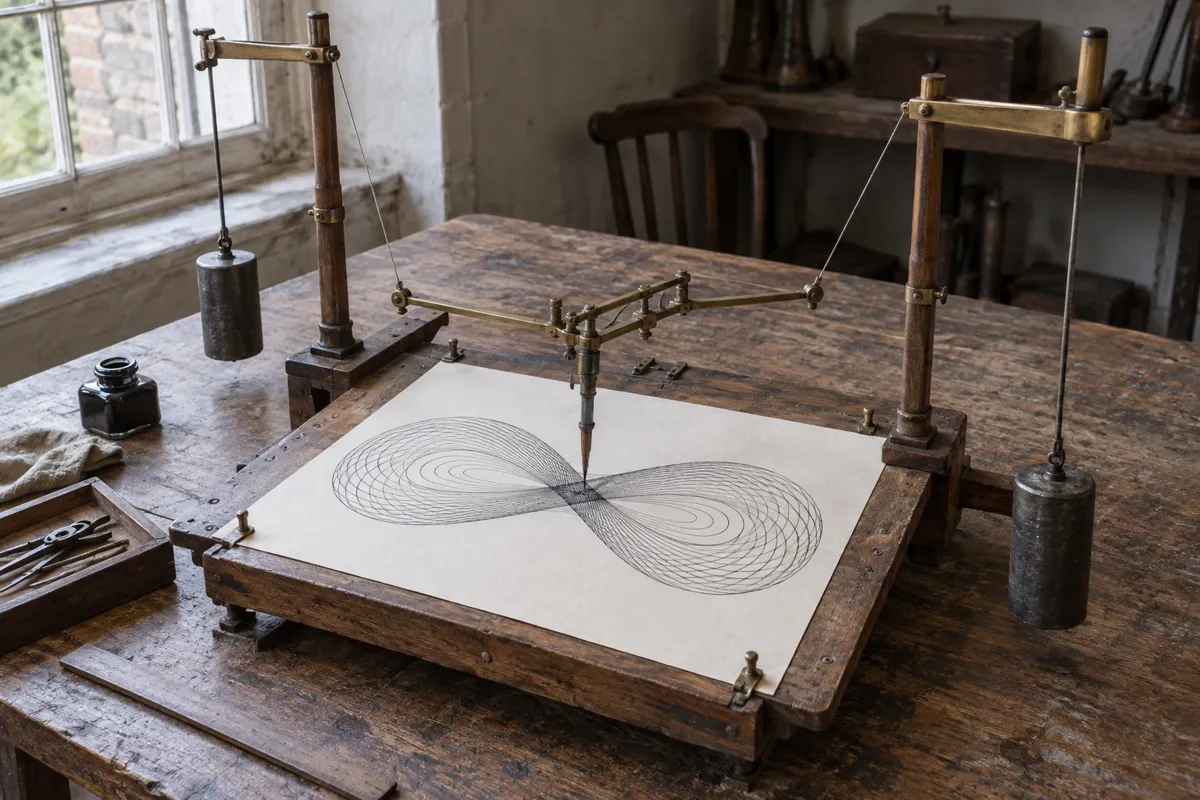
04 AI illustration: Twin-Pendulum Harmonograph Mechanism in OperationA wooden apparatus uses weighted pendulums and a mechanical linkage to guide a pen across paper, capturing a figure-eight motion. This setup demonstrates how gravity and kinetic energy are translated into a permanent visual record of mathematical ratios.Illustration generated for the Atlas (AI)
AI illustration: Four-Point Symmetrical Harmonic Trace
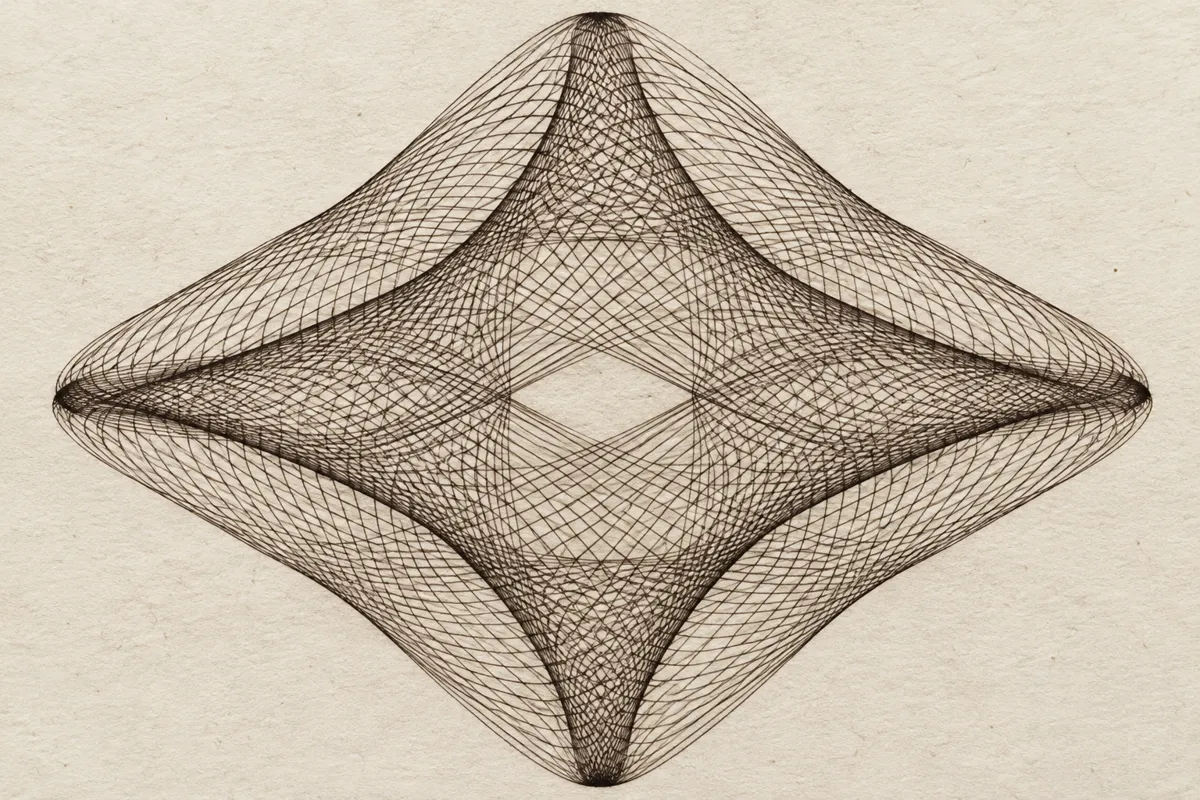
05 AI illustration: Four-Point Symmetrical Harmonic TraceSymmetrical webs of fine ink lines create a diamond-shaped lattice through the overlay of oscillating cycles. The density of the bands increases at the periphery where the pen momentarily slows before reversing direction.Illustration generated for the Atlas (AI)
AI illustration: Comparative Studies of Geometric Pendulum Motions
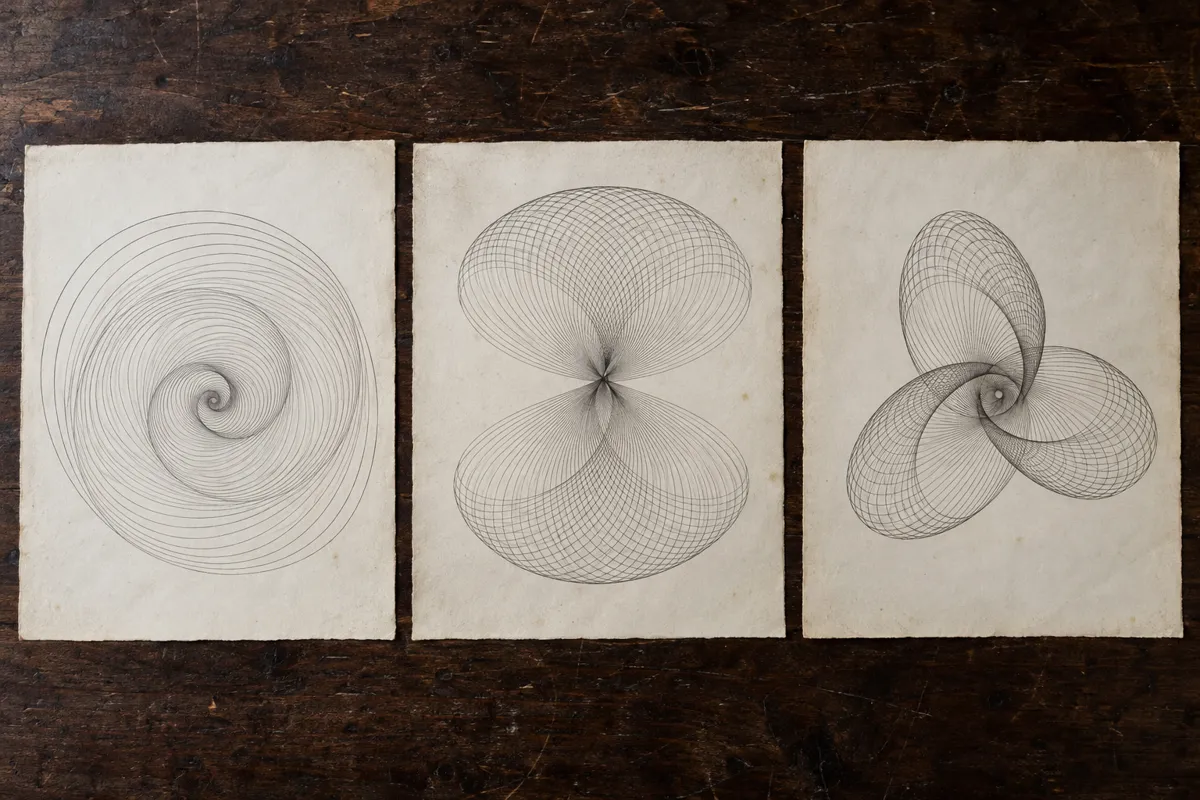
06 AI illustration: Comparative Studies of Geometric Pendulum MotionsThree separate plates show variations of decaying spirals and multi-lobed figures produced by varying a machine's initial settings. Each drawing serves as a physical graph of frequency and damping acting upon a single point.Illustration generated for the Atlas (AI)
AI illustration: Detailed Result of Damped Harmonic Motion
07 AI illustration: Detailed Result of Damped Harmonic MotionA close-perspective view captures a stylus finishing a series of nested ovals on a sheet of parchment. The gradual contraction of the loops is a direct visual manifestation of mechanical energy loss within the pendulum system.Illustration generated for the Atlas (AI)

Question

Why do later loops usually become smaller?

Show possible answer +

Friction and air resistance remove energy from the pendulums. Their swings become smaller, reducing the drawing's reach.

Sources