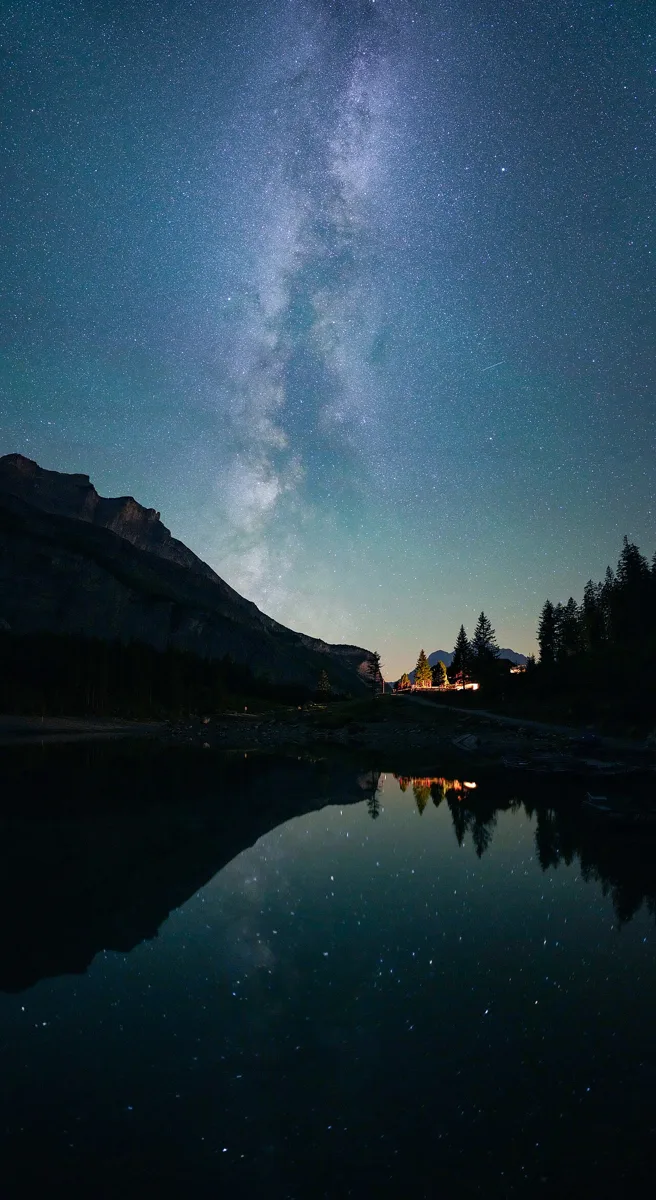
Milky Way Reflected in a Mountain Lake. The Milky Way rises above silhouetted mountains and trees, with stars reflected in a still lake.Giles Laurent · CC BY-SA 4.0 · via Wikimedia CommonsView source ↗
Prompt
Apply an Astrophotography treatment with deep charcoal blacks, cool silvery highlights, fine photographic grain, and luminous points concentrated in existing bright details. Suggest long-exposure celestial light through restrained halos and faint cloudlike tonal structures, preserving clear subject contours rather than replacing the scene. Keep the original subject and composition.
Images show a[cratered lunar disk], [scattered star points], or [faint nebular clouds]against dark space. Untracked long exposures can turn stars into curved trails.
Principle
Alens or telescope gathers celestial light onto alight-sensitive surface during exposure. Chemical development1makes the recorded image visible on historical plates; tracking Earth's rotation helps keep stars sharp.
Example
John W. Draper: Daguerreotype of the Moon, 1840.
Try it out
Photograph stars from afixed tripod with several exposure lengths, then compare how their points stretch into trails.
Background
In 1840, John W. Draper made asuccessful daguerreotype2of the Moon through atelescope. Its silver-coated copper plate recorded light chemically and required development to reveal the image. Early materials needed substantial exposure, making astronomical photography difficult. Later glass photographic plates supported systematic surveys of stars and recordings of faint nebulae. Longer exposures gathered more light, but Earth's rotation moved celestial images across an untracked plate. Tracking mounts3compensated for that motion. Photography also preserved records that astronomers could measure and compare across years.
Distinction
Unlike an astronomical drawing, astrophotography records incoming light rather than an observer's interpretation. False-color processing is optional, not adefining feature.
Aftermath
Astrophotography shows how accumulated light can reveal celestial structures too faint for unaided vision.
Further examples · 11 images
02Milky Way Above a Dark CoastA dense band of stars and mottled galactic clouds stretches above a dark coastal landscape. The exposure reveals faint Milky Way structure while preserving individual stars as distinct points.Photoneill · CC BY 4.0 · Wikimedia Commons03Filamentary Supernova RemnantFine red and blue filaments form an expansive shell against a densely populated star field. This deep-sky photograph reveals faint emission from a supernova remnant through the collection of celestial light.Georges Attard · CC BY-SA 4.0 · Wikimedia Commons04Dark Dust Clouds Among Dense StarsCountless stars fill the frame around irregular dark clouds that obscure portions of the background. The astronomical exposure records a rich stellar field and makes interstellar dust visible by its silhouetted absence of starlight.Brainandforce · CC BY 4.0 · Wikimedia Commons05Orion Nebula in Pink and WhitePink and pale luminous clouds surround a brilliant central region, with dark dust and scattered stars framing the Orion Nebula. This deep-sky photograph captures extended nebular light and fine structure beyond the appearance of isolated star points.Astroclubkosova · CC0 · Wikimedia Commons06Flame Nebula and Brilliant Blue StarA brilliant blue star shines above branching dark dust lanes and warm luminous clouds in the Flame Nebula region. The astronomical image records intricate nebular structure and optical rays around bright stars, demonstrating celestial photography.Chuck Ayoub · CC0 · Wikimedia Commons07Dense Globular Star ClusterA rounded stellar cluster concentrates into a bright central glow amid a wider field of scattered stars. This astronomical photograph resolves numerous peripheral stars while recording the combined light of the crowded core.Chuck Ayoub · CC0 · Wikimedia Commons08Solar Disk with ProminencesAn orange solar disk displays fine surface texture, dark markings, and small prominences along its rim. Filtered solar astrophotography records these celestial details while controlling the Sun's intense light.Astroclubkosova · CC0 · Wikimedia Commons09Historical Photograph of AndromedaA historical printed plate shows the Andromeda Galaxy as an elongated luminous form surrounded by numerous stars. The visible astronomical photograph demonstrates how an extended exposure records faint galactic structure.Isaac Roberts · Public domain · Wikimedia Commons10Horsehead Nebula Against Glowing GasThe Horsehead Nebula forms a dark silhouette against pink luminous gas dotted with bright stars. Deep-sky astrophotography reveals the contrast between obscuring dust and the faint emission behind it.N.A.Sharp/NOIRLab/NSF/AURA/ · CC BY 4.0 · Wikimedia Commons11Lunar Phases in Historical PhotographsTwelve mounted lunar photographs show changing phases, with cratered terrain and dark plains visible across the illuminated surfaces. These photographic prints demonstrate astronomical imaging through repeated observations of the Moon.A. A. Turner after Warren De la Rue · Public domain · Wikimedia Commons
Question
Why can a longer exposure reveal faint stars but also make them look like streaks?
Show possible answer +Hide answer −
Alonger exposure gathers more light from faint stars. Without tracking, Earth's rotation shifts their images during the exposure, producing trails.