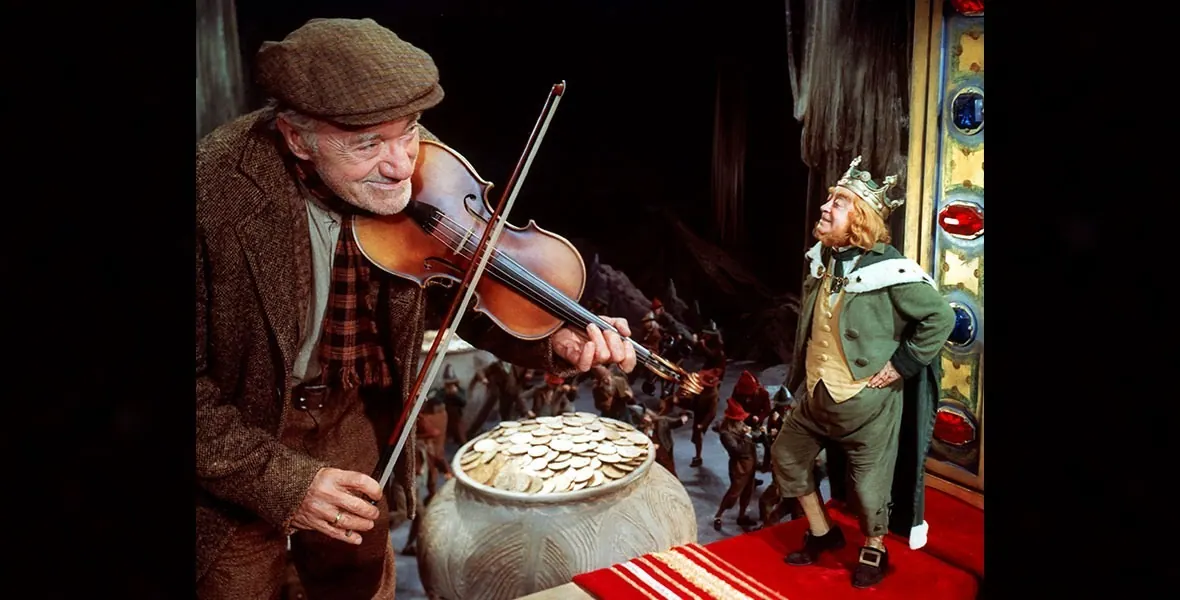
Apply a Forced Perspective illusion by manipulating apparent scale and depth in existing surroundings, making the subject seem unusually large or small without relocating it. Align overlapping contours, sharpen distant details, and match lighting and contact shadows so separate depths appear connected. Keep the original subject and composition.
Disney's Darby O'Gill is astriking example of cinematic illusions of scale. Characters and set pieces are actually at different distances; the camera angle and focus make them appear as asingle world. The 1950s represent this famous example, not an invention. Modern productions supplement the method with digital manipulations but retain its geometric foundations.
Distinction
The same perspective does not necessarily mean the same distance. Acamera pan, changing eye level, or incorrect viewing angles can reveal the spatial illusion.
Aftermath
Size in the image depends on object size and camera distance.
Further examples · 8 images
02Forced perspective gallery by Francesco BorrominiThis architectural corridor uses diminishing column heights and a rising floor to create a sense of extreme length. It demonstrates how geometry can fool the eye into perceiving more depth than physically exists.Livioandronico2013 · CC BY-SA 4.0 · Wikimedia Commons03Forced Perspective Miami DowntownA woman in the foreground opens her mouth toward a distant skyscraper in Miami. The alignment makes the building appear small enough to be swallowed, showing a common application of scale manipulation.Daniel Di Palma · CC BY-SA 4.0 · Wikimedia Commons04Comedic forced perspective exampleA man holds his hand out beneath a beverage can that appears large relative to his body. By placing the object closer to the camera, the photograph creates a comedic illusion of mismatched sizes.The original uploader was Ajkilpatrick at English Wikipedia. · CC BY-SA 2.5 · Wikimedia Commons05Forced perspective Istanbul blue mosqueA person appears to be standing on the roof of the Blue Mosque in Istanbul. This illustrates how overlapping subjects at different distances can merge into a single, impossible plane from a specific viewpoint.Serife Gerenschier · CC BY 4.0 · Wikimedia Commons06Forced Perspective in front of Jupiter, BaalbeckA man poses with his leg extended toward the ancient columns of Jupiter in Baalbek. The positioning suggests he is physically kicking the massive stone structure, utilizing distance to equalize the size of man and ruin.Akehs · CC BY-SA 3.0 · Wikimedia Commons07Perspective photography simpleA person stands behind a large pink ball resting in the grass. Because the ball is very close to the lens, it appears nearly as tall as the human, demonstrating basic depth-based scale distortion.Praveenapraviii · CC0 · Wikimedia Commons08Cloud ice creamA hand holds an ice cream cone in the foreground, aligned with a cloud in the background. The positioning makes the cloud appear as the ice cream scoop, merging two distant planes.Pandiyaraj · CC BY-SA 4.0 · Wikimedia Commons
Question
What small camera movement exposes the illusion?
Show possible answer +Hide answer −
Alateral step: The objects shift relative to each other due to parallax.