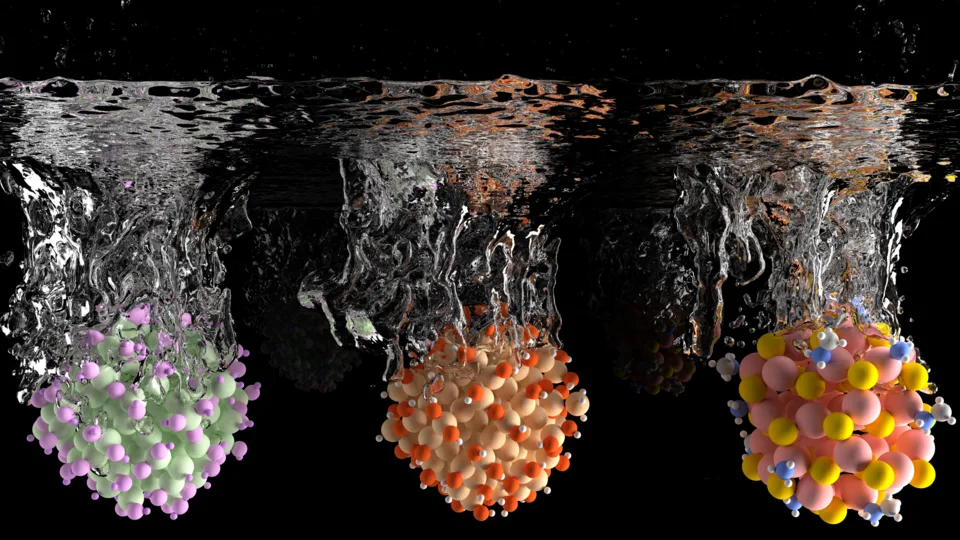
3D fluid simulation splashing over colored spheres. Highly realistic 3D rendered fluid is shown splashing dynamically over brightly colored molecular spheres.Nbrawand · CC BY 4.0 · via Wikimedia CommonsView source ↗
Prompt
Apply a Fluid Simulation effect with physically convincing translucent water curling around existing forms. Create coherent flowing sheets, splash crowns, suspended droplets, tiny bubbles, and swirling eddies, with refracted background details and sharp wet highlights. Match gravity, contact surfaces, and scene lighting without obscuring key features. Keep the original subject and composition.
You see [highly realistic water], smoke, or fire moving naturally on ascreen. It splashes, flows, and swirls just like physical matter.
Principle
Computers calculate the physics of [millions of tiny digital particles]interacting with each other. These calculations create an [underlying grid]that mimics natural fluid dynamics1.
Example
Industrial Light & Magic: The Perfect Storm, 2000.
Try it out
Watch areal splash of water in slow motion. Compare its chaotic droplets to a2000s CGI movie wave.
Background
Before the late 1990s, animators had to draw or sculpt water effects by hand. This was tedious and rarely looked realistic. In the 2000s, computers became powerful enough to run complex mathematical equations. They used physics formulas, like the Navier-Stokes equations2, inside 3D software. Instead of animating the surface, artists created volumes filled with interacting particles. The software calculated gravity, density, and collision for every single frame. Once the math was done, the particles were wrapped in adigital skin3. This allowed water to crash, foam, and break apart naturally.
Distinction
It differs from traditional animation because the computer simulates physical laws automatically. Older methods required an artist to manually draw every changing shape.
Aftermath
It shows how advanced mathematics can perfectly replicate the chaotic beauty of nature.
Further examples · 10 images
02Sequence of particle-based fluid drop simulationA time-sequence displays a ball of digital particles dropping and interacting with a grid surface. This perfectly illustrates the particle-based calculations that drive underlying fluid dynamics.A-palyanov · CC BY-SA 4.0 · Wikimedia Commons032D SPH fluid simulation of a breaking waveA 2D technical visualization depicts a wave breaking against a wall, calculated using Smoothed-particle hydrodynamics. It clearly shows the complex physical behavior and splashing of simulated fluids.Salvatore Marrone · CC BY-SA 4.0 · Wikimedia Commons04Particle-based 2D simulation of a splashing waveAnother cross-section of a wave simulation displays thousands of individual digital particles colored by pressure. It is a classic scientific demonstration of the technique's particle interactions.Salvatore Marrone · CC BY-SA 4.0 · Wikimedia Commons052D Turbulent Fluid Flow VisualizationA vibrant visualization of 2D fluid turbulence, displaying complex vortices and flow patterns. It clearly demonstrates the intricate mathematical calculations underlying fluid dynamics simulations.Terry Brannigan · CC BY 4.0 · Wikimedia Commons06Space Shuttle Aerodynamics Fluid SimulationA 3D simulation visualizing the aerodynamic flow of air around a space shuttle. It is a classic example of computational fluid dynamics used to calculate physical interactions.NASA · Public domain · Wikimedia Commons07Aerodynamic fluid simulation around a jet modelA colorful computational fluid dynamics visualization shows air flowing around a fighter jet model. While primarily used for engineering, it demonstrates the exact same principles used in visual effects.NASA · Public domain · Wikimedia Commons083D software interface showing basic fluid simulationA screenshot of 3D modeling software reveals a basic fluid dynamics setup with a sphere creating ripples. It provides a behind-the-scenes look at how these visual effects are generated.Animajosser · CC BY-SA 4.0 · Wikimedia Commons092D simulation of vortex shedding in fluid flowA vibrant heat map visualization illustrates swirling vortices forming behind a circular obstacle in a fluid stream. This effectively demonstrates the complex swirling behavior calculated in fluid dynamics.Asoutoiglesias · CC BY-SA 4.0 · Wikimedia Commons10Cylinder Vortex Street Fluid SimulationA computational visualization showing fluid streaming past a circular object and forming alternating vortices. This clearly illustrates the underlying grid calculations used to mimic natural fluid dynamics.Sciinstitute · CC BY-SA 3.0 · Wikimedia Commons
Question
Why does fluid simulation take so long to compute?
Show possible answer +Hide answer −
The computer must calculate the interactions of millions of individual particles for every frame. If one particle moves, it instantly affects all its neighbors.