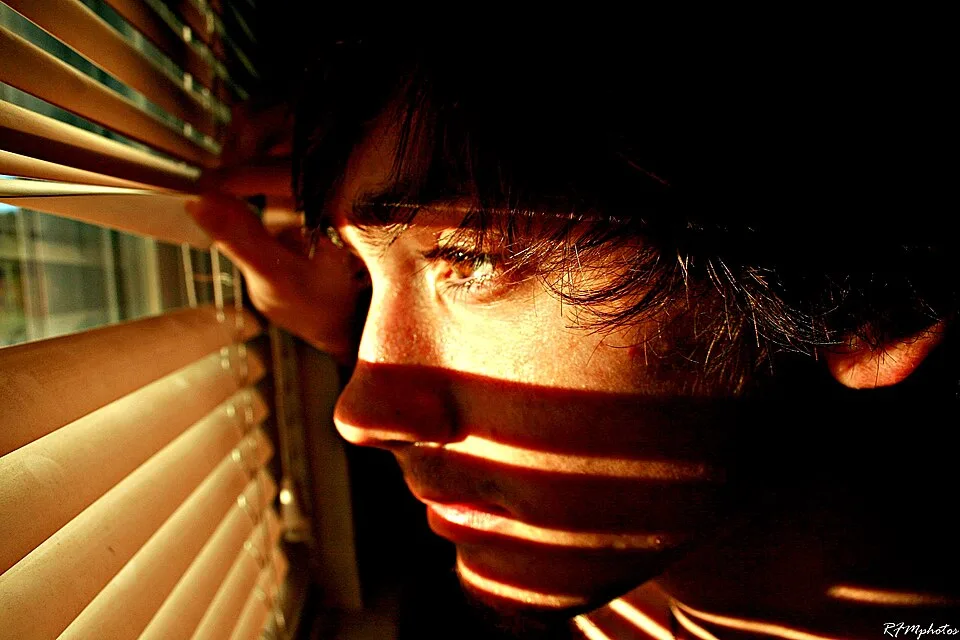
Venetian Blind Shadows Cast Across A Face. Harsh light filters through venetian blinds, casting distinctively striped, high-contrast shadows across a young man's face.Robby McKee · CC BY 2.0 · via Wikimedia CommonsView source ↗
Prompt
Apply Film Noir Lighting with stark black-and-white tonality, blinding highlights, pitch-black shadows, and hard illumination from steep angles. Cast narrow venetian-blind stripes across existing surfaces and faces where present. Add fine silver grain, sharp silhouettes, and minimal shadow fill. Keep the original subject and composition.
You see stark contrasts between [blinding white light]and [pitch-black shadows]. Distinctive patterns, like venetian blinds1, often fall across faces.
Principle
Cinematographers use [hard, undiffused light sources2]placed at harsh angles. They intentionally block most light to leave deep, unlit shadows.
Example
Billy Wilder: Double Indemnity, 1944.
Try it out
Shine aharsh flashlight through aslotted object in adark room to cast sharp striped shadows on awall.
Background
In the 1940s, Hollywood studios needed to produce cheap crime films rapidly. To save money on building detailed sets, directors hid empty backgrounds in deep shadows. German expressionist filmmakers, fleeing Europe, brought over this moody visual style. They adapted high-contrast theater lighting to black-and-white film stock. By relying on asingle hard light source, technicians created sharp edges. This subtractive approach actively blocked light using flags3or blinds. It perfectly matched the pessimistic, morally ambiguous themes of the postwar era.
Distinction
Unlike standard three-point lighting, noir lighting removes the soft fill light. This leaves shadows completely dark instead of gently brightening them.
Aftermath
It shows how hiding details in shadow creates more psychological tension than revealing everything.
Further examples · 11 images
02Classic Noir Scene With Stark High Contrast ShadowsTwo characters converse in a room featuring dramatic high-contrast black-and-white cinematography and dark corners. The harsh lighting and distinctive venetian blind patterns cast on the back wall make this a classic example of film noir lighting.Time Inc.; photograph by Paramount Pictures (no photographer credited) · Public domain · Wikimedia Commons03Classic Film Noir Train Track SceneA man and woman stand over a fallen figure on train tracks at night, illuminated by a harsh spotlight. This is a classic cinematic example featuring the stark high-contrast tones and deep, unlit shadows characteristic of the genre.Time Inc.; photograph by Paramount Pictures (no photographer credited) · Public domain · Wikimedia Commons04Noir-Style Split Lighting PortraitA portrait highlights one side of a woman's face while plunging the other half into pure black shadow. This provides a classic demonstration of harsh, undiffused chiaroscuro lighting used to create dramatic, sharp shadows.Ralf Roletschek (talk) - Fahrradtechnik auf fahrradmonteur.de · CC BY-SA 3.0 at · Wikimedia Commons05Low-Key Match Lighting On Man In DarkA man is illuminated purely by the flame of a match as he lights a cigarette in the dark. This stark, low-key lighting against a pitch-black background is a classic practical application of film noir cinematography.Uncredited · Public domain · Wikimedia Commons06Man Lit By Harsh Directional Light And ShadowA man in a fedora speaks on the telephone, his face half-illuminated by a strong, undiffused light source. The harsh angle and intentional blocking of light to leave the other side of his face in deep shadow clearly show the technique.Trailer screenshot · Public domain · Wikimedia Commons07Noir Chiaroscuro Lighting On A Man's FaceA close-up of a man's face reveals deep, unlit shadows and stark, high-contrast lighting typical of the genre. The intentional use of chiaroscuro to plunge much of the frame into pitch-black shadow makes this a solid example of the effect.Trailer screenshot · Public domain · Wikimedia Commons08Low-Key Dramatic Portrait LightingA woman wrapped in sheer fabric is illuminated by a single, controlled side light against a pitch-black background. It effectively demonstrates the technique of blocking most light to leave deep shadows and stark contrast on the subject.Robert Stites · CC BY-SA 4.0 · Wikimedia Commons09High-Contrast Figure PortraitA sharply angled light illuminates a woman in an otherwise completely dark environment, creating strong highlights and deep shadows. The intentional use of undiffused light perfectly isolates the subject from the unlit background, a key noir technique.Robert Stites · CC BY-SA 4.0 · Wikimedia Commons10Harshly Angled Noir PortraitA woman is carved out of total darkness by a hard, sharply angled light source hitting her profile. The image illustrates the intentional blocking of ambient light to emphasize stark contrasts and pitch-black shadows.Ralf Roletschek (talk) - Fahrradtechnik auf fahrradmonteur.de · CC BY-SA 3.0 at · Wikimedia Commons11High-Contrast Harsh Studio LightingStark, undiffused light strikes a woman in a leather jacket, leaving the background and deep crevices in absolute blackness. The high contrast between the bright highlights and pure black shadows is a clear demonstration of the technique.Lies Thru a Lens · CC BY 2.0 · Wikimedia Commons
Question
Why did filmmakers project venetian blind shadows onto sets?
Show possible answer +Hide answer −
It visually trapped the characters in acage of light. It also broke up boring walls without building expensive props.