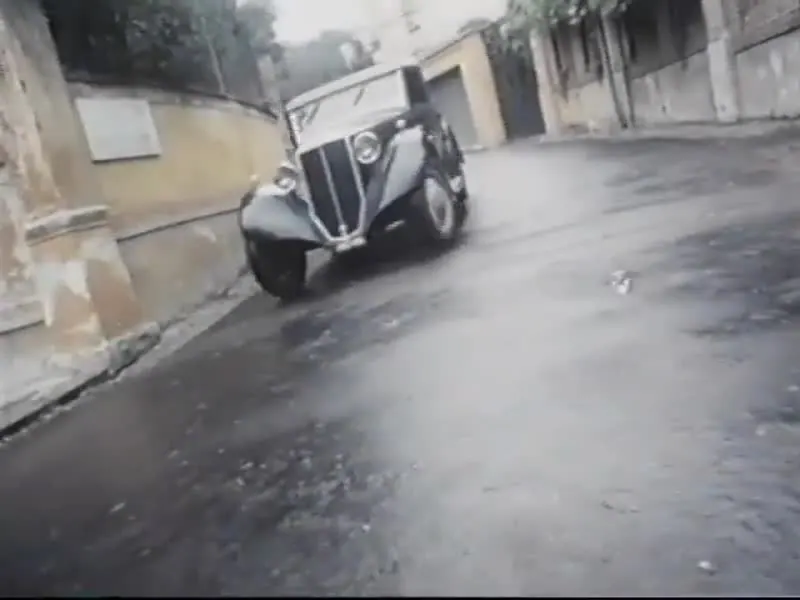
Apply a Dutch Angle effect by rotating the entire image plane to create a clearly tilted horizon and slanting verticals. Preserve natural perspective, realistic lighting, original colors, and coherent edges; extend borders subtly rather than cropping important details. Keep the original subject and relative composition.
Photograph the same scene straight on and at an angle.
Background
The Dutch angle is acamera technique, not adigitally invented filter. The tilted coordinate system can suggest instability or asubjective state. Columbia illustrates the concept with Bertolucci's *The Constructive Mistake*. The film noir2of the 1940s provides arelevant point of reference, while similar compositions appear earlier and later. Crucially, it relates to the scene, movement, and recurring visual language.
Distinction
Tilting acamera is not an automatic guarantee of meaning. It can signal restlessness, humor, or simply an established cinematic language. An intentionally tilted camera must be distinguished from an accidentally uneven composition.
Aftermath
The audience also interprets the orientation of the image space.
Further examples · 9 images
02Person passed out on sidewalk photographed with a dutch angle NYCA person lies prone on a New York City sidewalk near an ambulance and traffic. The diagonal street and curb lines create a sense of disorientation and instability characteristic of the technique.Wil540 art · CC BY-SA 4.0 · Wikimedia Commons03Key lime pie slice with birthday candle in Dutch angleA slice of key lime pie with a birthday candle is shown on a restaurant table. The tilted horizon line and slanted drinking glasses add dynamic energy to a common still-life subject.OuiOuiBaguetteSyndicalist · CC0 · Wikimedia Commons04Seattle SunA boat travels across water with the Seattle skyline silhouetted in the background. The extreme rotation of the horizon line emphasizes movement and gives a subjective, non-traditional perspective of the landscape.Ian Kpachavi · CC BY 3.0 · Wikimedia Commons05Munich Subway Station Georg-Brauchle-Ring, April 2017Metal benches sit in a modern subway station with colorful wall panels. The slanted perspective turns the long parallel lines of the platform into steep diagonals, increasing the sense of depth and speed.Martin Falbisoner · CC BY-SA 4.0 · Wikimedia Commons06Lecteur de paixA golden figurine is shown reading a book on a wooden surface. The camera rotation makes the wood grain appear as diagonal slopes, focusing attention on the sculpture's form through a tilted coordinate system.Jackie SMG · CC BY-SA 4.0 · Wikimedia Commons07Krasnoyarsk embankment at night, RussiaA person leans against a railing on a lit embankment at night near a bridge. The slanted vertical lamp posts and tilted water level suggest a psychological state of unease or intoxication.Vyacheslav Argenberg · CC BY 4.0 · Wikimedia Commons08Mayday Mae at the San Jose Sapphic Extravaganza (dutch tilt angle)A performer in a red dress sings into a microphone on a stage. The sharp camera tilt aligns with the diagonal equipment stands, capturing the kinetic energy and chaotic atmosphere of the live event.Junefreund · CC0 · Wikimedia Commons09Intentional camera tilt or Dutch angle - example in fashion photography for filling the frame - ModelTanjaA model leans against a stone column in a fashion photograph. The intentional camera tilt fills the frame more effectively by turning the vertical columns into dynamic diagonal elements.Tobias ToMar Maier · CC BY-SA 3.0 · Wikimedia Commons
Question
Around which axis is the camera rotated in the Dutch Angle technique?
Show possible answer +Hide answer −
Around the axis through the lens, i.e., around the direction of view.