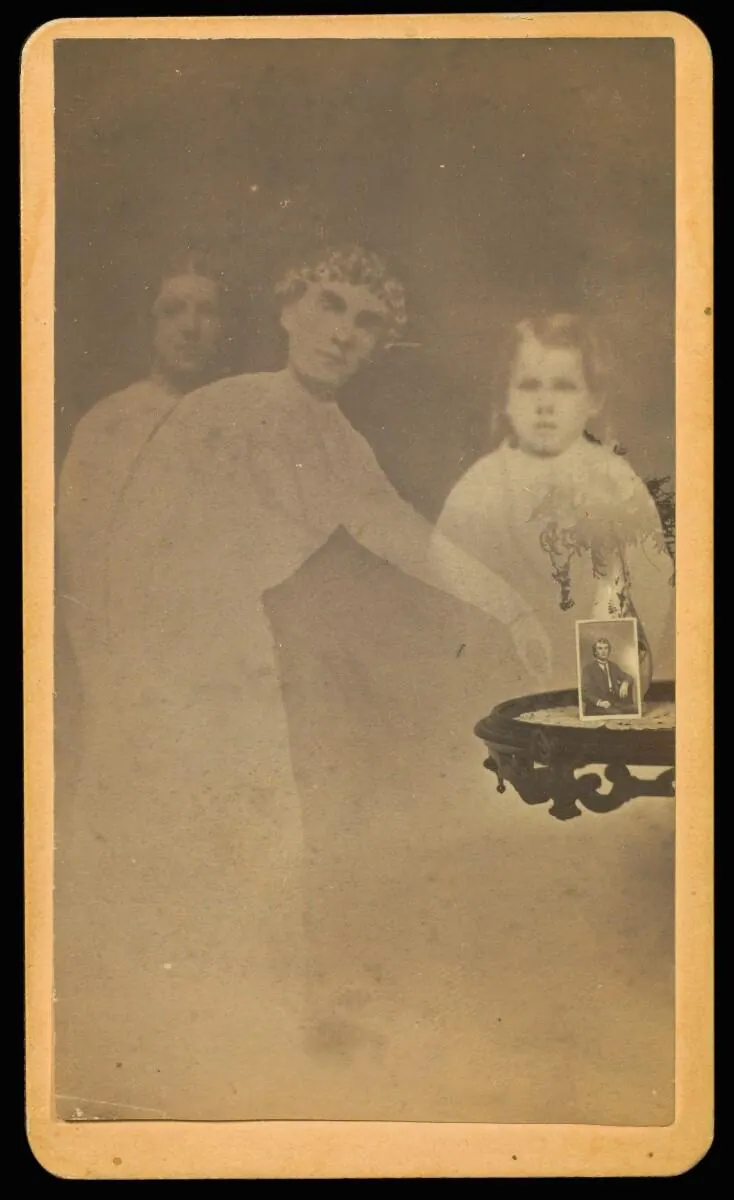
Double exposure / spirit photography. Ghost photography as a business in the 1860s
Typeface · Poiret One
William H. Mumler: Alleged Ghosts, 1862–1875.William H. Mumler / possibly Helen F. Mumler; J. Paul Getty Museum. Getty Open Content; historical work in the public domain.View source ↗
Prompt
Apply a Double Exposure effect by layering a translucent secondary view of existing environmental details across the photograph. Let textures pass through the main subject, with overlapping contours, luminous combined highlights, muted shadows, and fine analog grain. Keep the primary silhouette clearly recognizable. Keep the original subject and composition.
[Semi-transparent people]and translucent backgrounds. [Two visual worlds occupy the same space].
Principle
An [image carrier1receives multiple exposures]. Aless exposed subject can appear transparent in another scene.
Example
William H. Mumler: Alleged Ghosts, 1862–1875.
Try it out
Overlay two portraits with different opacity2. Check which contours immediately reveal the double exposure.
Background
Multiple exposures were an early photographic technique; spirit photography was marketed in the USA in the 1860s. Spiritualist portraits appeared in the 19th and early 20th centuries; later, it became an independent art technique. Detailed mechanism: An image carrier is exposed more than once. Aless exposed subject can appear transparent in asecond exposure. The visible effect is aform of image manipulation, not proof of ghosts. The exact technique used in some historical images remains partially unconfirmed.
Distinction
The visible phenomenon is amanipulation of the image, not proof of ghosts. The exact method used in some historical images remains partially unproven.
Aftermath
Double-exposure portraits, blend modes, experimental music visuals.
Further examples · 11 images
02Pineapple double exposure, in camera, Canon R7A close-up of a pineapple's texture is overlaid with a translucent image of the fruit's leafy top. It demonstrates how different exposures of the same object can create a spectral, vertically stacked composition.Hassan Albadawi · CC BY-SA 4.0 · Wikimedia Commons03Double Exposure IIThis image shows a grid of glowing squares shifted diagonally over another identical pattern. The resulting translucent overlap creates a sense of depth and geometric complexity through a repeated exposure technique.Karl Thomas Moore · CC BY-SA 4.0 · Wikimedia Commons04Double exposure 2An airport arrival board is seen with ghostly text and directional arrows appearing in the foreground. It illustrates how two visual worlds occupy the same space, making information from separate scenes visible simultaneously.Sgroey · CC BY-SA 4.0 · Wikimedia Commons05Double exposure 1White Japanese characters and icons are superimposed over a dark background with additional signage. The bright text becomes transparent where it meets other elements, typical of a multi-exposure image carrier.Sgroey · CC BY-SA 4.0 · Wikimedia Commons06Double exposure 4A Sapporo train station sign and commuters are overlaid with horizontal light streaks and structural details. The transparency of the human figures exemplifies the historical spirit photography effect where subjects appear ghost-like.Sgroey · CC BY-SA 4.0 · Wikimedia Commons07Double exposure 3Illuminated red signs and horizontal light bars are layered over a dark scene. The overlapping glows show how light sources from different exposures can blend to create an abstract urban atmosphere.Sgroey · CC BY-SA 4.0 · Wikimedia Commons08Double exposure 6A person sitting with a laptop is visible through the translucent folds of a curtain. This is a clear example of the technique where a less exposed subject appears transparent behind another foreground element.Sgroey · CC BY-SA 4.0 · Wikimedia Commons09Double exposure 5Glowing 'PARCO' signs are duplicated and offset against a nighttime cityscape. The transparency of the large letters reveals the building architecture behind them, showing the mechanical overlay of two distinct frames.Sgroey · CC BY-SA 4.0 · Wikimedia Commons10Double exposure (21850899400)Two silhouetted men standing at a railing are filled with a textured landscape of tree roots. It utilizes double exposure to merge human contours with nature, creating a composite artistic portrait.Marco Nürnberger from Nuremberg, Germany · CC BY 2.0 · Wikimedia Commons11Double exposure (34836334520)A bicycle and park bench are set against a landscape with a pinkish sky and bare trees. Subtle translucent layers suggest the image was exposed multiple times to blend these specific scenic elements.bluesbby from Mountain View, USA · CC BY 2.0 · Wikimedia Commons