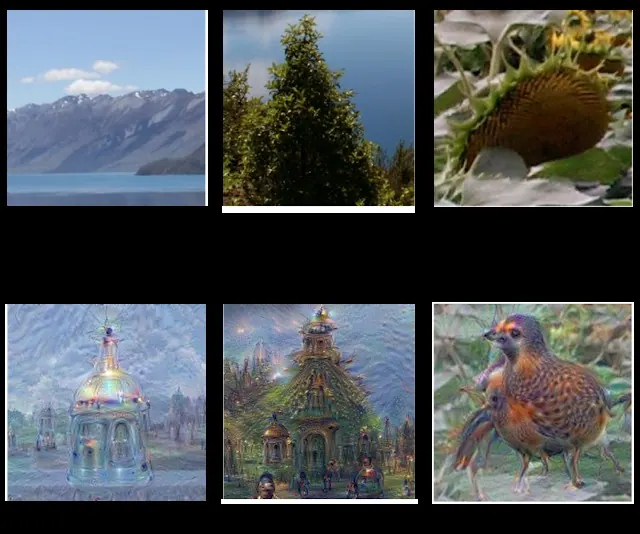
DeepDream / neural style transfer. Two different neural imaging approaches will become publicly visible in 2015.
Typeface · Rubik Puddles
Google Research: Inceptionism / DeepDream, 2015: Input at the top, neural reinterpretation at the bottom.Google Inc.; Alexander Mordvintsev, Christopher Olah & Mike Tyka. CC BY 4.0View source ↗
Prompt
Apply a DeepDream effect with recurring eye-like motifs, animal-shaped suggestions, and recursive organic patterns emerging from existing textures. Intensify jewel-toned colors, curl edges into nested forms, and create intricate, hallucinatory surface detail while keeping the underlying scene legible rather than replacing it entirely. Keep the original subject and composition.
DeepDream displays [recurring eyes and animal shapes]. Style Transfer overlays photographic images with painting-like textures.
Principle
[DeepDream enhances detected network features1]. Style Transfer combines content features of asource image with [style statistics2of asecond image].
Example
Google: DeepDream (2015). Gatys, Ecker, Bethge: Neural Style Transfer (2015).
Try it out
Compare both using the same image. What is added, what is retained, which textures are carried over?
Background
Two defining public approaches in 2015.
DeepDream enhances features that atrained image network already believes it recognizes. Neural Style Transfer seeks an image version that combines the image content of asource image with the texture and style statistics of another image.
Google, Inceptionism/DeepDream (June/July 2015); Gatys, Ecker and Bethge, ANeural Algorithm of Artistic Style (August 2015).
Image: Historical original / source image. Aneural network amplifies recognized image patterns. This historical example shows DeepDream; Neural Style Transfer is arelated, technically different approach.
Distinction
Style transfer is not simply an oil paint filter. DeepDream is not the same as today's text-to-image diffusion technology. DeepDream and Neural Style Transfer are different methods. Treat them as alearning family, but clearly distinguish their functionality; no equals sign.
Aftermath
Not only image values or geometry, but also the learned feature spaces of anetwork could control the visible transformation.
Further examples · 10 images
02Deep-dream-white-noise-0036A dense pattern of colorful, recursive dog heads and circular eye shapes emerges from white noise. This is an example of the algorithm generating complex features from random pixels.MartinThoma · CC0 · Wikimedia Commons03DeepDream Schillergym HOF04021The school building is covered in vibrant animal faces and multi-eyed, slug-like forms. It shows how the algorithm interprets architectural structures as organic, animalistic features.PantheraLeo1359531 · CC0 · Wikimedia Commons04"Mona Lisa" with DeepDream effect using VGG16 network trained on ImageNetThe portrait features a central dog face surrounded by bird-like textures and eyes. It illustrates the network's tendency to overlay high-level ImageNet classes like dogs onto human forms.Pjfinlay · CC0 · Wikimedia Commons05Deep Dream Art 05A tree trunk is transformed into a vertical column of stacked eyes and lizard-like skins. The algorithm enhances the natural bark texture into recognizable biological patterns.Mitumial · CC BY-SA 4.0 · Wikimedia Commons06Deep Dream Art 07Dog and bird faces are embedded within the frame of an indoor scene. This demonstrates how DeepDream creates pareidolia-like effects across varying lighting and surface textures.Mitumial · CC BY-SA 4.0 · Wikimedia Commons07Deep Dream Art 01A landscape seen through windows is overlaid with intricate, swirling patterns and eye motifs. The effect creates a hallucinogenic distortion of the original outdoor environment.Mitumial · CC BY-SA 4.0 · Wikimedia Commons08Deep Dream Art 08Animal faces and hybrid creatures are hidden among the leaves of a green bush. It demonstrates how the neural network hallucinates specific creature features within random foliage.Mitumial · CC BY-SA 4.0 · Wikimedia Commons09DeepDream -3 "Gettlinge" (25737183830)Standing stones and a windmill appear alongside rocks transformed into animal heads. The swirling sky patterns represent the characteristic fractal-like iterations of the DeepDream process.Alexander Boden from Bonn, Germany · CC BY-SA 2.0 · Wikimedia Commons10Deep Dream Art 06Bird and insect shapes are scattered across a playground area. The image shows the algorithm's ability to insert small-scale animal features into wide-angle outdoor scenes.Mitumial · CC BY-SA 4.0 · Wikimedia Commons