Apply an AR Face Filters effect to visible faces, adding softly shaded animal ears, a fitted translucent facial mask, and subtly enlarged expressive eyes. Align overlays precisely with facial landmarks, head angle, and perspective, using consistent highlights and believable occlusion around hair. Keep the original subject and composition.
Ears, masks and enlarged eyes immediately [follow head movements and facial expressions].
Principle
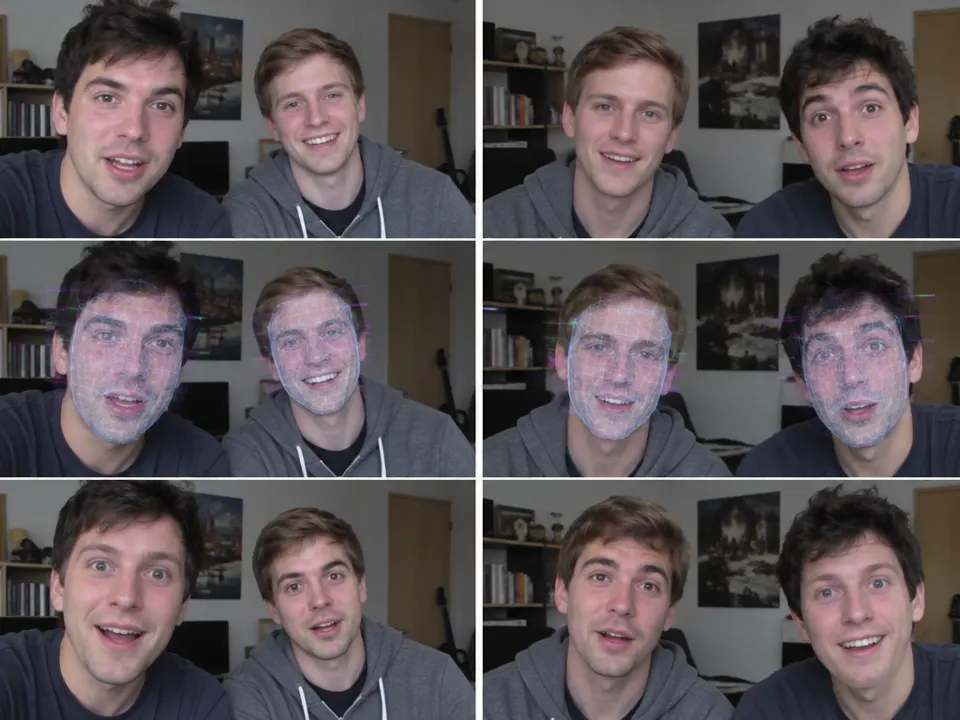
The [software tracks facial features1]. Deformations, materials, and [3D objects are superimposed2]according to position, perspective, and movement.
Example
Snapchat Lenses launch in 2015. Puppies, rainbows, and Face Swap become popular.
Try it out
Compare rigid masks with masks that fit snugly against facial features. Test rotation, head tilt, and open mouth.
Background
Large consumer wave with Snapchat Lenses from September 2015.
The software estimates facial features or afacial model and tracks its movement. Deformations, masks, materials, and 3D objects are superimposed in real time, matching the facial expressions and camera perspective.
Snapchat introduced Lenses on September 15, 2015; the official 2017 retrospective mentions puppies, rainbows, and Face Swap.
Image shown: Later technical demonstration. Facial positions are captured and digital elements are attached to them. This is acurrent public product preview, not an original image from the Lenses launch in 2015.
Distinction
Acolor filter changes pixel values across the entire image. An AR face filter must track the shape, position, and movement of the face. Face tracking and AR are older technologies. 2015 marks an important product and distribution milestone, not the invention of facial recognition itself.
Aftermath
Visual effects became an everyday form of social expression. The viewer simultaneously became both performer and operator of the effect.
Further examples · 7 images
02Eva van kempen-1583406753A woman wears a digital spiked crown and floating text overlaid on her face. It demonstrates how AR software tracks head position to superimpose 3D objects and graphic elements in perspective.Eva van Kempen · CC BY-SA 4.0 · Wikimedia Commons03FaceRig with full bodyA digital fox avatar mimics a human's facial expressions and head position through a webcam. It demonstrates real-time feature tracking and the application of a complex 3D character mask over a user's movements.Aty87 · CC BY-SA 4.0 · Wikimedia Commons04Dlib-face landmark detectionGreen digital lines outline the eyes, noses, and mouths of three men in real-time. This landmark detection is the foundational process used by AR apps to anchor 3D objects to facial features.MTheiler · CC BY-SA 4.0 · Wikimedia Commons05Facial Recognition22A smartphone scans a human face using a polygonal mesh. This conceptual illustration shows the underlying geometry and tracking points required to anchor 3D objects and deformations in augmented reality filters.mikemacmarketing · CC BY 2.0 · Wikimedia Commons06AI illustration: A smartphone displays a face with enlarged eyes and a rainbow emerging frA smartphone displays a face with enlarged eyes and a rainbow emerging from the mouth. This demonstrates real-time feature tracking and 3D object superimposition triggered by facial expressions.Illustration generated for the Atlas (AI)07AI illustration: A grid shows two men with digital mesh overlays tracking their facial movA grid shows two men with digital mesh overlays tracking their facial movements. The sequence illustrates the underlying software process of identifying and mapping facial landmarks for AR placement.Illustration generated for the Atlas (AI)