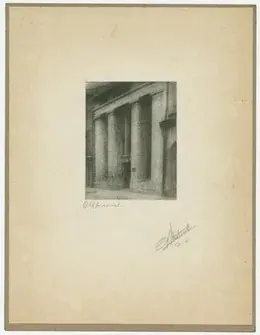
Bromoil print. Developed in 1907; Pictorialism of the 1910s and 1920s
Typeface · Averia Serif Libre
Joseph Woodson “Pops” Whitesell: Old Arsenal, 1930s. Bromooil printing.Historic New Orleans Collection, 1978.122.5 / Joseph Woodson WhitesellView source ↗
Prompt
Transform this image into a Bromoil Print with velvety brown-black ink, warm paper highlights, and selectively softened contours. Add stippled pigment deposits, irregular brush and stipple textures, subdued photographic detail, and broad, painterly tonal masses on matte gelatin-coated paper. Keep the original subject and composition.
Bromoil printing originated in 1907 as afurther development of oil printing. The starting point is an enlarged silver bromide print. After bleaching and tanning, the gelatin sections react differently to water and oil-based printing ink. The photographer can significantly influence the image effect using abrush. Abromoil transfer transfers the inked image onto adifferent paper; this transfer is aseparate technique.
Distinction
Oil prints and bromoil prints are related but technically different. Apictorialist photograph with apainterly effect should not automatically be labeled as abromoil print. The specific museum object must demonstrate the process.
Aftermath
The photograph becomes an editable print matrix.
Further examples · 7 images
02Untitled (Walther Kühn) by Heinrich Kühn, c. 1900, bromoil transfer print, Museum of Modern ArtA child in a dark coat blows a soap bubble against a flat background. The bromoil transfer technique creates a soft, painterly surface with suppressed detail and a warm, monochromatic color palette.Hiart · Public domain · Wikimedia Commons03Floating Past BromoilA dark, silhouetted figure walks past a grid-like architectural structure. The heavy grain and diffused highlights exemplify the textural qualities achievable through oil-based ink application in the bromoil process.George Smyth · CC BY 3.0 · Wikimedia Commons04Bromoil-Josef Jindřich ŠechtlA landscape shows two slender trees in the foreground overlooking a body of water. The print displays the characteristic granular texture and manipulated tonal values typical of early 20th-century bromoil photography.No machine-readable author provided. Hubicka~commonswiki assumed (based on copyright claims). · CC BY 2.5 · Wikimedia Commons05Hanns Heinz Ewers by DührkoopA portrait shows a man in a dark cap and coat looking towards the camera. The grainy, brushed appearance of the highlights illustrates how photographers manually controlled ink distribution to create a painting-like effect.Rudolf Dührkoop / Minya Diez-Dührkoop · Public domain · Wikimedia Commons06Gezicht op de korenmolen de Eendracht, Gouwsluis, Alphen aan de Rijn Gezicht op korenmolen De Eendracht, Gouwsluis, Alphen ad Rijn, RP-F-200A windmill stands by a river, reflected in the calm water. The visible stippling and textured sky demonstrate the manual ink application that differentiates bromoil prints from standard silver bromide enlargements.Rijksmuseum · CC0 · Wikimedia Commons07Franz Fiedler - Painter with model Dresden, 1920sA painter sits with a palette before a canvas and a model. The print exhibits the distinctive mottled grain and variable ink density that characterize bromoil works from the 1920s.Franz Fiedler- Painter with model Dresden, 1920s(bromoil) · CC BY 3.0 · Wikimedia Commons
Question
Is a bromoil print simply a photograph over which someone has painted?
Show possible answer +Hide answer −
No. The photographically controlled gelatin structure determines where the oil-based printing ink adheres.