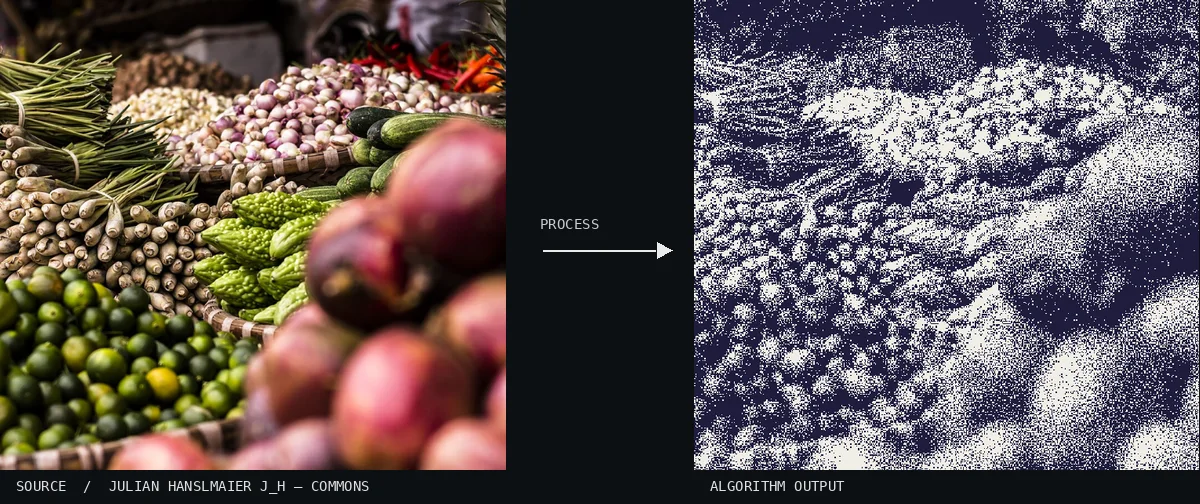
Atlas demonstration: the free source photo and the computed Blue-Noise Dither. A close-up view captures the organic, bumpy textures of harvested cauliflower and other vegetables. The fine, uniform distribution of dots preserves the soft gradients across the rounded surfaces of the produce.Image: Julian Hanslmaier j_h · CC0 (via Wikimedia Commons), processed for the AtlasView source ↗
Prompt
Apply a Blue-Noise Dither effect, representing tones with tiny pure black and white pixels distributed in an evenly dispersed, nonrepeating pattern. Make shading read smoothly at a distance while avoiding clumps, directional trails, and visible grids; retain sharp contours without blur. Keep the original subject and composition.
Notice how smooth the gradients look compared to standard checkerboard or ordered dithering.
Classification
Calculated image processing result.
Further examples · 9 images
02Blue-Noise Dither, applied to “Empty vintage train (Unsplash)”The photograph depicts the interior of a symmetrical hallway or architectural structure with repetitive columns. This technique renders the smooth transition from light to shadow across the walls with exceptional clarity.Ricky Kharawala rk2productions (photo); processed for the Atlas · CC0 · Wikimedia Commons03Blue-Noise Dither, applied to “Graceful butterfly on flowers (Unsplash)”A delicate flower sits in the foreground against a deeply blurred, dark background. High-frequency spacing ensures that the soft bokeh circles remain smooth and free from distracting artificial patterns.Vincent van Zalinge vincentvanzalinge (photo); processed for the Atlas · CC0 · Wikimedia Commons04Blue-Noise Dither, applied to “Traffic on Brooklyn Bridge (Unsplash)”Looking down a long, straight road at night, the lights from distant traffic create a sense of motion. The uniform density of dots manages the high contrast between the glowing pavement and the dark night sky with precision.Ferdinand Stöhr fellowferdi (photo); processed for the Atlas · CC0 · Wikimedia Commons05Blue-Noise Dither, applied to “Fresh catch at a fish market (Unsplash)”A stack of crates rests beside a figure, with one open container revealing a mass of organic material. The uniform scattering of points creates a high-frequency grain that defines the shadows without clumped artifacts.Aman Bhargava aman (photo); processed for the Atlas · CC0 · Wikimedia Commons06Blue-Noise Dither, applied to “Monochrome deer in Texas (Unsplash)”Two deer are captured in a close-up, their delicate facial features appearing amidst a sea of fine stippling. The tonal gradients of their fur are represented by a dense, even distribution of dots that avoids repetitive geometric patterns.Fernanda Vélez García fer (photo); processed for the Atlas · CC0 · Wikimedia Commons07Blue-Noise Dither, applied to “Flag over a beach (Unsplash)”An American flag waves prominently over a rugged, coastal cliffside landscape. The sky and topography are rendered through a randomized yet balanced point distribution, characteristic of high-quality digital halftoning.Greg Ortega antisocia1 (photo); processed for the Atlas · CC0 · Wikimedia Commons08Blue-Noise Dither, applied to “Shiba-koen, aerial view on Tokyo Tower at dusk (Unsplash)”A dense urban skyline stretches toward the horizon under a bright, expansive sky. The complex architectural details are sustained by an intricate, stochastic dot pattern that prevents the sky from appearing as a solid, flat block.Kazuend (photo); processed for the Atlas · CC0 · Wikimedia Commons09Blue-Noise Dither, applied to “China At Night (Unsplash)”A landscape reveals the distant silhouettes of traditional rooftops against a bright, hazy sky. The scattering of points creates a subtle atmospheric haze that mimics the natural behavior of light in the distance.Ken Lawrence kenner_be (photo); processed for the Atlas · CC0 · Wikimedia Commons