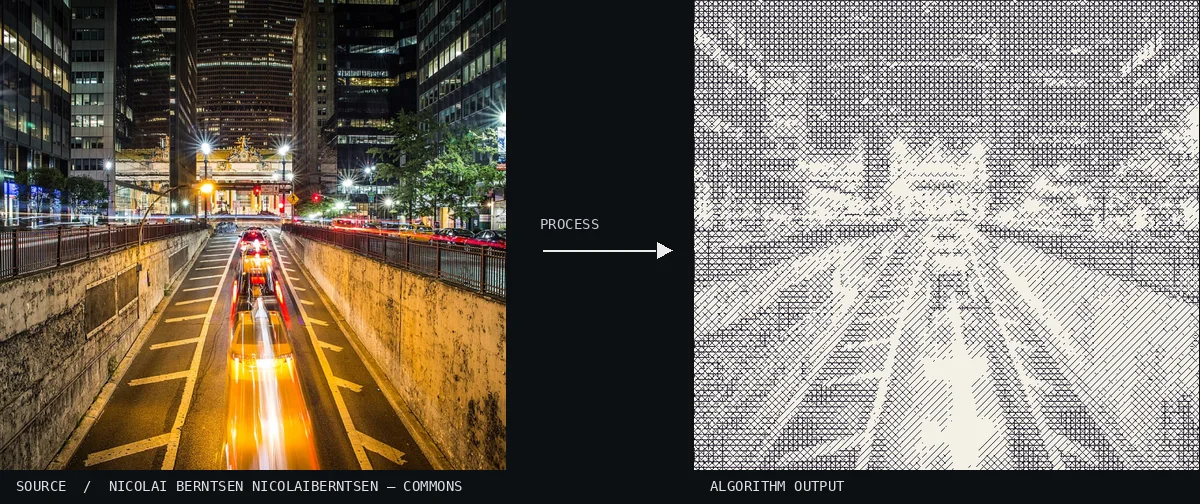
Atlas demonstration: the free source photo and the computed Crosshatching. A dense urban street view stretches toward a distant focal point beneath a complex sky. The rendering uses multiple layers of intersecting lines to define the heavy shadows of buildings against the lighter road surface.Image: Nicolai Berntsen nicolaiberntsen · CC0 (via Wikimedia Commons), processed for the AtlasView source ↗
Prompt
Transform this image into a Crosshatching drawing built entirely from intersecting sets of fine black parallel lines on white paper. Layer diagonal strokes densely in shadows, use fewer crossings in midtones, and leave highlights mostly empty. Avoid solid gray fills; keep the original subject and composition.
You see an image built entirely from [intersecting sets of parallel lines1]that create varying shades of gray.
Principle
The algorithm maps [pixel brightness values2]to layers of diagonal lines. Darker areas receive more [intersecting layers], while lighter areas remain mostly empty.
Try it out
Adjust the line thickness and angle to see how the perceived shading changes.
Classification
Calculated image processing result.
Further examples · 9 images
02Crosshatching, applied to “Fruit Pun (Unsplash)”Two pears are positioned in the center of the frame, contrasting against a much darker surrounding environment. The varying density of the line work creates a clear distinction between the bright fruit skins and the deeply shaded backdrop.Markus Spiske markusspiske (photo); processed for the Atlas · CC0 · Wikimedia Commons03Crosshatching, applied to “Fruit waffles and coffee (Unsplash)”A close-up view reveals a breakfast setting featuring a plate, a cup, and a patterned waffle. Each object is distinguished by the number of intersecting line sets, with the darkest shadows appearing as a thick mesh.Joseph Gonzalez miracletwentyone (photo); processed for the Atlas · CC0 · Wikimedia Commons04Crosshatching, applied to “People entering the ocean (Unsplash)”A serene mountain landscape stretches under a cloud-filled sky. The transition from light air to dark peaks is rendered through increasingly dense grids of overlapping ink-like lines.James Wei unibodies (photo); processed for the Atlas · CC0 · Wikimedia Commons05Crosshatching, applied to “Little boy blue (Unsplash)”The portrait captures a young person looking slightly off-camera with a neutral expression. Finely spaced diagonal strokes define the contours of the face while deeper shadows are formed by thick, intersecting patterns.Séan Gorman oakandwillow (photo); processed for the Atlas · CC0 · Wikimedia Commons06Crosshatching, applied to “Unprotected beauty (Unsplash)”A small dog stands alert on a path, its form silhouetted against a bright light source. Multiple layers of perpendicular lines build deep tonal values in the surrounding environment, creating a sense of physical texture.rachel baskerville rachelroyall (photo); processed for the Atlas · CC0 · Wikimedia Commons07Crosshatching, applied to “Desert Wedding (Unsplash)”A couple is captured in an embrace amidst a textured, outdoor setting. Varying densities of linear clusters distinguish the subjects' clothing from the lighter, more airy strokes representing the ground and sky.Emma Frances Logan emmafranceslogan (photo); processed for the Atlas · CC0 · Wikimedia Commons08Crosshatching, applied to “Monochrome portrait (Unsplash)”A dark silhouette of a person's head and shoulders is centered against a stark, empty background. The form is defined by a consistent grid of overlapping diagonal lines that break into single strokes along the softer edges of the hair.Volkan Olmez volkanolmez (photo); processed for the Atlas · CC0 · Wikimedia Commons09Crosshatching, applied to “Flowers (Unsplash)”A collection of organic shapes and a watering can suggest a garden or floral scene. The bright, paper-like quality of the central object is achieved by leaving the area largely free of any line strokes.Joanna Kosinska joannakosinska (photo); processed for the Atlas · CC0 · Wikimedia Commons