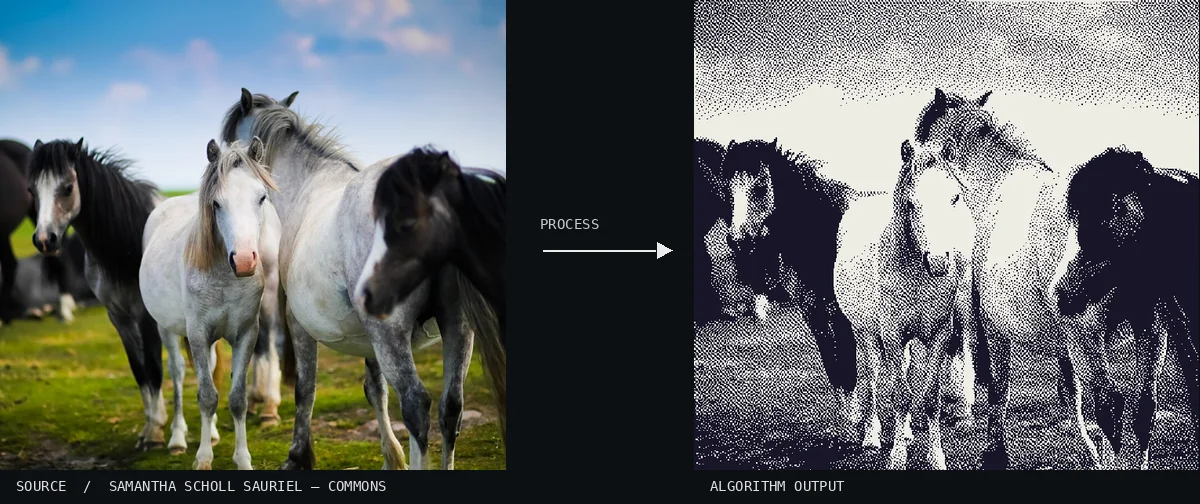
Atlas demonstration: the free source photo and the computed Atkinson Dither. A group of horses stands together in an open field under a bright sky. The algorithm transforms the animal forms into a dense field of black and white specks that simulate soft shading.Image: Samantha Scholl sauriel · CC0 (via Wikimedia Commons), processed for the AtlasView source ↗
Prompt
Apply an Atkinson Dither effect using pure black and white pixels, with compact dot clusters, open white highlights, and bold dark shadow areas. Replace smooth shading with airy, high-contrast pixel patterns that retain less midtone detail, avoiding gray pixels and regular checkerboard screens. Keep the original subject and composition.
You see ahigh-contrast image where [smooth shading1]is replaced by distinct clusters of tiny monochrome dots.
Principle
It turns pixels into [pure black or pure white]. It then shifts afraction of the resulting [quantization error2]to nearby unvisited pixels.
Try it out
Look closely at how midtones display distinct speckled patterns while pure highlights and deep shadows remain solid.
Classification
Calculated image processing result.
Further examples · 9 images
02Atkinson Dither, applied to “Coffee, notebooks and pen (Unsplash)”A top-down view captures an open notebook, a pen, and a cup of coffee resting on a wooden table. Stippled patterns define the grain of the wood and the gradients of light hitting the paper surfaces.Freddy Castro readysetfreddy (photo); processed for the Atlas · CC0 · Wikimedia Commons03Atkinson Dither, applied to “People watching 1 (Unsplash)”The ocean tide rolls in over a sandy beach populated by small figures of people. Large clusters of dots create the appearance of undulating gray waves while preserving the silhouettes of the beachgoers.Jarrett Kow haskel (photo); processed for the Atlas · CC0 · Wikimedia Commons04Atkinson Dither, applied to “Steel Bridge Below (Unsplash)”This perspective looks directly upward from beneath the massive iron structure of the Eiffel Tower. High-contrast monochrome rendering highlights the geometric complexity of the girders through sharp black shapes and fine-grain error diffusion.valor kopeny valor (photo); processed for the Atlas · CC0 · Wikimedia Commons05Atkinson Dither, applied to “Crayons beside child coloring (Unsplash)”The composition features a small container of pens or tools in the foreground set against a soft, organic background. The process translates the smooth photographic bokeh into a textured, mechanical-looking distribution of pixels.Aaron Burden aaronburden (photo); processed for the Atlas · CC0 · Wikimedia Commons06Atkinson Dither, applied to “Elegant boardroom (Unsplash)”A modern conference room is shown with a long table, ergonomic chairs, and large floor-to-ceiling windows. The technique is clearly represented through the stippled patterns on the floor and the varied densities of black dots defining the shadows on the chairs.Benjamin Child bchild311 (photo); processed for the Atlas · CC0 · Wikimedia Commons07Atkinson Dither, applied to “Desert Sunrise (Unsplash)”A mountain range is silhouetted against a bright, hazy sky during a sunset or sunrise. The transition from light to dark in the sky is achieved through a precise scattering of monochrome dots that simulates a smooth gradient.Red Morley Hewitt redvers (photo); processed for the Atlas · CC0 · Wikimedia Commons08Atkinson Dither, applied to “Shahdad desert (Unsplash)”A lone figure with a backpack and hat stands in a vast, arid landscape near a large rock formation. The grit of the desert floor and the shading on the hiker's clothing are meticulously rendered using the characteristic error-diffusion pattern.POOYAN ESHTIAGHI pyeshtiaghi (photo); processed for the Atlas · CC0 · Wikimedia Commons09Atkinson Dither, applied to “Winter (Unsplash)”A dense forest of leafless trees stands over a field covered in a light layer of snow or frost. The intricate branches and the texture of the ground are defined by a complex web of black and white pixels that preserves fine detail.Maarten Deckers maartendeckers (photo); processed for the Atlas · CC0 · Wikimedia Commons