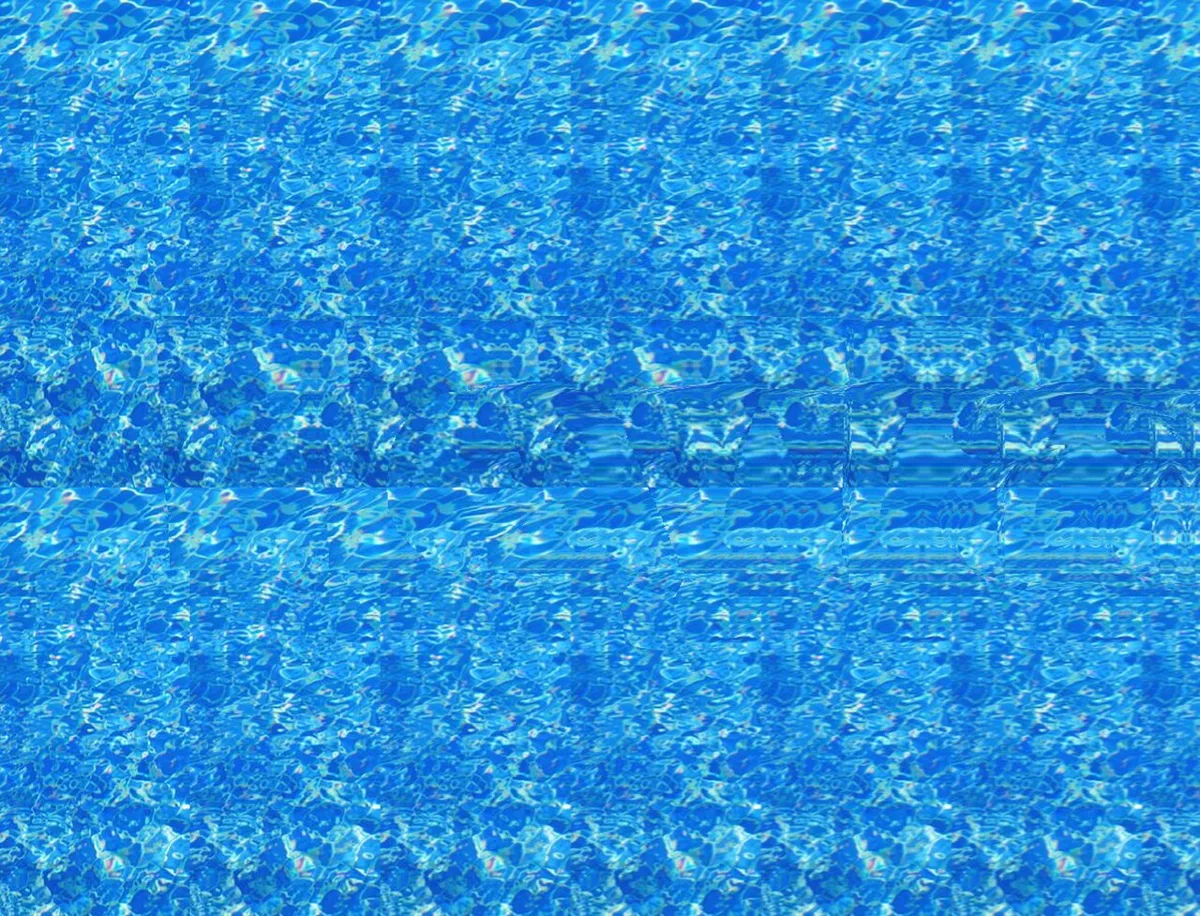
Blue Water-Pattern Autostereogram. A blue, waterlike texture repeats across the picture, with localized distortions interrupting its rhythm.Nevit Dilmen (talk) · CC BY-SA 3.0 · via Wikimedia CommonsView source ↗
Prompt
Transform this image into an Autostereogram covered edge to edge with dense, horizontally repeating multicolored speckles. Encode the subject as hidden depth through small local shifts in repeat spacing, with nearer forms receiving greater disparity and no visible outlines or conventional shading. Keep the original subject and composition.
A[dense repeating pattern]covers aflat picture, often resembling colorful wallpaper or visual noise. With the right gaze, a[hidden three-dimensional shape]appears within it.
Principle
Small changes in [horizontal spacing]encode depth within the pattern. When your eyes match different repetitions, binocular disparity1makes the brain interpret those differences as depth.
Example
N. E. Thing Enterprises: Magic Eye: ANew Way of Looking at the World, 1993.
Try it out
View aparallel-view autostereogram as though looking through the page; notice whether ashape emerges, and stop if uncomfortable.
Background
Autostereograms became apopular visual puzzle during the 1990s, especially through Magic Eye books and posters. Their roots lie in stereoscopic research and computer-generated random-dot images2. Christopher Tyler developed the random-dot autostereogram in 1979. Unlike paired stereo pictures, one image supplies matching features for both eyes. Adepth map3guides small horizontal shifts in repeated texture. These shifts create disparities when the eyes pair neighboring repetitions rather than identical positions. The surface remains flat, but the brain reconstructs an apparent arrangement of nearer and farther regions.
Distinction
Aconventional stereogram presents separate left-eye and right-eye pictures. An autostereogram combines the necessary depth cues in one patterned image, without colored filters or astereoscope.
Aftermath
It shows that perceived depth depends on how the eyes match visual information, not simply on the picture's physical surface.
Further examples · 10 images
02Autostereogram Repetition and Depth DiagramRows of repeated tigers and riders on sharks appear against blue, with arrows marking different horizontal intervals. The measured spacing demonstrates how repeated motifs can occupy different apparent depths when viewed stereoscopically.Unknown author · CC BY-SA 3.0 · Wikimedia Commons03Multicolored Random-Dot AutostereogramDense multicolored speckles form a repeating field with subtly displaced patches. The displaced repetitions carry binocular disparity information, allowing a hidden three-dimensional form to emerge from the visual noise.No machine-readable author provided. Fred Hsu assumed (based on copyright claims). · CC BY-SA 3.0 · Wikimedia Commons04Turquoise Random-Dot AutostereogramTurquoise dots cover a black field in closely spaced, subtly shifting repetitions. Matching neighboring repeats with the eyes reveals depth encoded within this single flat image.The original uploader was Wzwz at English Wikipedia. Later versions were uploaded by Zc… · Public domain · Wikimedia Commons05Black-and-White Random-Dot AutostereogramFine black-and-white marks create a noisy surface with recurring textures and localized horizontal shifts. These shifts provide the disparity cues that turn the flat pattern into an apparent relief under stereoscopic viewing.Rparle (talk) (Uploads) · CC BY-SA 3.0 · Wikimedia Commons06Animal Collage AutostereogramA dense collage of animals and figures repeats across the picture with localized horizontal shifts and distortions. These altered repetition intervals encode binocular disparity, allowing a hidden three-dimensional form to emerge when the eyes match neighboring repeats.Unknown author · CC BY-SA 3.0 · Wikimedia Commons07Layered Decorative Pattern StereogramA framed composition arranges repeated hanging forms, ochre silhouettes, and pink figures around a blue central band. Its differently spaced motif sequences produce layered stereoscopic depth through the wallpaper principle used in autostereograms.Mindcube3D · CC BY-SA 4.0 · Wikimedia Commons08Striped Figures and Ringed Spheres StereogramRepeated striped animal figures extend above and below ringed spheres, accompanied by small circles and triangles. Differences in the horizontal repetition of these elements allow the composition to separate into apparent depth layers when neighboring motifs are fused.Mindcube3D · CC BY-SA 4.0 · Wikimedia Commons09Purple and Green Pattern StereogramLime-green animal silhouettes repeat between mirrored purple contours and alternating pale and orange circles. The motif bands use differing horizontal intervals to create stereoscopic depth within a single decorative picture.Mindcube3D · CC BY-SA 4.0 · Wikimedia Commons10Seaside Repetitions with Hidden DepthRepeated seals balancing balls appear against a blue sea, with birds overhead and a striped foreground. Different horizontal repetition intervals across these elements allow binocular matching to separate the scene into apparent depth layers.Mindcube3D · CC BY-SA 4.0 · Wikimedia Commons
Question
Why can changing your gaze reveal a shape without changing the printed image?
Show possible answer +Hide answer −
Changing eye alignment changes which repeated features the two eyes match. Their spacing differences then become signals of depth.