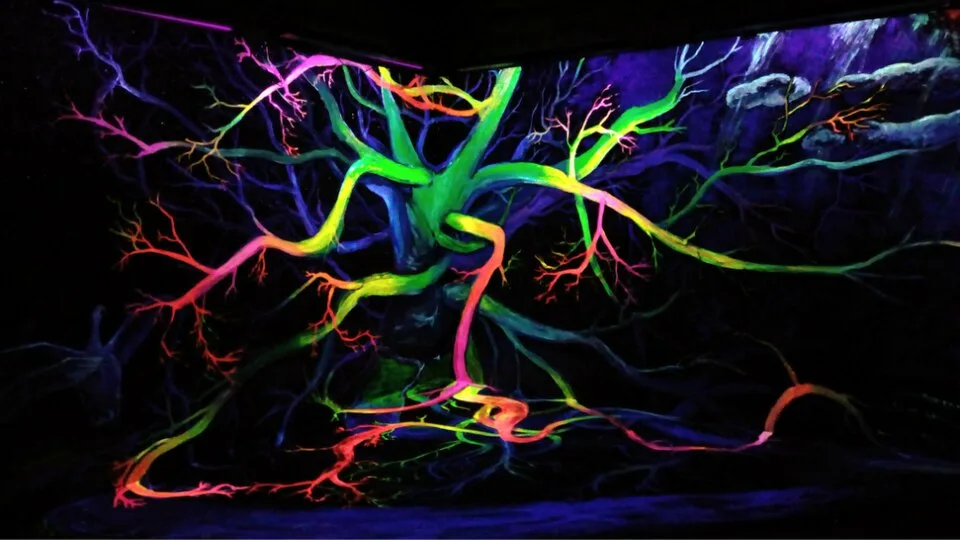
Rainbow Branches for ChromaDepth Viewing. A luminous network of twisting branches shifts from red and yellow through green to blue against a nearly black background.Paweł Janczewski · CC BY-SA 4.0 · via Wikimedia CommonsView source ↗
Prompt
Apply a chromatic depth 3D effect, mapping foreground forms to vivid red and orange, middle distances to yellow and green, and distant areas to cyan and deep blue. Use black negative space, crisp boundaries, and flat saturated color without stereo ghosting. Keep the original subject and composition.
Through special glasses, [red shapes appear forward], while blue shapes appear farther back, especially against black backgrounds. Without the glasses, you see aflat, brightly colored image.
Principle
The glasses use [optical dispersion1]to shift different colors sideways by different amounts in each eye. These color-dependent offsets create [binocular disparity2], which the brain interprets as depth.
Example
KISS: Psycho Circus (music video), 1998.
Try it out
View red, green, and blue circles on black through ChromaDepth glasses, then remove them and compare their apparent distances.
Background
ChromaDepth became commercially available in the 1990s, offering depth from asingle color image rather than two separately photographed views. Its transparent lenses use tiny optical structures to redirect light according to wavelength3. The resulting differences between the eyes make colors occupy apparent depth layers. Designers typically place red subjects in front and blue backgrounds behind, with other colors between them. The method works with printed pictures and screens. However, color and depth are linked, so choosing arealistic surface color can conflict with placing an object.
Distinction
Unlike red-and-cyan anaglyphs, ChromaDepth does not filter two overlaid views into separate eyes. It derives apparent depth from colors within one image.
Aftermath
ChromaDepth shows how controlled differences between the eyes can turn color choices into spatial cues.
Further examples · 7 images
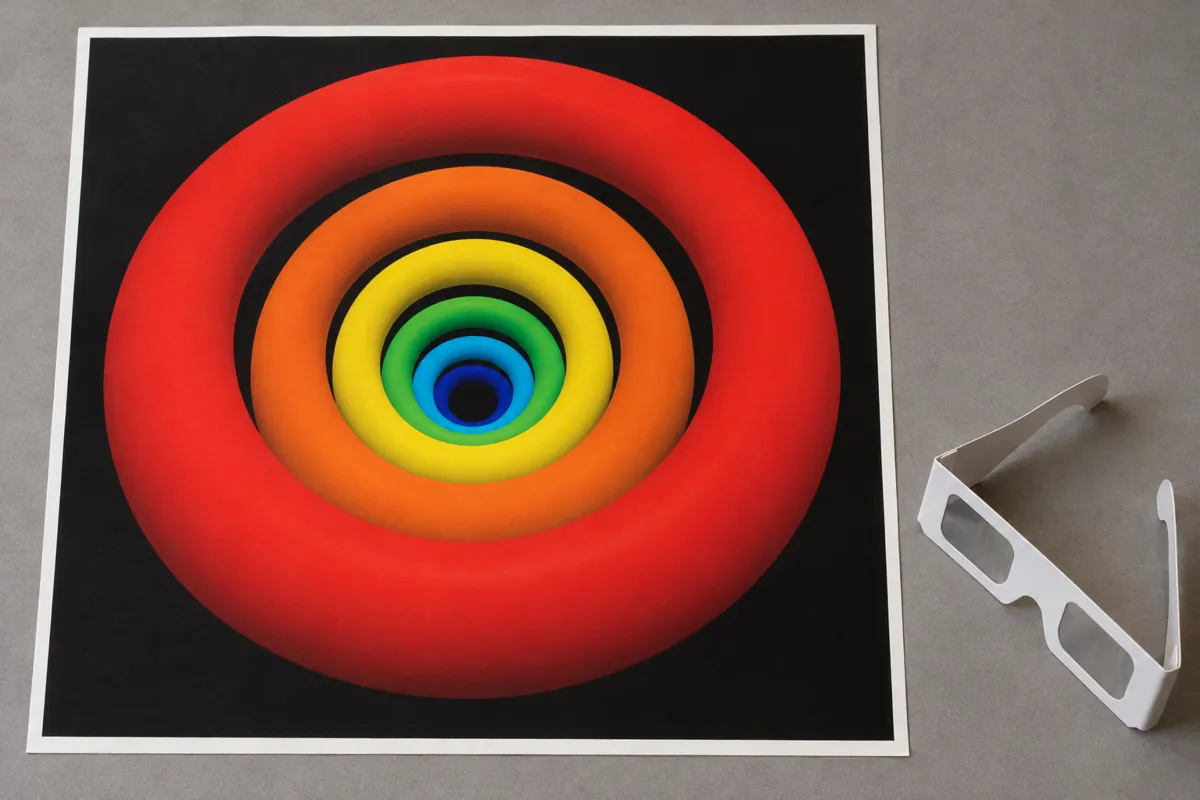
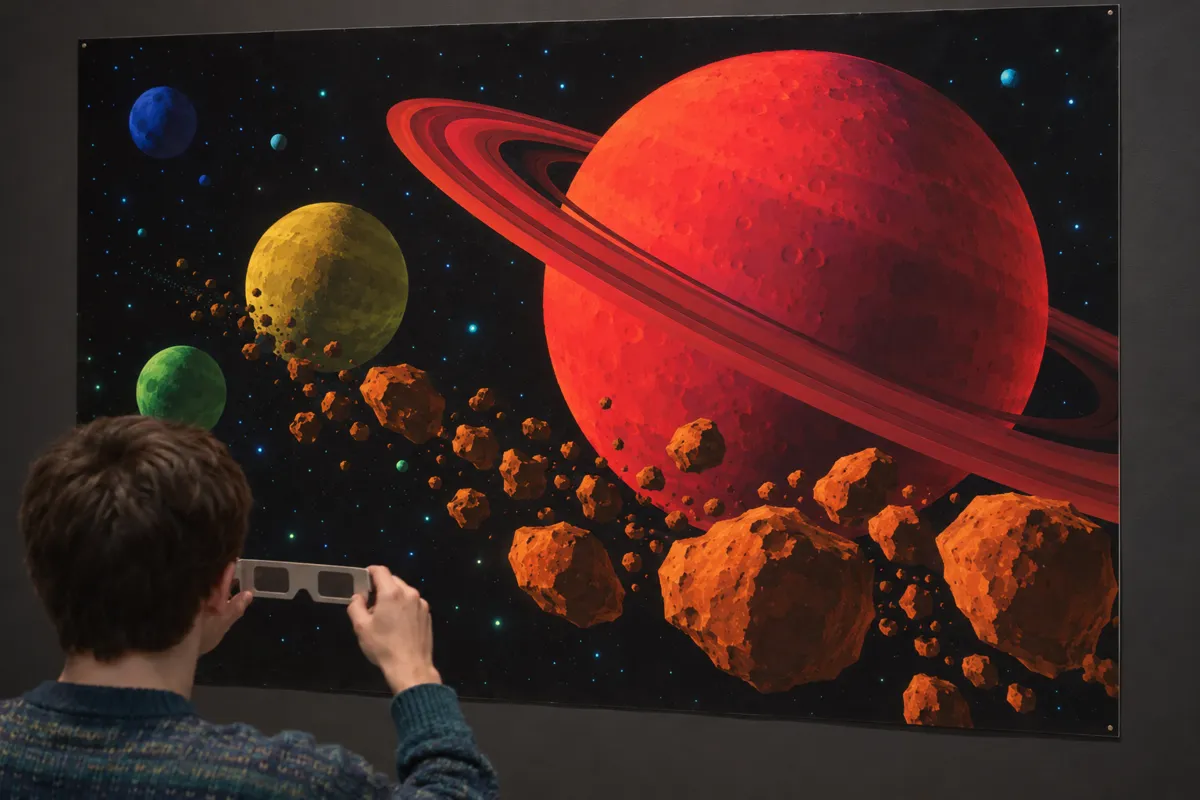
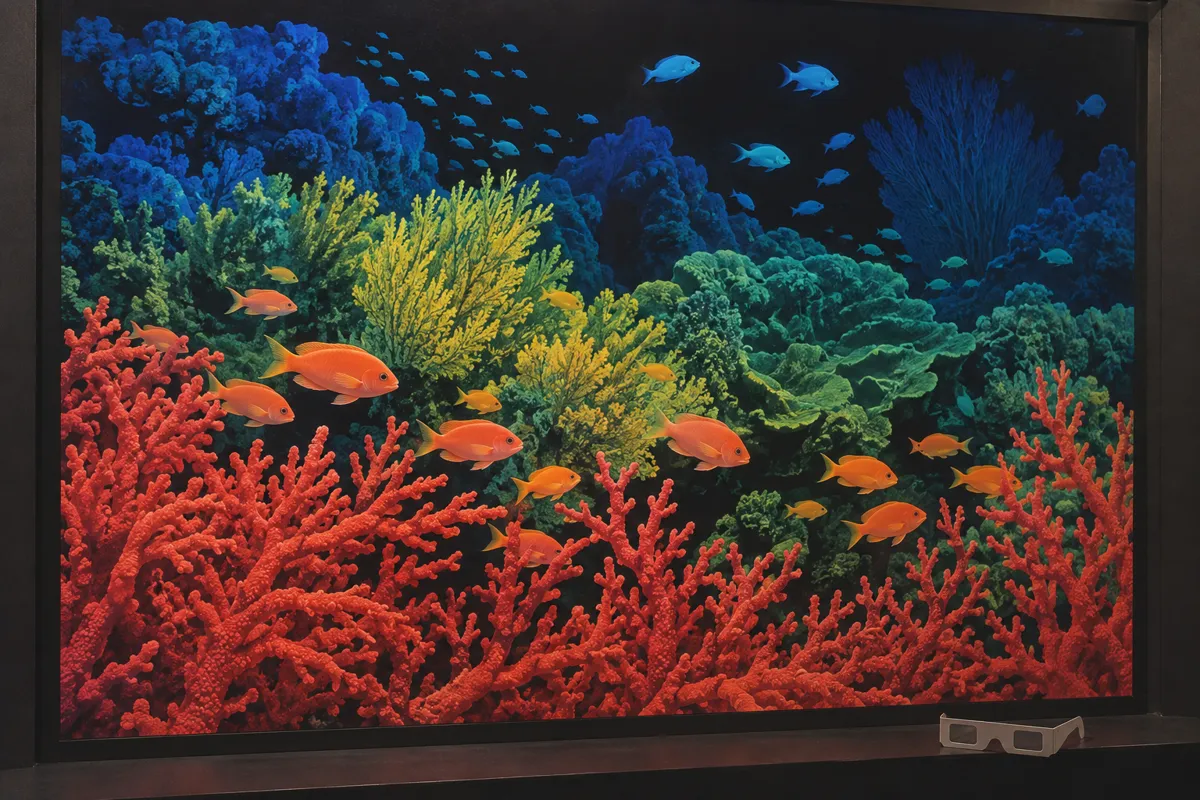
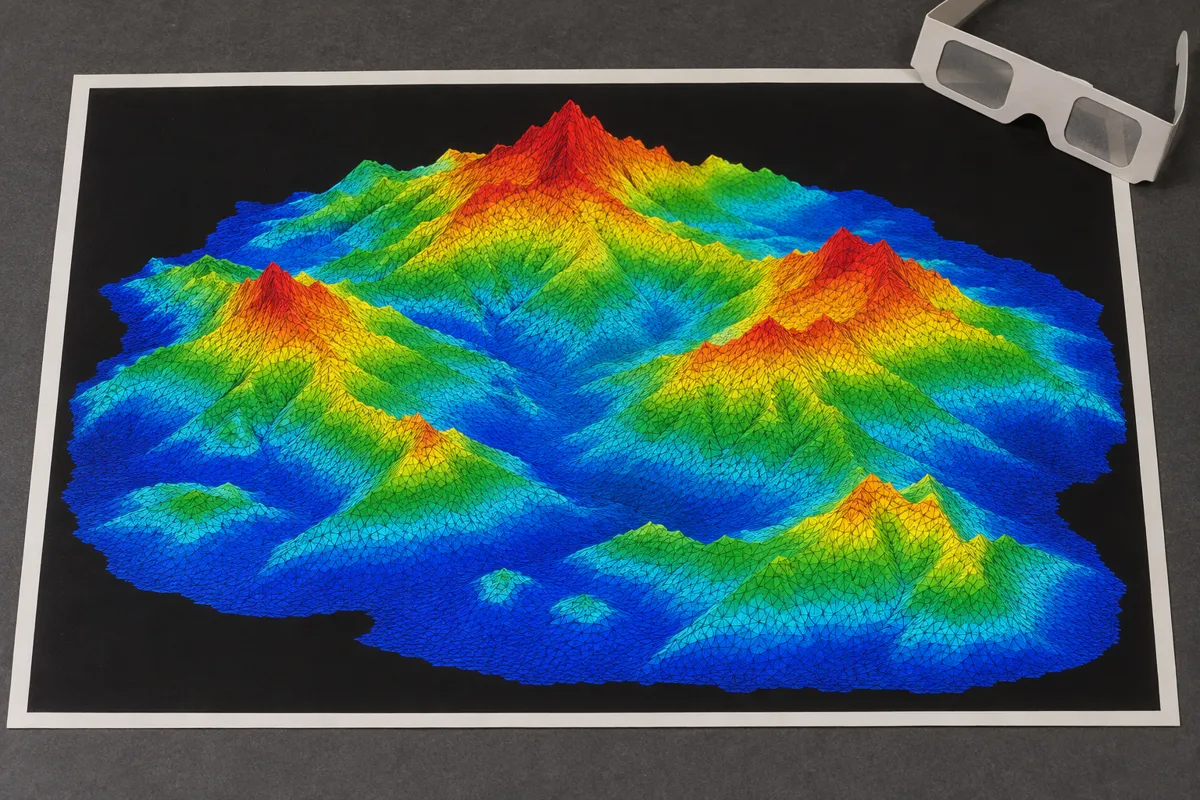
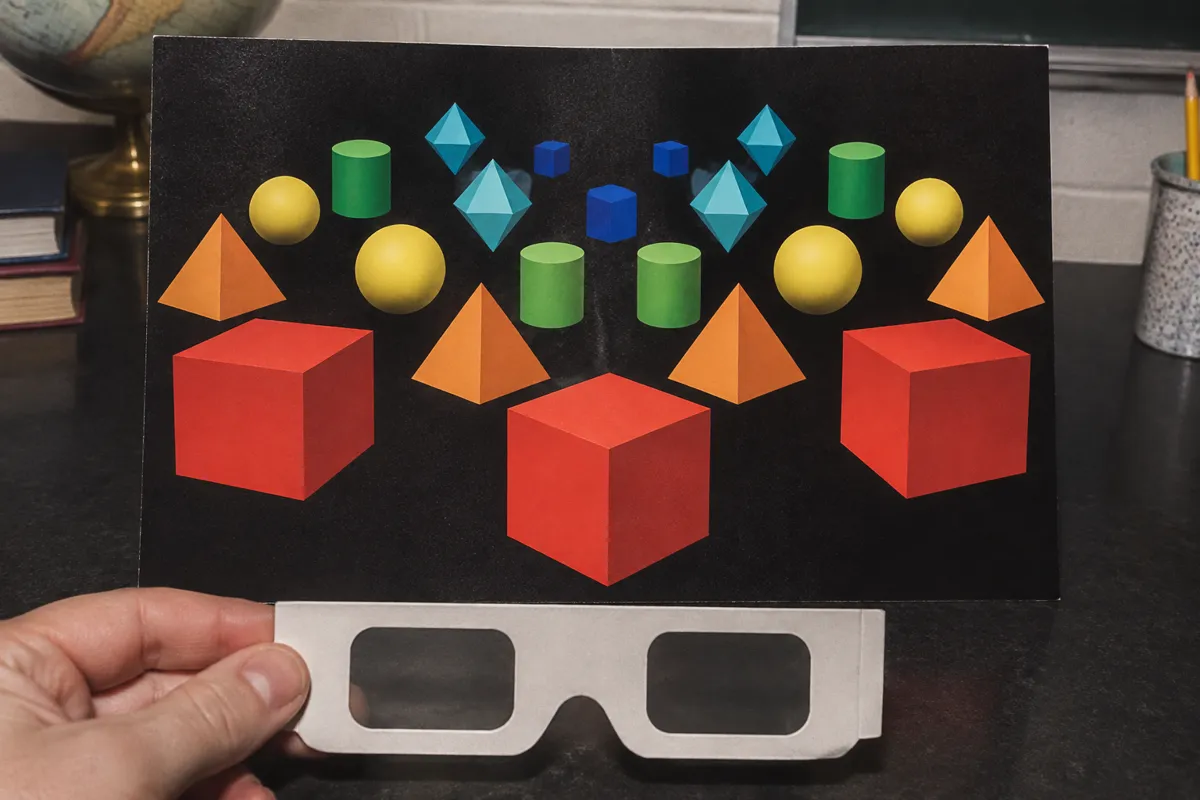
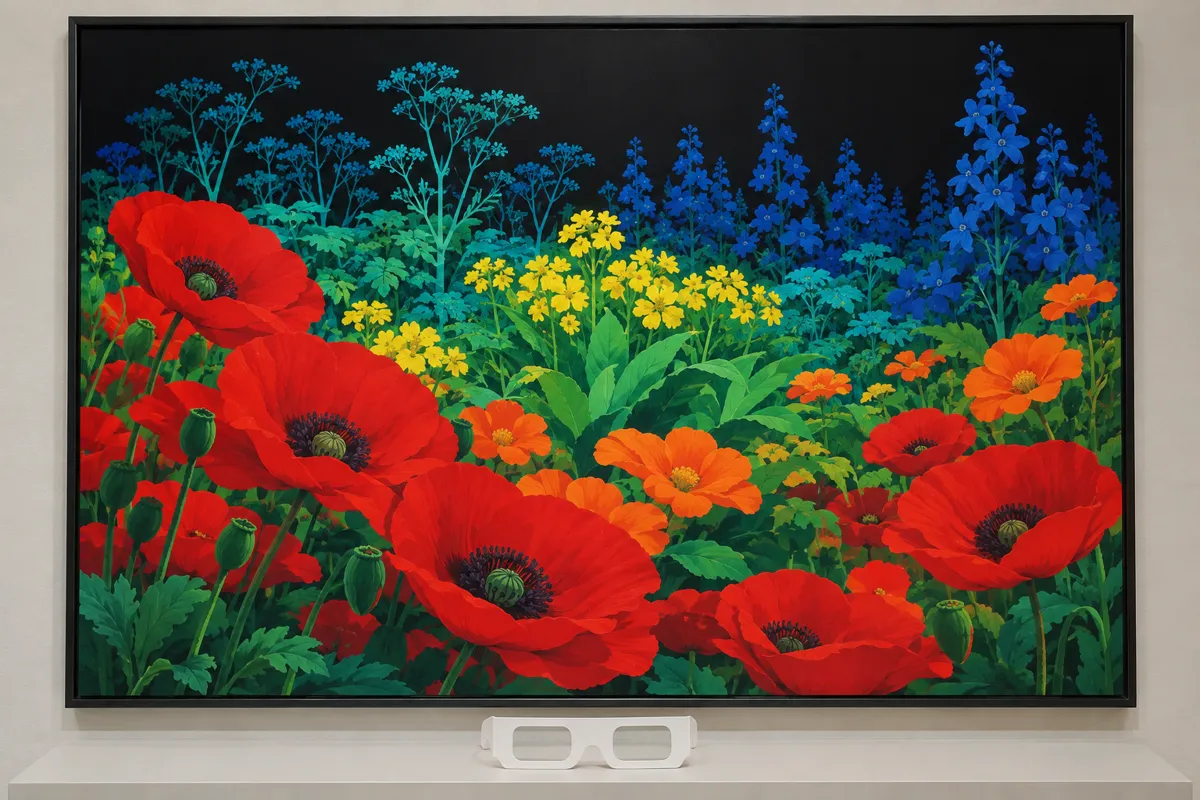
02AI illustration: Concentric rings demonstrating color-coded depthA series of concentric rings transition through the visible spectrum from a large red outer torus to a tiny blue center. This arrangement utilizes the maximum depth range of the ChromaDepth process, with red appearing at the closest plane and blue receding furthest.Illustration generated for the Atlas (AI)03AI illustration: Interplanetary depth through spectral layeringA space scene features a large red planet and asteroids in the foreground, with green, yellow, and blue celestial bodies trailing into the distance. By assigning colors based on the desired Z-axis position, the artist creates a convincing three-dimensional landscape when viewed through diffraction lenses.Illustration generated for the Atlas (AI)04AI illustration: Marine life organized by ChromaDepth planesThis underwater scene depicts red coral in the immediate foreground, followed by orange and yellow sea life, ending with blue background elements. The image adheres perfectly to the technique's requirements, using high-contrast colors against a dark background to simulate binocular disparity.Illustration generated for the Atlas (AI)05AI illustration: Topographic map using color for vertical reliefA topographic map uses a rainbow gradient to represent elevation, with the red peaks appearing to rise off the paper toward the viewer. This practical application shows how the technology can be used to visualize complex data sets through color-induced stereoscopy.Illustration generated for the Atlas (AI)06AI illustration: Geometric primitives arranged in a depth sequenceFloating geometric solids are arranged in rows, with red cubes at the bottom and blue prisms at the top against a black field. The placement of the glasses in the frame highlights that the perceived depth is a result of optical dispersion rather than traditional perspective.Illustration generated for the Atlas (AI)07AI illustration: Floral garden illustration with chromatic depthBright red poppies dominate the lower half of this composition, while blue wildflowers stand behind them in the upper background. This illustration demonstrates how naturalistic subjects can be adapted to the technique by strictly following the warm-to-cool color depth hierarchy.Illustration generated for the Atlas (AI)
Question
Why can changing an object's color change its apparent distance?
Show possible answer +Hide answer −
The glasses shift different colors by different amounts between the eyes. Recoloring an object therefore changes the disparity that signals its depth.