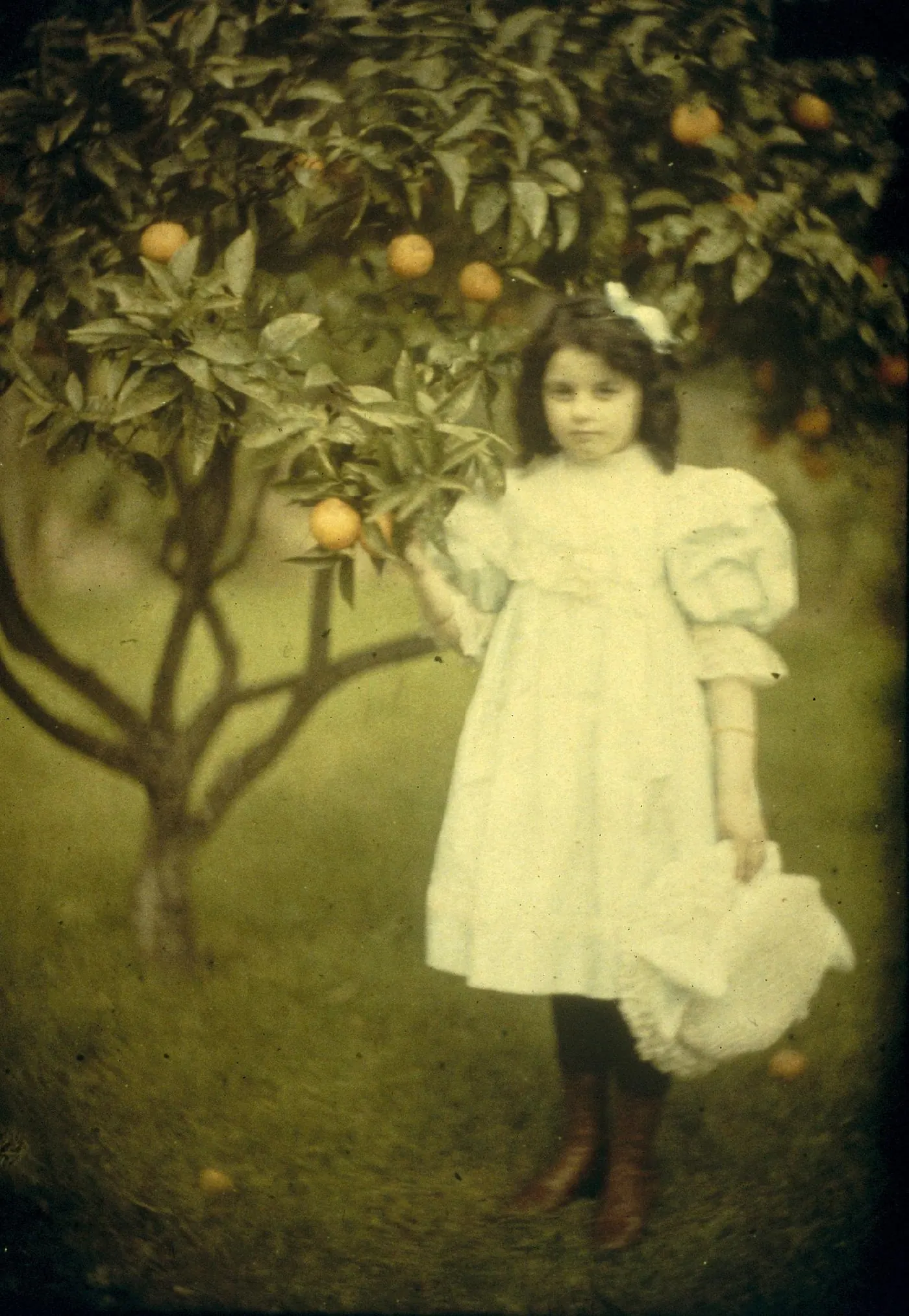
John Cimon Warburg: Peggy in the garden, around 1908.National Science and Media Museum / Science Museum Group; John Cimon Warburg; Museum web image.View source ↗
Prompt
Transform this image into an Autochrome photograph with softly luminous colors, muted greens, warm coral reds, and delicate violet shadows. Add a fine mosaic of colored starch-like granules, gentle optical softness, restrained contrast, and the translucent glow of a backlit glass positive. Keep the original subject and composition.
John Cimon Warburg: Peggy in the garden, around 1908.
Try it out
Compare colors and fine details with adigital photograph. Look for grainy transitions between adjacent color tones.
Background
Introduced in 1904; commercially launched in 1907. 1907–1930s: early practical color photography. Neither the first color photograph nor apost-processing filter. The commercial launch in 1907 is the clear milestone.
Recognize: Bright, slightly grainy colors; asoft, pointillist impression.
Mechanism: Microscopically colored starch grains form acolor filter on aglass plate. When the developed positive image is illuminated, acolor picture is produced.
example: John Cimon Warburg: Peggy in the garden, around 1908.
Practice: Compare the color, grain, and fine details with amodern digital photograph. Notice how the grain creates adifferent color appearance compared to uniform digital pixels and artificially applied grain.
Microscopically colored starch grains form acolor filter on aglass plate. When the developed positive image is illuminated, acolor picture emerges.
Bright, slightly grainy colors; asoft, pointillist impression.
Compare the color, grain, and fine details to amodern digital photograph.
Neither the first color photograph nor asubsequent filter. The commercial launch in 1907 is the clear milestone.
Distinction
Neither the first color photograph nor asubsequent filter. The commercial launch in 1907 is the clear milestone.
Aftermath
Cited today as ahistorical color look; atrue Autochrome is amaterial process.
Further examples · 11 images
02Mauretania in drydock 1928 autochrome process starboard sideA large steamship is docked in a harbor with a figure in the foreground. The image demonstrates characteristic muted, grainy color transitions across the sky and water.Clifton R. Adams · Public domain · Wikimedia Commons03Microphoto of Autochrome plateA microscopic view reveals a mosaic of green, orange, and violet particles. These dyed potato starch grains act as the color filter for the Autochrome process.Janke · CC0 · Wikimedia Commons04Olympic in drydock 1928 autochrome process (cropped)The ocean liner Olympic is shown in drydock with its distinct orange funnels. The soft, pointillistic texture is evident in the hazy rendering of the ship's superstructure.Clifton R. Adams · Public domain · Wikimedia Commons05Tekniske prøver (autochrome) (14578283697)A technical diagram illustrates the cross-section of an Autochrome plate. It shows the light path through the glass, color grains, and silver emulsion layers.National Library of Norway · No restrictions · Wikimedia Commons06Friedrich Walker, plaque autochrome-Lumière, Gustav Klimt vers 1910Artist Gustav Klimt stands in a garden wearing a blue robe. The background foliage displays the typical soft, stippled color blending found in early 1910s Autochromes.Friedrich Walker ca 1910. · Public domain · Wikimedia Commons07Autochrome - Lyon - Pont du change - Quai de Saône - Institut LumièreMen in a small boat appear on the Saône river in Lyon with a bridge behind them. The image shows the characteristic dreamlike, painterly quality of the colored starch filter.AnonymousUnknown author · CC0 · Wikimedia Commons08Autochrome PrincipeAn exploded diagram displays the various layers of an Autochrome plate. It highlights how the color filter layer is sandwiched between the glass and the emulsion.fr:User:Lozère · CC BY-SA 3.0 · Wikimedia Commons09Dja-far-al-Askari-commander1918A 1918 portrait showing the characteristic soft, pointillistic texture. The colors are muted and grainy, typical of the dyed starch grains used in the Lumière process.Paul Castelnau · CC0 · Wikimedia Commons10Marshal Hubert Lyautey, May 1927This 1927 portrait displays the mottled color transitions inherent to the technique. The background clearly shows the random distribution of the color-filter starch particles.Georges Chevalier (photographer) · CC BY 4.0 · Wikimedia Commons11Mosaïque romaine représentant une scène de pêcheA photograph of a Roman mosaic recorded on an autochrome plate. The graininess of the photographic process overlaps with the tesserae of the subject, demonstrating early color documentation.Chevalier Georges · CC BY-SA 4.0 · Wikimedia Commons