Anaglyph stereo. 1850s: early color stereoscopy; science and design to this day
Typeface · Audiowide
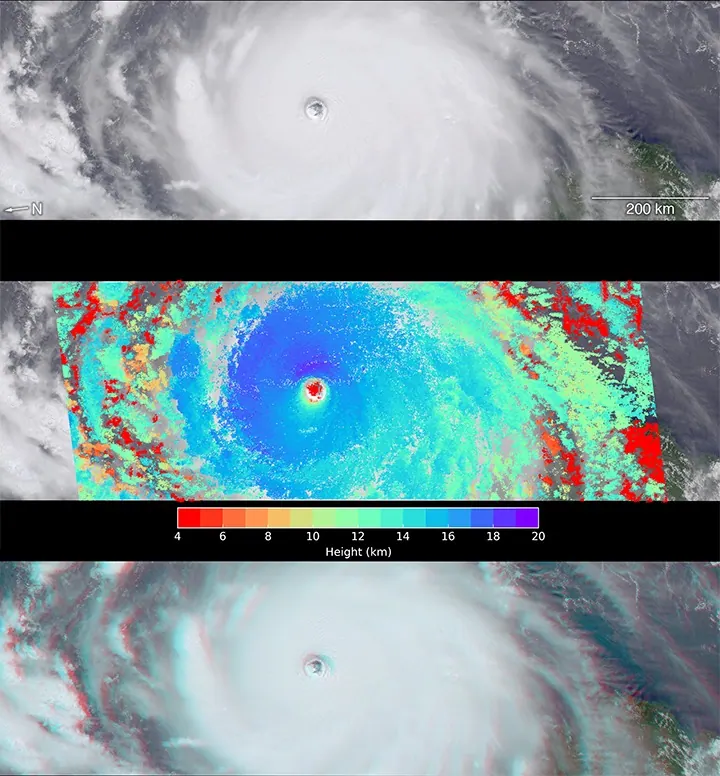
NASA: Typhoon Nepartak as an anaglyph and comparison views, 2016.NASA / GSFC / LaRC / JPL-Caltech, MISR team.View source ↗
Prompt
Apply an Anaglyph Stereo effect using overlapping red and cyan image channels with small horizontal offsets. Vary the separation by apparent depth, producing recognizable doubled contours around foreground forms while keeping distant regions more closely aligned. Retain clear underlying detail and restrained neutral midtones. Keep the original subject and composition.
[Red and cyan1double contours]; spatially visible through filter glasses.
Principle
[Two perspectives are separated by color]and [each is directed to one eye].
Example
NASA: Stereo view of atyphoon.
Try it out
Compare true stereo shifting with simple RGB shift2.
Background
Color stereoscopic experiments date back to the 1850s; Rollmann described acolor stereoscope in 1853. The anaglyph is aspecial form of stereoscopic representation: Two views are placed in different color channels, and specially filtered glasses separate them again for the two eyes. NASA demonstrates how this can be used to spatially examine cloud heights and landscape features, for example. Red-cyan is acommon combination, but not the only one. The comparison with RGB shift is crucial: Adecorative color shift replicates the same perspective. Atrue stereo anaglyph requires two matching views with spatially different shifts. The NASA example shown is amodern scientific application.
Distinction
Simply shifting the color channels of aphotograph does not create correct, different perspectives.
Aftermath
Stereoscopy refers to spatial vision from two perspectives; anaglyph here refers to their color-separated encoding. The terms are not interchangeable.
Further examples · 12 images
02Auchenorrhyncha AnaglyphA close-up view of an Auchenorrhyncha insect head is shown. Red and cyan fringes indicate a true stereo offset suitable for spatial perception of biological textures.Richard Bartz, Munich aka Makro Freak · CC BY-SA 2.5 · Wikimedia Commons03Art Institute of Chicago Lion Statue (anaglyph stereo)The Chicago Art Institute's lion statue is depicted in front of the museum building. The distinct color shifts across the mane and architectural details demonstrate depth through filtered lenses.Kim Scarborough · CC BY-SA 3.0 us · Wikimedia Commons04Stereo anaglyph map (3511509430)This image presents a street map with overlapping color channels. It illustrates how anaglyph techniques can be applied to cartography to represent topographical variations or layered information.Steven Kay from Edinburgh, United Kingdom · CC BY-SA 2.0 · Wikimedia Commons05Kasuga Lantern (anaglyph) (519490987)A stone Kasuga lantern is positioned against a background of trees. The variation in red and cyan offsets between the lantern and the branches provides a clear depth gradient.Kim Scarborough from Chicago, IL · CC BY-SA 2.0 · Wikimedia Commons06Sun 3D anaglyph STEREO crop brightThis is a solar crop showing the sun's surface and prominences. The anaglyph effect allows for the visualization of three-dimensional structures within the solar atmosphere.Sun_3D_anaglyph_STEREO.jpg: NASA derivative work: WolfmanSF (talk) · Public domain · Wikimedia Commons07Moto (Anaglyph Stereo 3D) (26171378446)A motor scooter is parked on a sidewalk next to a building. The separation of color channels on the vehicle's curves illustrates volume and distance from the background.Carlos ZGZ 3D Pictures · CC BY 2.0 · Wikimedia Commons08Water reflection (Anaglyph Stereo 3D) (26051884120)The image shows a reflection in a puddle on a textured pavement. Using anaglyph stereo here highlights the spatial relationship between the ground surface and the reflected depth.Carlos ZGZ 3D Pictures · CC BY 2.0 · Wikimedia Commons09Anaglyph compositionA three-part composition displays a 3D model in mono and anaglyph versions. It serves as a direct comparison between standard views and color-separated stereoscopic depth.Koperczak (talk) 08:01, 16 March 2009 (UTC) · Public domain · Wikimedia Commons10Earnie & Panach (Anaglyph Stereo 3D) (26079728016)A small figure stands in front of a beverage can on a rough surface. The different color shifts on the foreground object and background can demonstrate macro-scale depth.Carlos ZGZ 3D Pictures · CC BY 2.0 · Wikimedia Commons11Catullus crater stereo pair pitThis satellite view shows the Catullus crater on a planetary surface. The anaglyph process is used here to reveal the vertical relief and internal structure of the crater.NASA/Johns Hopkins University Applied Physics Laboratory/Carnegie Institution of Washington · Public domain · Wikimedia Commons12Motel room (Anaglyph Stereo 3D) (25473577384)A motel bedroom with a bed, lamp, and chairs is captured. The color contours throughout the room allow for the spatial mapping of furniture within an indoor environment.Carlos ZGZ 3D Pictures · CC BY 2.0 · Wikimedia Commons
Question
Why does a uniformly shifted red-cyan portrait often appear flat?
Show possible answer +Hide answer −
It often contains only two shifted copies of the same view; the objects lack different, depth-dependent parallaxes.