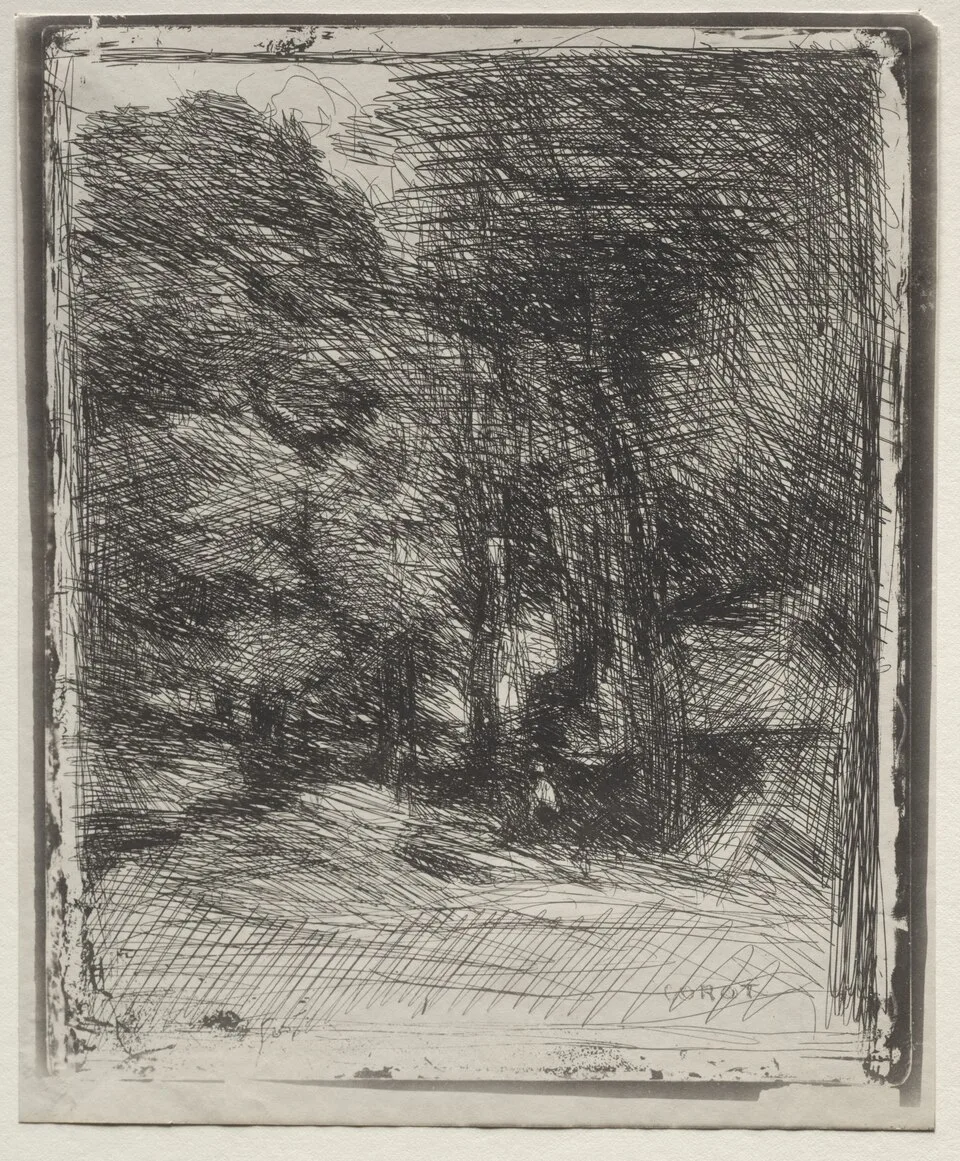
Energetically Scratched Tree Landscape Print. You see a landscape featuring trees rendered with highly energetic, chaotic scratched lines.Jean-Baptiste Camille Corot · CC0 · via Wikimedia CommonsView source ↗
Prompt
Transform this image into a Cliché Verre print resembling a delicate scratched-glass drawing transferred onto photographic paper. Use fluid dark lines, irregular etched hatching, softly blurred line edges, and warm ivory highlights. Add sparse coating specks and gently uneven exposure without conventional photographic grain. Keep the original subject and composition.
You see an image resembling a[fluid ink drawing]or delicate etching. However, the lines often show aslightly soft, [photographic blur].
Principle
An artist scratches lines through an opaque coating1on aglass plate. Light shines through these scratches to [expose2photographic paper]underneath.
Example
Jean-Baptiste-Camille Corot: The Woodcutter of Rembrandt, 1853.
Try it out
Examine acliché verre print under magnification to find soft, diffused edges that distinguish it from the sharp bite of acid etching.
Background
In 1853, three Frenchmen developed the cliché verre technique. They convinced famous painters like Corot and Millet to try it. The artist takes aglass plate covered with an opaque coating, usually collodion3or white lead. They draw onto the plate with an etching needle, removing the coating to reveal clear glass. This creates ahandmade photographic negative. The plate is then placed onto light-sensitive paper and exposed to the sun. Because the glass has thickness, the drawn lines cast slightly diffused shadows. This gives the final print its characteristic soft, atmospheric quality.
Distinction
Unlike traditional etching into metal, cliché verre uses light to expose hand-drawn lines onto photographic paper. It requires no ink or mechanical printing press.
Aftermath
It bridges printmaking and photography, proving that photosensitive paper can capture direct hand-drawn gestures.
Further examples · 11 images
02Scratched Rural Landscape Photographic PrintYou see a rural landscape with trees and a building, created with vigorous, uniform scratches. The drawing style directly reflects a stylus moving through a glass coating, while the soft underlying tones reveal its photographic printing method.Jean Baptiste Camille Corot · CC0 · Wikimedia Commons03Scratched Landscape with Visible Plate BordersYou see a dense composition of trees with expressive scratch marks, framed by an uneven dark border. The dark edges where light passed around the bare glass plate, alongside the soft lines, make this a quintessential example of the medium.Jean Baptiste Camille Corot · CC0 · Wikimedia Commons04Woman Emptying Bucket Cliché VerreYou see a woman pouring water into jugs, drawn with consistent hatched lines and a reversed signature at the bottom left. The unreversed text printed backwards and the slightly blurred line edges are unmistakable artifacts of exposing photographic paper through a scratched matrix.Jean-François Millet · CC0 · Wikimedia Commons05Mother and Child Print with Plate BordersYou see a domestic scene of a mother and children, clearly framed by dark, irregular borders. The visible dark edges of the original glass plate and the soft, photographic quality of the etched lines vividly showcase the entire printing process.Jean-François Millet · CC0 · Wikimedia Commons06Cliché Verre Landscape Matrix or NegativeThe image shows a landscape composed of rough, light lines scratched into a solid black background. This perfectly illustrates the cliché verre matrix or a negative print, showcasing the physical scratches that let light through.Jean-Baptiste Camille Corot · Public domain · Wikimedia Commons07Sepia Cliché Verre with HorsesA warm, sepia-toned print depicts horses by a pond using fluid, sketch-like strokes. The lines exhibit the slightly soft, photographic blur characteristic of light diffusing during the cliché verre printing technique.Charles-François Daubigny · CC0 · Wikimedia Commons08Cliché Verre Portrait with Dense HatchingA portrait of a man created with dense, energetic hatching that appears slightly diffused. It is a genuine cliché verre, combining the spontaneous feel of a drawing with the soft tonal qualities of photographic printing.Jean-Baptiste-Camille Corot · CC0 · Wikimedia Commons09Sepia Cliché Verre Landscape with TreesThis sepia-toned landscape features delicate, meandering lines representing trees and foliage. The photographic softness of the line edges clearly identifies it as a cliché verre print.Jean-Baptiste Camille Corot · CC0 · Wikimedia Commons10Cliché Verre Landscape by a RiverA river landscape is rendered with deep brown lines that vary in thickness and sharpness. The continuous tone and slight blur of the ink-like strokes are unmistakable signs of cliché verre.Jean-Baptiste-Camille Corot · CC0 · Wikimedia Commons11Cliché Verre of Woman Pouring WaterA peasant woman pouring water is depicted with confident, varied strokes that lack the harsh bite of a metal etching needle. The subtle photographic softness in the lines makes this a classic cliché verre.Jean-François Millet · CC0 · Wikimedia Commons
Question
Why do cliché verre lines look softer than traditional ink drawings?
Show possible answer +Hide answer −
The drawing sits on top of thick glass, creating agap above the paper. Light scatters slightly during exposure, softening the shadows.


_-_Corot_LCCN2003691015.jpg)


