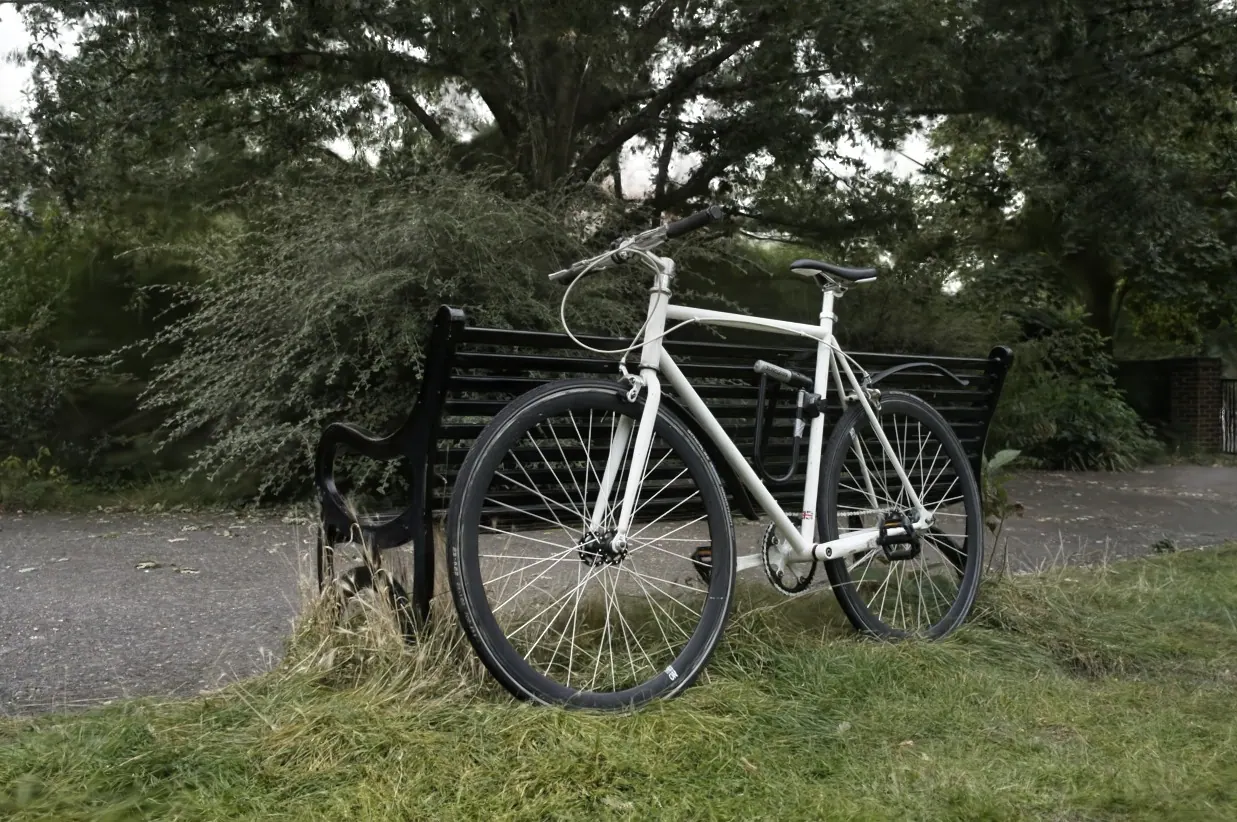
3D Gaussian splatting. 2023: SIGGRAPH work by Kerbl and team
Typeface · Sora
3D Gaussian Splatting: Research result Bicycle, 2023.Bernhard Kerbl, Georgios Kopanas, Thomas Leimkühler and George Drettakis / Inria.View source ↗
Prompt
Apply a 3D Gaussian Splatting look with a photorealistic central subject surrounded by softly overlapping translucent splats in uncertain background areas. Preserve convincing illumination and surface color while adding sparse floating flecks, cloudy depth transitions, and gently dissolving peripheral edges. Keep the original subject and composition.
Compare agood view with the edge of the recorded space.
Background
In 2023, Kerbl, Kopanas, Leimkühler, and Drettakis presented amethod for high-quality, real-time view synthesis. It begins with calibrated cameras and asparse point cloud, then optimizes spatial Gaussian distributions with extent and other properties. An efficient visibility-dependent renderer projects these contributions onto the image. Their work reports high-quality rendering at aminimum of 100 frames per second at 1080p for their tests. This performance figure applies to the research environment, not to any subsequent tool. Unlike asimple point cloud, the elements possess aspatial shape and overlapping effect. Edge artifacts indicate where the underlying views provide little information.
Further examples · 7 images
02Polycam gaussian splatting exemploA garden fountain and lawn are shown with soft, painterly textures in the foreground. The image demonstrates how optimized Gaussians reconstruct complex organic environments from a sparse point cloud for real-time viewing.Óscar Mirás · CC BY-SA 4.0 · Wikimedia Commons033D Gaussian Splatting MethodologyA flowchart illustrates the technical pipeline from point cloud initialization to tile rasterization. It outlines how spatial distributions are optimized through density control and gradient flow to produce the final rendered image.Bernhard Kerbl, Georgios Kopanas, Thomas Leimkühler, George Drettakis · CC BY 4.0 · Wikimedia Commons04Gaussian Splatting GIFA camera movement through a reconstructed scene shows characteristic foggy artifacts at the edges. These floating, translucent shapes appear where the density of 3D Gaussians is insufficient to form solid surfaces.Jurdein · CC BY 4.0 · Wikimedia Commons053dgs viewer QIBWA66MsCThe user interface displays a reconstructed roof using a splatting viewer. Performance metrics and optimization parameters are visible, illustrating the real-time nature of the 2023 methodology.Jurdein · CC BY-SA 4.0 · Wikimedia Commons06AI illustration: A photorealistic street scene transitions into cloudy, floating splats atA photorealistic street scene transitions into cloudy, floating splats at the frame edges. These peripheral elements illustrate the underlying Gaussian primitives used to render three-dimensional volumes beyond the optimized reconstruction zone.Illustration generated for the Atlas (AI)07AI illustration: A clear central garden view transitions into blurred, semi-transparent elA clear central garden view transitions into blurred, semi-transparent ellipsoidal shapes at the periphery. This illustrates how optimized Gaussian distributions represent scene data at the edges of recorded space.Illustration generated for the Atlas (AI)
Question
Why can a Gaussian splat look photorealistic even though it doesn't have a closed surface mesh?
Show possible answer +Hide answer −
The renderer assembles optimized spatial color and transparency contributions for the viewed view; aclosed polygon skin is not necessary for this.