2013, the release of the Ricoh Theta consumer 360° camera
Typeface · Plus Jakarta Sans
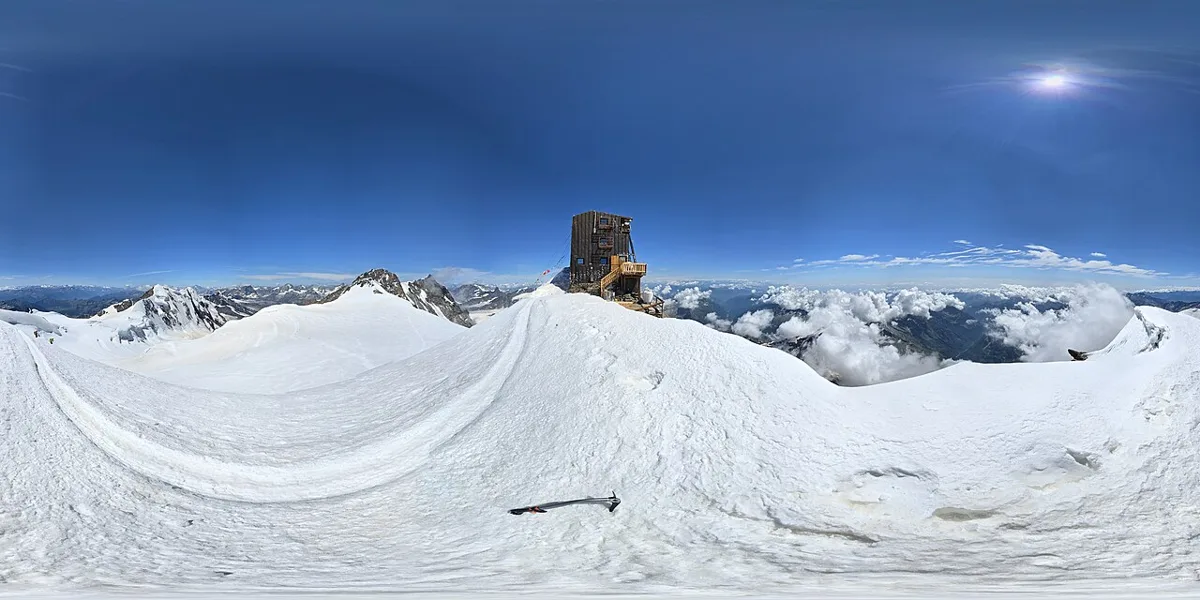
360° panorama of a snowy mountain top building. A snowy mountain landscape with a small building is shown as a flat, wrapped image.Capricorn4049 · CC BY-SA 4.0 · via Wikimedia CommonsView source ↗
Prompt
Apply a 360° Panorama effect as a flattened equirectangular-style projection, with a level central horizon, widened peripheral space, and progressively stretched shapes near the top and bottom poles. Suggest seamless panoramic stitching and consistent lighting, keeping the main subject minimally distorted near its original position. Keep the original subject and composition.
You see afully [interactive sphere of vision]wrapped around acentral viewing point. When viewed flat, it looks heavily distorted at the top and bottom poles.
Principle
Software stitches multiple wide-angle photographs together into an [equirectangular projection1]. This flat map [maps spherical coordinates]to arectangular grid.
Example
Chris Milk: Clouds Over Sidra, 2015.
Try it out
Open aflat equirectangular image and notice how straight lines curve dramatically near the top and bottom edges.
Background
Creating full spherical panoramas once required complex rigs and tedious manual stitching. In the 2010s, consumer cameras with dual fisheye lenses2made instant 360-degree capture accessible. These devices record overlapping ultra-wide fields of view. Built-in processors instantly merge the edges to form an unbroken sphere. The final file is typically saved as an equirectangular projection. This standard format stretches the top and bottom regions severely to fit a 2:1 rectangle. Dedicated software or web players then wrap this flat image onto avirtual sphere around the viewer's perspective. You can then look in any direction.
Distinction
Unlike atraditional cylindrical panorama, a 360° spherical panorama includes the zenith and nadir. This means you can look straight up and straight down.
Aftermath
It reveals how mathematical map projections are essential for translating three-dimensional viewing space onto two-dimensional digital screens.
Further examples · 11 images
02Equirectangular projection of a vast snowy glacierA vast glacier surface stretches across the frame beneath a deep blue sky. The flattened spherical view exhibits the characteristic stretching at its upper and lower edges, typical of a 360-degree panorama.Capricorn4049 · CC BY-SA 4.0 · Wikimedia Commons03360-degree panorama of an icy glacial valleyA panoramic view displays a wide, icy glacial valley surrounded by mountain peaks. The seamless wrap-around horizon and heavily distorted foreground snow clearly show spherical coordinates mapped to a rectangular grid.Capricorn4049 · CC BY-SA 4.0 · Wikimedia Commons04Equirectangular panorama from a rocky mountain summitA rocky mountain summit is captured under a hazy sky with a bright sun halo. The extreme stretching at the zenith and nadir confirms this is a flattened 360-degree spherical photograph.Capricorn4049 · CC BY-SA 4.0 · Wikimedia Commons05360° equirectangular projection of a snowy mountain expanseA pristine snow-covered mountain expanse stretches out continuously under a clear blue sky. The distorted snow in the foreground and continuous wrap-around horizon are classic features of a stitched equirectangular panorama.Capricorn4049 · CC BY-SA 4.0 · Wikimedia Commons06360-degree panoramic view from a rocky mountain peakA rocky mountain peak featuring a cairn covered in prayer flags overlooks surrounding valleys. The distinct wrap-around perspective and warped poles make it a clear, classic example of an equirectangular panoramic image.Capricorn4049 · CC BY-SA 4.0 · Wikimedia Commons07Equirectangular mountain panorama with distorted sky contrailsA high-altitude mountainous landscape is overlaid with prominently curved contrails spanning the blue sky. The dramatic visual distortion of the contrails and foreground rocks perfectly illustrates the flattening of a spherical panorama.Capricorn4049 · CC BY-SA 4.0 · Wikimedia Commons08360° spherical panorama of a mountain summit crossA high mountain summit marked with a cross overlooks rugged glaciers and distant peaks. The severely stretched clouds and warped rocky foreground flawlessly demonstrate the equirectangular projection used for 360-degree panoramas.Capricorn4049 · CC BY-SA 4.0 · Wikimedia Commons09360-degree equirectangular mountain panoramaThis image displays a mountain range where the rocky foreground is severely stretched along the bottom edge. The distortion at the poles confirms it is a flattened equirectangular projection of a 360-degree panorama.Capricorn4049 · CC BY-SA 4.0 · Wikimedia Commons10Equirectangular panorama with polar distortionA mountainous terrain is shown with a curved lens flare in the sky and a heavily warped rocky foreground. The unnatural stretching at the top and bottom clearly identifies it as a 360-degree equirectangular panorama.Capricorn4049 · CC BY-SA 4.0 · Wikimedia Commons11Snowy 360-degree panorama with zenith distortionThe bottom edge of this snowy landscape features extreme horizontal stretching, while the sun's glare forms an unnatural arc. These distortions at the zenith and nadir are hallmark signs of a flattened 360-degree spherical panorama.Capricorn4049 · CC BY-SA 4.0 · Wikimedia Commons
Question
Why does the person holding a 360° camera often lack an arm in the final image?
Show possible answer +Hide answer −
The software stitches the overlapping images at ablind spot between the two lenses. This effectively erases the selfie stick and the hand holding it.