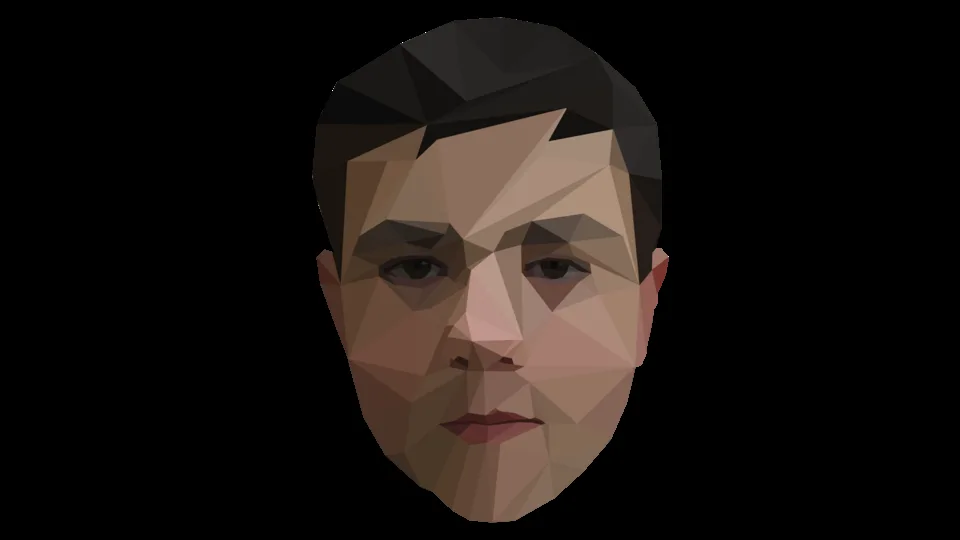
Faceted Polygon Portrait. A human face emerges from interlocking angular patches against a black background.KenClarck11 · CC BY-SA 4.0 · via Wikimedia CommonsView source ↗
Prompt
Transform this image into a Low Poly rendering built entirely from flat, interlocking polygonal facets, predominantly triangles. Replace smooth curves with angular silhouettes and convert shading into discrete color planes, using larger facets in simple areas and smaller facets around defining features. Keep the original subject and composition.
You see an image made entirely of flat, [interlocking geometric shapes], usually triangles. There are no smooth curves, only sharp angles and flat color facets.
Principle
3D modeling software renders surfaces using a[mesh of flat polygons]. Artists intentionally reduce the polygon count1and remove smooth shading2to expose this [underlying geometry].
Example
Timothy J. Reynolds: 3D Low Poly Landscapes, 2012.
Try it out
Find alow poly portrait and notice how lighting is faked using distinctly different shades on adjacent flat triangles.
Background
Early 3D video games used low polygon counts due to hardware limits. Characters looked blocky out of technical necessity. By the 2010s, hardware could render smooth, photorealistic graphics. However, artists began adopting low poly visuals as adeliberate stylistic choice. They stripped away detailed textures and smooth shading algorithms. Instead, they exposed the raw geometric mesh3beneath. This process turned a3D model into afaceted sculpture. Lighting calculates distinctly on each flat face, creating crisp shadows. It became aminimalist digital art movement. The style celebrates the basic building blocks of computer graphics rather than hiding them.
Distinction
Unlike pixel art, which uses aflat 2D grid of colored squares, low poly uses a3D spatial mesh.
Aftermath
It reveals that technical limitations from the past often evolve into cherished artistic aesthetics in the future.
Further examples · 11 images
02Low-Poly Bird on a BranchA blue-and-orange bird perches on an angular branch within a pale geometric background. Distinct flat triangles construct the bird, perch, and surrounding space, making low-poly simplification visible throughout.Elionas · CC0 · Wikimedia Commons03Yellow Faceted Rabbit Beside a PrinterA hand holds a bright yellow rabbit sculpture beside a 3D printer. Broad planar facets and sharply angular ears preserve the low-poly geometry in a physical object.Creative Tools · CC BY 2.0 · Wikimedia Commons04Handheld Low-Poly RabbitA yellow rabbit sculpture rests in an open hand, revealing angular planes across its head and body. Its visibly polygonal surface translates rounded animal anatomy into a clear low-poly form.Creative Tools · CC BY 2.0 · Wikimedia Commons05Faceted Mountain and River LandscapeAngular mountains, faceted trees, and a pale blue river form a brightly colored landscape. Broad polygon faces and sharply segmented silhouettes expose the reduced geometry of the scene.Srkrishna412 · CC BY-SA 4.0 · Wikimedia Commons06Low-Poly Green Pickup TruckA green pickup truck is shown at an angle, revealing its open bed, blocky hood, and sharply segmented wheels. Flat shading and visibly reduced geometry make the low-poly construction clear throughout the vehicle.Kurt Kaiser · CC0 · Wikimedia Commons07Low-Poly Police CarA black-and-white police car has a wedge-shaped cabin, yellow headlights, and a blocky front guard. Polygonal wheels and unblended planar surfaces make its deliberately sparse geometry unmistakable.Kurt Kaiser · CC0 · Wikimedia Commons08Faceted Robot Rear ViewA gray-and-red wheeled robot appears from behind against a black background. Its triangular head planes and angular torso visibly demonstrate low-poly modeling, although some joints and limbs retain smoother shading.Kurtkaiser · CC0 · Wikimedia Commons09Low-Poly Robot Three-Quarter ViewA wheeled robot with red bands and colored controls appears in a three-quarter view. Clearly separated facets across its head and tapered body show low-poly construction, alongside some smoother mechanical parts.Kurtkaiser · CC0 · Wikimedia Commons10Faceted Robot in ProfileA gray robot with red accents stands in profile above a single visible wheel. Angular head facets and broad body planes expose simplified polygonal geometry, while the arm and joints appear more smoothly shaded.Kurtkaiser · CC0 · Wikimedia Commons11Green Polygonal Car in ProfileA green car appears in profile with angular windows, polygonal tires, and flat gray wheel spokes. Its simplified construction replaces rounded automotive forms with straight edges and broad planar surfaces.Kurt Kaiser · CC0 · Wikimedia Commons
Question
Why do low poly images usually rely on triangles instead of squares or hexagons?
Show possible answer +Hide answer −
Atriangle is the simplest possible polygon in 3D geometry. Its three points always form aperfectly flat surface, which makes mathematical calculations fast and stable.