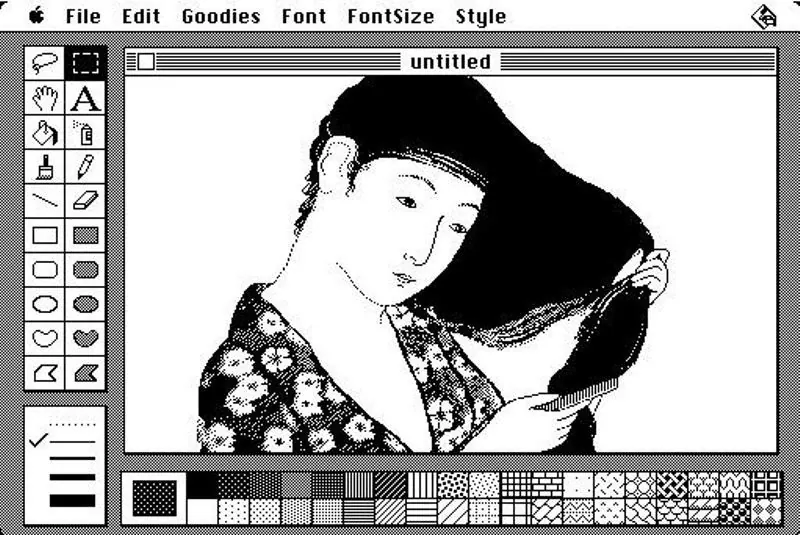
1-bit dithering. Older algorithms. Personal computer look with MacPaint from 1984 onwards.
Typeface · Press Start 2P
MacPaint, 1984: Susan Kare's 1-bit bitmap based on a Japanese template.Apple / Susan Kare; Image: Computer History Museum. Copyright protected; Source image courtesy of the Computer History MuseumView source ↗
Prompt
Apply a 1-bit dithering effect using only pure black and pure white pixels. Translate shadows and gradients into tightly distributed error-diffusion dot patterns, with denser black clusters in darker regions, crisp pixel-stepped edges, and no actual gray, color, blur, or transparency. Keep the original subject and composition.
A[black and white dot pattern]merges from adistance into apparent shades of gray and soft gradients.
Principle
Limited colors are spatially distributed to [approximate intermediate tones]. [Error diffusion1passes rounding errors]to neighboring pixels.
Example
Bill Atkinson's MacPaint for the Macintosh (1984) shaped monochrome2computer graphics.
Try it out
Convert agradient to threshold black and white and dithering. Compare the gradations and dot structure.
Background
Algorithmic prehistory before 1980; iconic personal computer look with MacPaint (1984).
Intermediate tones are approximated by the spatial distribution of lighter and darker pixels. In error diffusion, the quantization error of one pixel is passed on to neighboring pixels.
Bill Atkinson's MacPaint for the first Macintosh (1984); dithering is also discussed in the preserved developer oral history.
Image: Historical original / source image. Black and white pixel and pattern areas simulate grayscale, textures and shading with only two tonal values.
Distinction
Pixelation reduces the resolution; dithering distributes alimited number of colors for tonal simulation. Both can be combined. Do not confuse this with the invention of the halftone screen in printing and photography. This refers to digital tonal simulation with alimited number of colors.
Aftermath
The technical limitation to afew colors became adistinct graphic aesthetic: home computers, early desktop publishing, and later retro graphics.
Further examples · 8 images
02Dithering algorithmsThis comparison shows an original grayscale image alongside three 1-bit dithering methods. It demonstrates how ordered dithering and error diffusion algorithms like Floyd-Steinberg use black and white dots to simulate continuous tones.DemonDeLuxe (Dominique Toussaint) · CC BY-SA 3.0 · Wikimedia Commons03Passfoto-Rasterung 1994, 1A portrait rendered using only black and white pixels. The spatial arrangement of dots creates the illusion of a continuous grayscale image through error diffusion, a defining characteristic of 1-bit dithering.Renardo la vulpo · CC0 · Wikimedia Commons041-Bit Dithering, applied to “Tor-Arne Moen Natural selection”A man stands before a large painting of several figures. The monochrome dot pattern varies in density to suggest depth and shadow through spatial distribution.Painting: Tor-Arne Moen; photo: Tor-Arne Moen (photo); processed for the Atlas · CC BY-SA 3.0 · Wikimedia Commons051-Bit Dithering, applied to “Mozambique - traditional sailboat”A small boat with a sail occupies the center of a body of water. Fine black and white stippling approximates the gray tones of the ripples.Steve Evans from Bangalore, India (photo); processed for the Atlas · CC BY 2.0 · Wikimedia Commons061-Bit Dithering, applied to “Campamento de ganado de la tribu Mundari, Terekeka, Sudán del Sur, 2024-01-28, D”A person stands near a body of water with distant trees. Dithered pixels create a soft gradient in the sky and define the silhouette against the light.Diego Delso (photo); processed for the Atlas · CC BY-SA 4.0 · Wikimedia Commons071-Bit Dithering, applied to “Kartause Gaming Laterne 01”An ornamental lantern and a nearby object are set against a white background. Error diffusion creates textured gray values to provide a sense of volume.Uoaei1 (photo); processed for the Atlas · CC BY-SA 4.0 · Wikimedia Commons081-Bit Dithering, applied to “Plastic Protractor Polarized 05375”A plastic protractor shows numerical markings and light refractions. The 1-bit dithering translates smooth highlights and dark shadows into a high-contrast dot matrix.Nevit Dilmen (photo); processed for the Atlas · CC BY-SA 3.0 · Wikimedia Commons