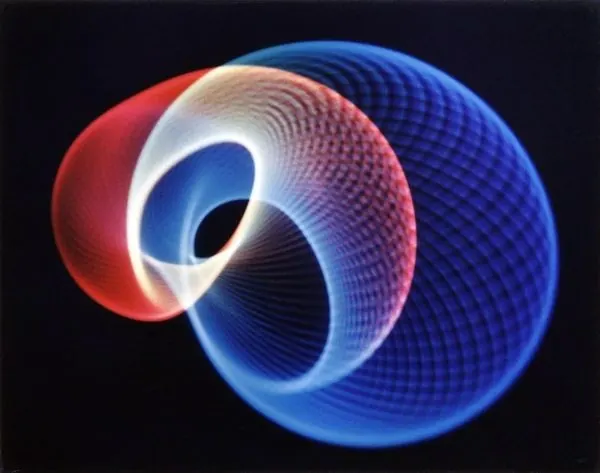
Oscilloscope art / Lissajous figures. Ben Laposky's Oscillons, circa 1952.
Typeface · Audiowide
Ben Laposky: Oscillon 4, around 1952. Museum reproduction.Ben Laposky; Courtesy of the Sanford Museum / Computer History Museum.View source ↗
Prompt
Transform this image into Oscilloscope Art, rebuilding visible forms from luminous green phosphor traces against a near-black field. Use looping contours, intertwined waveforms, bright intersections, fine scan jitter, and soft persistence trails. Suggest interior shading through denser overlapping lines rather than solid fills. Keep the original subject and composition.
Ben Laposky photographed moving patterns on an oscilloscope screen and called the electronic compositions Oscillons. The Computer History Museum dates Oscillon 4 to approximately 1952 and cites the Sanford Museum as the source of the image. Early electronic imagery was thus made collectible and exhibitable through long-term photographic recording. Here, the decade refers to adocumented example of art, not to the invention of mathematical curves.
Distinction
Lissajous curves are older than electronic displays. Not every oscilloscope artwork is asimple Lissajous figure; complex signals produce more complex shapes.
Aftermath
Sound and image can be two versions of the same signal.
Further examples · 7 images
02Collection Charles Cros. Caméras film (média : image animée). Caméras pour oscilloscope type 6 - Telec. Caméra Telec pour oscilloscope de l' (1)The back of the camera shows a flat mounting surface and the side of the funnel. Such devices turned mathematical frequency ratios into visible, exhibitable media.Telec. Concepteur · Public domain · Wikimedia Commons03Collection Charles Cros. Caméras film (média : image animée). Caméras pour oscilloscope type 6 - Telec. Caméra Telec pour oscilloscope de l' (2)A close-up view looks directly through the wide cone towards the lens. This interface allowed the camera to document moving patterns on an oscilloscope screen as still compositions.Telec. Concepteur · Public domain · Wikimedia Commons04Collection Charles Cros. Caméras film (média : image animée). Caméras pour oscilloscope type 6 - Telec. Caméra Telec pour oscilloscope de l' (3)The camera is shown at an angle, highlighting its industrial build and cone attachment. This tool provided the mechanical means to transform electronic oscillations into historical visual art.Telec. Concepteur · Public domain · Wikimedia Commons05Collection Charles Cros. Caméras film (média : image animée). Caméras pour oscilloscope type 6 - Telec. Caméra Telec pour oscilloscope de l' (4)This head-on shot emphasizes the circular opening meant for an oscilloscope screen. It illustrates the technical process behind creating Oscillons through precise long-exposure photography.Telec. Concepteur · Public domain · Wikimedia Commons06Lissajous-Figur 1 zu 3 (Oszilloskop)A green luminous curve on an oscilloscope screen showing a 1 to 3 frequency ratio. The image demonstrates the characteristic glow and geometric precision of electronic wave patterns.Unknown · CC BY-SA 3.0 · Wikimedia Commons07Lissajous figureComplex intertwined loops of light displayed on a vintage Heathkit oscilloscope. The long exposure captures the shifting electronic oscillations as a static, collectible image similar to Laposky's Oscillons.Greg Francke · CC BY-SA 4.0 · Wikimedia Commons
Question
What changes if you only change the phase shift of two sine waves at the same frequency?
Show possible answer +Hide answer −
With asuitable amplitude, the line, ellipse, and circle change; the frequency remains the same, but the relative temporal position changes.