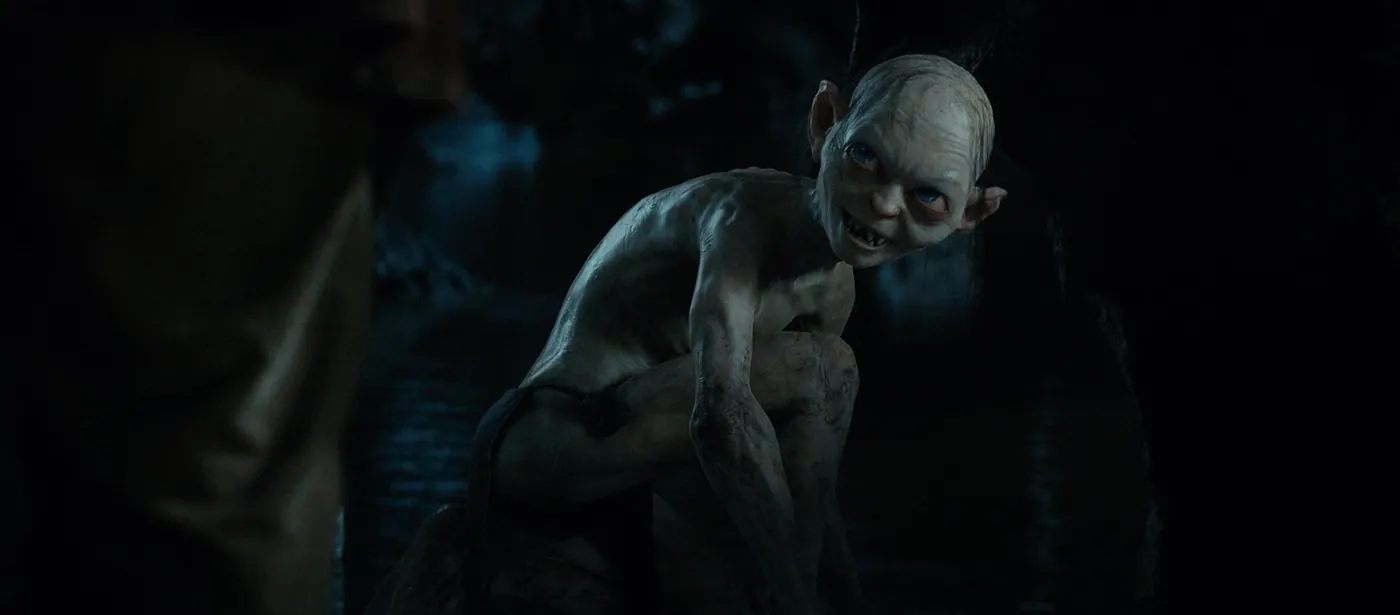
Apply a motion capture visualization effect, rendering the subject as a smooth shaded digital double with small luminous tracking markers at visible articulation points and thin skeletal rig connections. Preserve natural posture, silhouette, and subtle asymmetries, with restrained wireframe accents and cool studio lighting. Keep the original subject and composition.
Compare the performance and the finished animation of agesture.
Background
Wētā made significant progress in motion capture and character animation for Gollum. In later Hobbit productions, Andy Serkis and Martin Freeman were captured on set. Animators translated the performance into the digital character and augmented it with their work. The 2000s mark the widespread public visibility of such characters, while measurement techniques and digital motion research are considerably older.
Distinction
Motion capture does not produce afinished figure. Retargeting, correction, animation, anatomy, and rendering remain essential; not every visible facial expression originates directly from captured data.
Aftermath
Abelievable digital body combines performance, measurement, and animation.
Further examples · 10 images
02Two repetitions of a walking sequence of an individual recorded using a motion-capture systemA wireframe digital skeleton replicates a walking gait. It demonstrates how motion capture transfers spatial coordinate data from a human subject into a functional digital rig for animation.Lars Lau Raket · CC BY-SA 4.0 · Wikimedia Commons03MotionCaptureA performer wearing a suit with reflective markers walks in a studio while a monitor displays the live data. This shows the simultaneous capture of physical movement and its digital translation.T-tus at English Wikipedia · CC BY-SA 3.0 · Wikimedia Commons042010 Motion Capture SuitA black bodysuit fitted with small spherical tracking markers is displayed on a mannequin. These markers serve as the measurement points for cameras to track joint rotations and limb positioning.Mbrickn · CC0 · Wikimedia Commons05Body Motion CaptureA computer monitor shows two digital skeletons mirroring the actions of performers in a green-screen space. It illustrates the real-time processing of multiple actors into a virtual environment.Raíssa Ruschel · CC BY 2.0 · Wikimedia Commons06Motion capture facialA close-up view shows a face covered in small white dots. These markers allow for the recording of subtle muscle movements, which are essential for creating realistic facial expressions in digital characters.Mounirzok · CC BY-SA 3.0 · Wikimedia Commons07Estudio de Motion Capture en FuncomAn actor in a tracking suit performs a dynamic sword-swinging motion at Funcom studio. This captures the speed and arc of complex combat actions for use in video game character animation.Jesusbella · CC BY-SA 4.0 · Wikimedia Commons08Motion Capture with Chad PhantomA three-part image compares an actor in a suit, a digital skeleton, and a rendered human model. It documents the complete pipeline from recording physical performance to the final digital asset.Vazquez88 · CC BY-SA 3.0 · Wikimedia Commons09The Last of Us Part II motion capture 1Actors and technical crew work in a large studio volume equipped with numerous tracking cameras and monitors. This represents a modern performance capture environment used for high-fidelity narrative games.Sam White · CC BY-SA 4.0 · Wikimedia Commons10The Last of Us Part II motion capture 3Performers use foam props to simulate physical interactions within a motion capture stage. These props provide tactile feedback for the actors while their precise movements are recorded by the overhead sensor array.Sam White · CC BY-SA 4.0 · Wikimedia Commons
Question
What does retargeting mean?
Show possible answer +Hide answer −
The transfer of captured movements to the differently proportioned digital skeleton of afigure.