Mirror repeat / mirrored tiling. 2000s: established filter and texture work
Typeface · Righteous
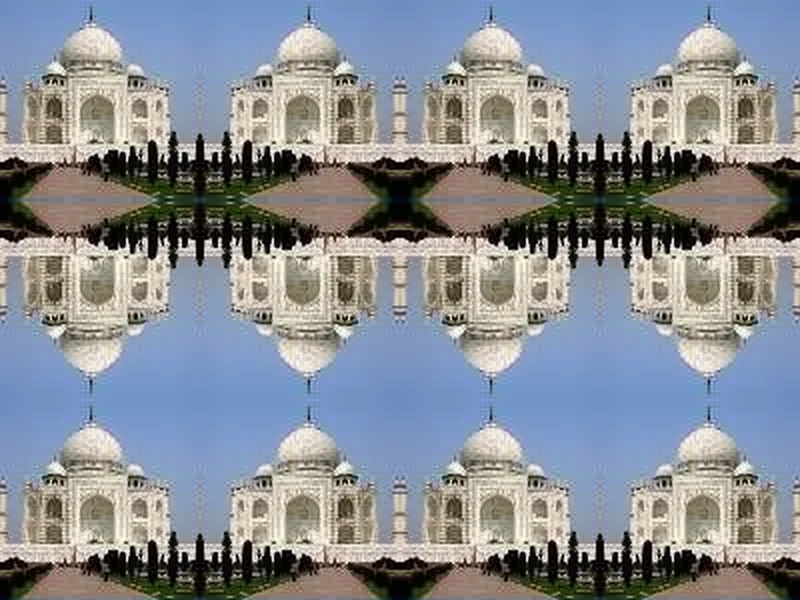
A tile repeated with alternating horizontal and vertical mirroring.Tile from the GIMP Documentation Team, GNU Free Documentation License · mirrored for the AtlasView source ↗
Prompt
Apply a mirror repeat effect in secondary background areas, arranging reduced image fragments into a precise grid with alternating horizontal and vertical reflections. Create crisp tile seams, symmetrical edge junctions, and rhythmic repeated colors while leaving the main subject unduplicated and unobscured. Keep the original subject and composition.
[Image copies repeat themselves]in the grid, sometimes [mirrored against each other].
Principle
Tiles1are reduced in size, offset, and [mirrored along changing axes2].
Example
Textile patterns, woven backgrounds and motion graphics surfaces.
Try it out
Build afour-tile grid; mirror only every second tile.
Background
Rectangular repetition and mirroring is an older ornamental method. The digital reference point for this slide is the GIMP documentation: The Small Tiles page was revised as early as 2005 and describes image repetition as well as horizontal or vertical mirroring of selected tiles. This dates an available implementation and not the origin of the symmetry. In contrast to the kaleidoscope, arectangular field is primarily created here, not aradial segmented circle. The illustration shows the basic repetition; mirroring is an additional option. The exercise with four tiles helps to read transitions precisely. Pay attention to whether motif edges meet appropriately or suddenly form double faces and unintended symmetrical figures.
Distinction
Seamless tiling and mirror repetition are different ways to connect image edges.
Aftermath
This technique is suitable for the desired jersey and textile patterns. Ausable repeat and the desired direction of repetition are crucial.
Further examples · 7 images
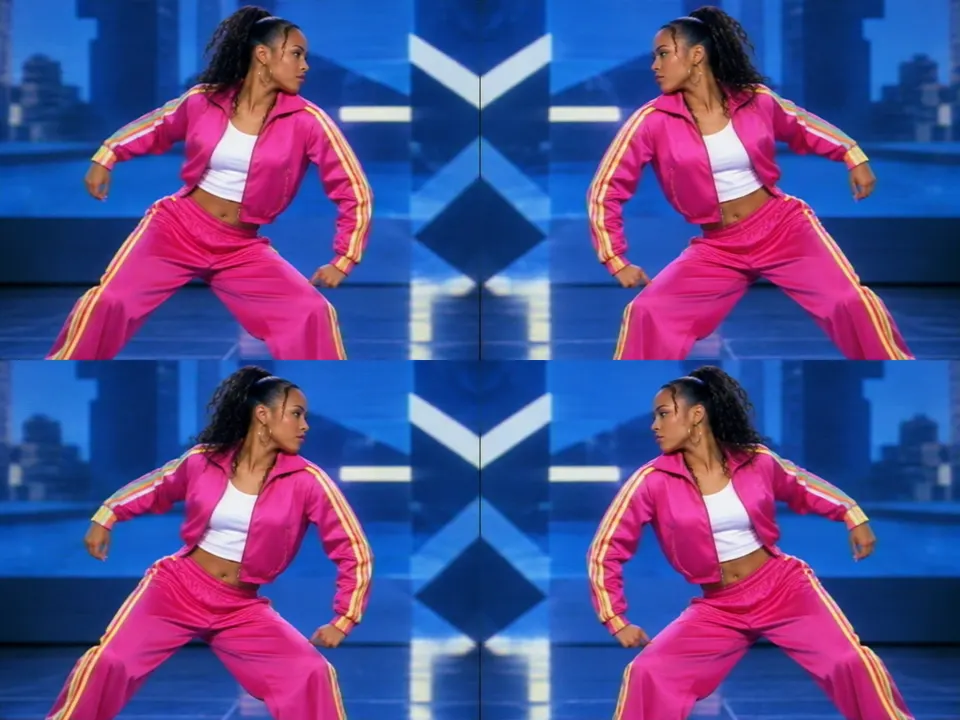
02Circle Packing of Planar Tiling with all 14 Planigons Semiplanigons (Uniform 92 Tiling)This pattern displays a grid of repeating circle packings. The layout employs mirroring along horizontal and vertical axes, characteristic of digital ornamental filters and textile motion graphics surfaces.Harry Princeton · CC BY-SA 4.0 · Wikimedia Commons03Mirror Repeat, applied to “Kop-hals-rompboerderij (Tjepma state) Overijsselsestraatweg 22, Reduzum. 23-03-2”The farmhouse is repeated in a four-tile grid. It shows horizontal mirroring in the top row and vertical mirroring in the bottom row, creating a symmetrical rhombal pattern in the center.Agnes Monkelbaan (photo); processed for the Atlas · CC BY-SA 4.0 · Wikimedia Commons04Mirror Repeat, applied to “S-charl, Clemgia zijrivier van de Inn. 12-10-2024. (d.j.b) 03”A mountain stream is tiled four times. The top-right tile is flipped horizontally, while both bottom tiles are flipped vertically, resulting in a seamless, kaleidoscopic riverbed center.Dominicus Johannes Bergsma (photo); processed for the Atlas · CC BY-SA 4.0 · Wikimedia Commons05Mirror Repeat, applied to “Bloeiwijze van een Kruisdistel (Eryngium). 21-07-2023. (actm.) 01”This thistle flower is arranged in a rectangular grid. Mirroring occurs across the vertical central axis and the horizontal central axis, connecting the stems to form a single ornamental structure.Agnes Monkelbaan (photo); processed for the Atlas · CC BY-SA 4.0 · Wikimedia Commons06AI illustration: A four-tile grid displays a portrait where every second column is horizonA four-tile grid displays a portrait where every second column is horizontally mirrored. This demonstrates the basic rectangular repetition and axial symmetry described in the GIMP Small Tiles documentation.Illustration generated for the Atlas (AI)07AI illustration: Four tiles show a dancer with horizontal mirroring applied to the second Four tiles show a dancer with horizontal mirroring applied to the second tile in each row. The composition creates a symmetrical ornamental pattern through simple rectangular repetition.Illustration generated for the Atlas (AI)
Question
How does Mirror Repeat differ from simply repeating the same photo?
Show possible answer +Hide answer −
Some of the copies are additionally mirrored; this changes the transitions and axes of symmetry between the tiles.