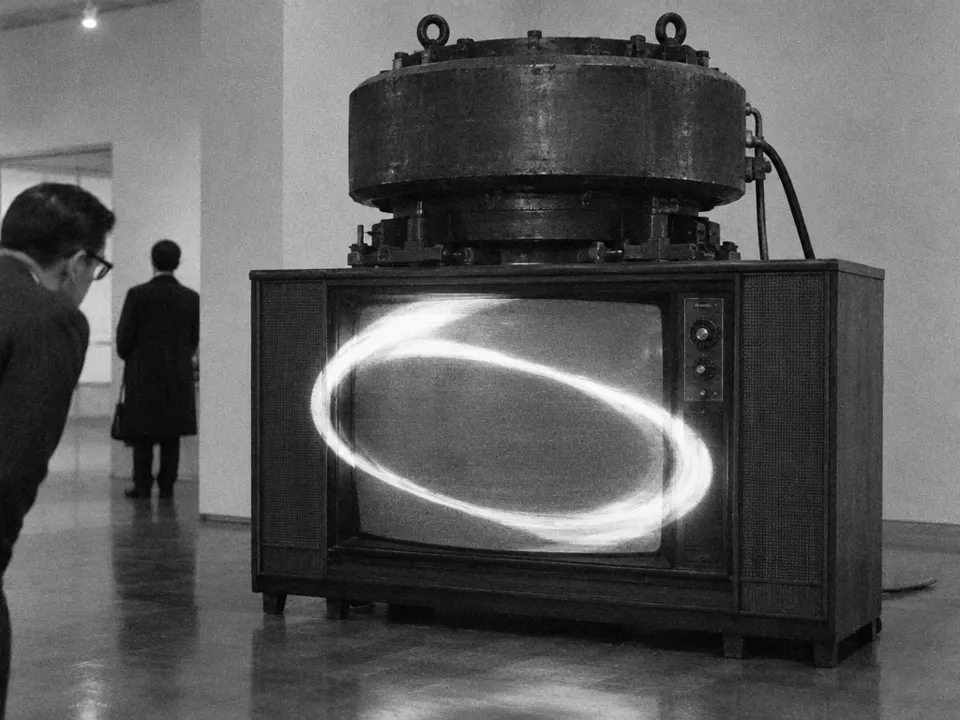
Magnetic CRT Distortion
Magnetic CRT distortion. 1960s: Television images become material for media art.
Prompt
Apply Magnetic CRT Distortion with bending scanlines, localized luminous waves, and warped contours that curl around invisible magnetic centers. Add green-magenta color separation, uneven phosphor brightness, soft screen glow, and dark gaps between raster lines, keeping distortion restrained around identifying features. Keep the original subject and composition.
Identify
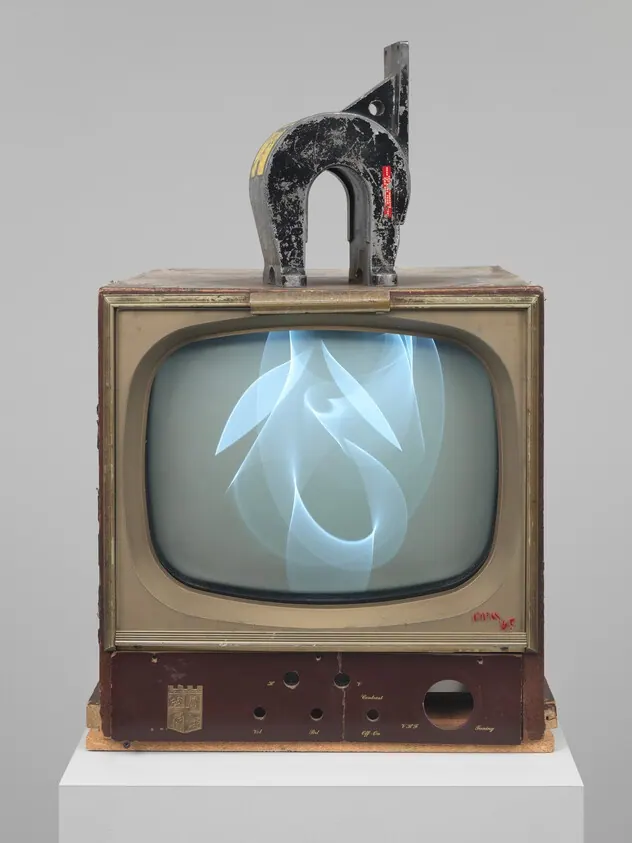
The television image bends into luminous loops and waves.
Principle
A strong magnet alters the electron deflection1 in a cathode-ray tube2 television. This distorts the projected image into abstract lines.
Example
Nam June Paik: Magnet TV, 1965.
Try it out
Compare a stable housing and a distorted image. Describe where a recognizable light source ends and an independent, abstract light form begins.
Background
Nam June Paik's prepared television sets in the early 1960s; Magnet TV in 1965. 1960s: The television image becomes material for media art. This is not a recursive camera-monitor-video feedback loop. The feedback in the museum text refers to direct interaction. Do not hold magnets against modern devices.
recognize: A screen image bends into luminous loops and waves. Mechanism: A strong magnet alters the electron deflection in the cathode-ray tube television. The projected image becomes distorted, abstract lines. example: Nam June Paik: Magnet TV, 1965. Practice: Compare the television's form factor to the image: The casing remains stable, while only the signal image is distorted. Describe how a recognizable broadcast becomes abstract light. Where, then, is the boundary between the displayed content and the pure image signal?
A strong magnet alters the electron deflection in a cathode-ray tube television. The projected image becomes distorted, abstract lines. A screen image bends into luminous loops and waves. Compare the shape of the television to the image: The casing remains stable, while only the signal image deforms. This is not a recursive camera-monitor video feedback loop. The feedback mentioned in the museum text refers to direct interaction. Do not hold magnets against modern devices.
Distinction
This is not a recursive camera-monitor video feedback loop. The feedback in the museum text refers to direct interaction. Do not hold magnets against modern devices.
Aftermath
Important prehistory of artistic signal disruption and later glitch aesthetics.
Further examples · 7 images