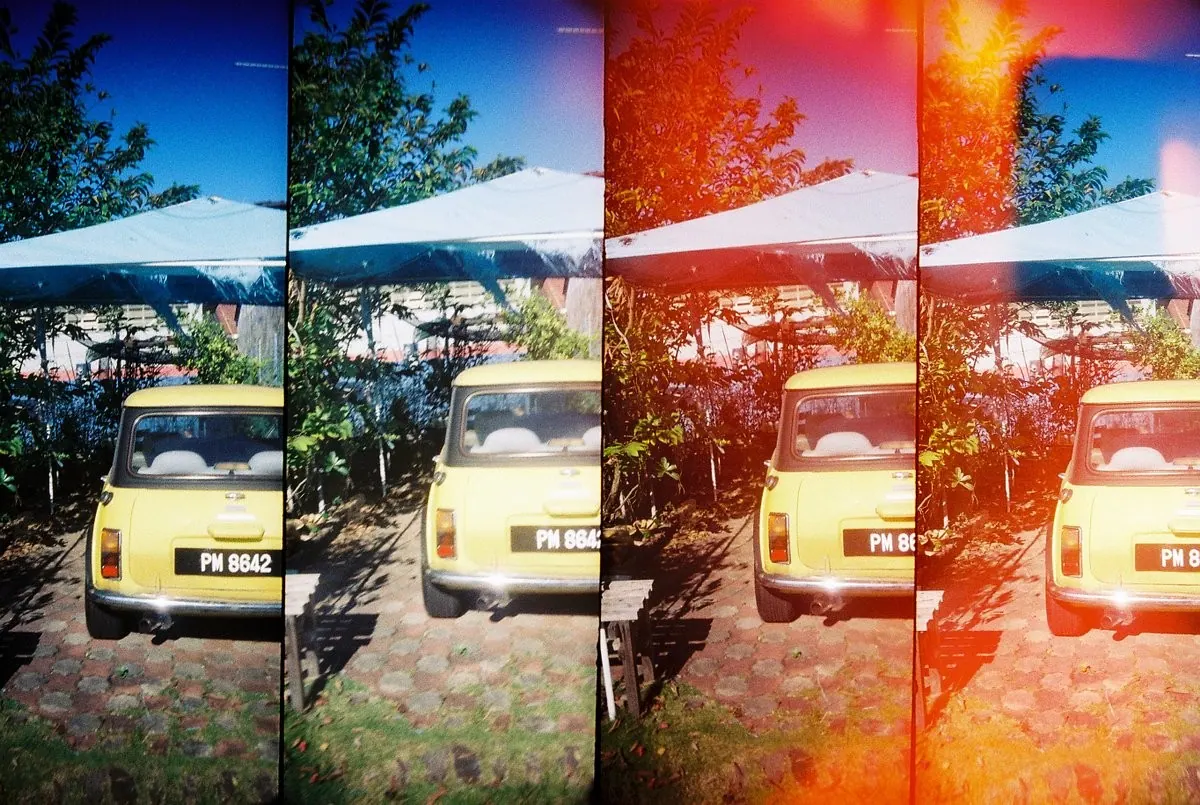
Light leaks. 1990s Lomography; 2010 digital retro filters
Typeface · Quicksand
Lomography: deliberate analog light incidence. Contemporary experiment.Lomography / Community Photography; Credits on source pageView source ↗
Prompt
Apply a Light Leaks effect with irregular translucent red, orange, and pale yellow veils entering from the image edges. Include softly feathered streaks, locally washed-out contrast, and occasional overexposed borders, blending the accidental exposure into fine film grain without masking key features. Keep the original subject and composition.
[Colored veils or light bands]move [from the edge]into the picture.
Principle
[Unwanted light further exposes the film].
Example
Analog light incidence from aLomography experiment.
Try it out
Place afaint veil of light at abelievable edge of the image.
Background
Light leakage occurs, for example, at leaky camera seals1or during loading and unloading. The additional exposure2overlays the actual subject. Experimental analog photography later consciously embraced such traces as chance and material signals. Digital retrofilters made the effect reproducible. The artistic use thus differs from the original technical goal of reliably protecting the film from extraneous light.
Distinction
Atrue light leak can ruin images and is not precisely controllable. For this exercise, adigital simulation is sufficient. Bright color gradients can also be artistic overlays and do not indicate acamera defect.
Aftermath
Aflaw at the edge can make the entire image readable as analog material.
Further examples · 10 images
02Sailboats in the ocean with light leaks (12418268115)The image captures sailboats on the ocean under a cloudy sky. Large, diffused white veils of light overlay the center and right side, demonstrating how accidental light entry masks the scene.simpleinsomnia · CC BY 2.0 · Wikimedia Commons03Light leak - Brandanschlag solingen 1993A crowd gathers in front of a damaged building in Solingen. A soft red glow enters from the left edge, showing how unintended exposure can colorize a documentary photograph.Sir James · CC BY-SA 2.0 de · Wikimedia Commons04Light leakThis frame is mostly dark with a vibrant red light streak on the left margin. It provides a clear example of light entering through a leaky camera seal at the film's edge.dudeman · CC BY-SA 3.0 · Wikimedia Commons05Light leak 2A landscape with water and trees is seen through several vertical orange and red light bands. These streaks represent the experimental aesthetic of Lomography, where light traces become part of the composition.Sgroey · CC BY-SA 4.0 · Wikimedia Commons06Leaking Light (15659220679)The photo shows a metal fence against a city skyline with a magenta and yellow color shift. This tinting across the image plane illustrates a uniform light leak overlaying the main subject.Phil Dolby · CC BY 2.0 · Wikimedia Commons07Light leak 1Flags are shown against a blue sky, partially hidden by intense vertical light glares. The bright yellow columns demonstrate how extraneous light can create abstract shapes on the film surface.Sgroey · CC BY-SA 4.0 · Wikimedia Commons08I swear it's the last one - Flickr - hnt6581A vertical orange-toned veil of light extends from the top edge, partially obscuring the plant silhouettes. It shows how extraneous light incidence overlays the subject in analog photography.hnt6581 · CC BY 2.0 · Wikimedia Commons09Hải Vân, 6-2015 - Flickr - Khánh HmoongA broad, bright white vertical band appears on the right side of the landscape. This demonstrates a severe light leak, likely from a faulty camera seal or during film handling.Khánh Hmoong from Nha Trang, Vietnam · CC BY 2.0 · Wikimedia Commons10Habitat 67 Montreal Black and WhiteA white vertical flare is visible on the left side of the architectural subject. The overexposure illustrates typical light infiltration from the edge of the film frame.Maela Ohana · CC BY-SA 4.0 · Wikimedia Commons
Question
Where must light enter: necessarily through the lens?
Show possible answer +Hide answer −
No. Leaks or open film handling can expose the film outside the intended light path.