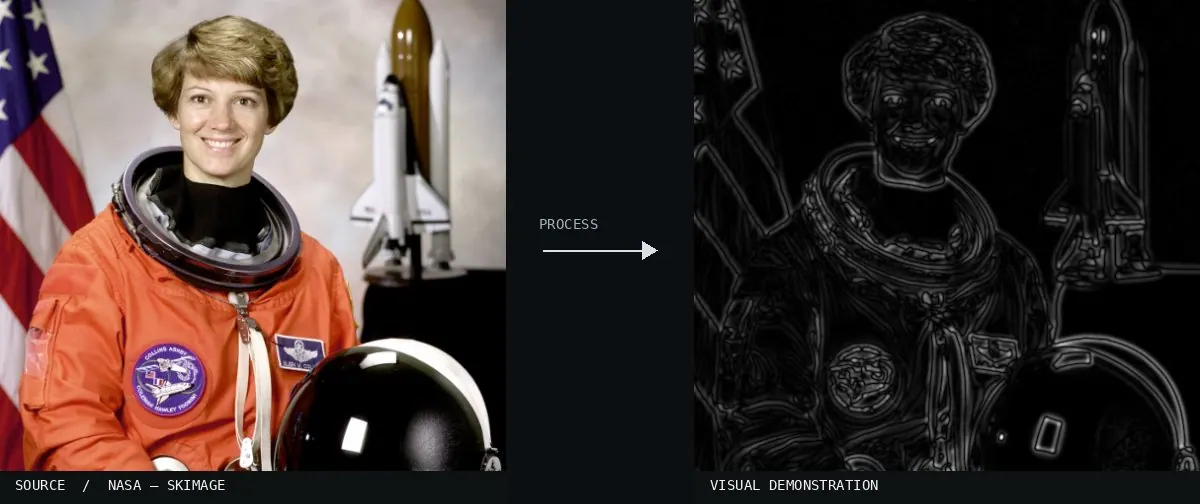
Real-world algorithm demonstration, applied to a NASA portrait.Image: NASA / Eileen Collins · scikit-image (public domain)View source ↗
Prompt
Apply Laplacian of Gaussian, smoothing fine noise before rendering structural boundaries as controlled light-dark paired contours against neutral gray. Emphasize clean curves and major transitions, with softly rounded edge profiles and minimal speckling. Suppress tiny surface texture while retaining recognizable forms. Keep the original subject and composition.
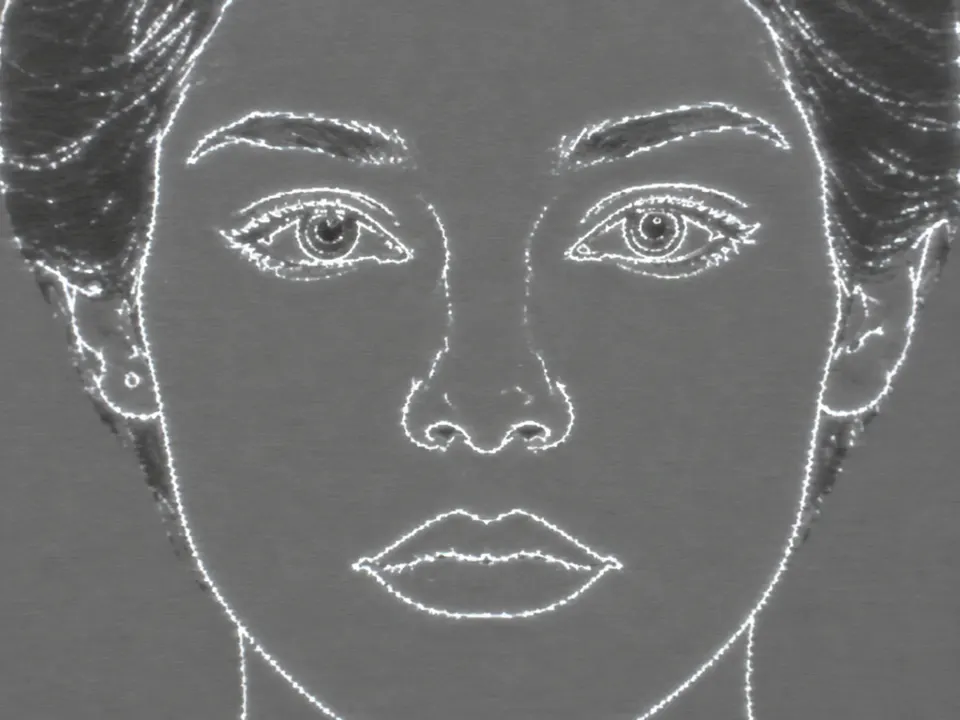
02LaplaceGaussFkt2DA wireframe plot displays the Laplacian of a 2D Gaussian function. The central peak and surrounding valley illustrate the spatial weights used to compute zero-crossings for edge detection.Uwwo · Copyrighted free use · Wikimedia Commons03DOG vs MHFGraphs compare the Difference of Gaussians (DoG) with the Mexican Hat Function. It demonstrates how subtracting two Gaussians approximates the Laplacian of Gaussian operator for efficient edge detection.File:DOG vs MHF.png by JustinWick · Public domain · Wikimedia Commons04Laplacian of Gaussian, applied to “07-17-2012 - Emborio - Emporio - Santorini - Greece - 11”A narrow street in Santorini shows structural edges through three increasing Gaussian radii. The triptych demonstrates transition from sharp edge detection to broad, contoured outlines as the blur radius expands.Norbert Nagel (photo); processed for the Atlas · CC BY-SA 3.0 · Wikimedia Commons05Laplacian of Gaussian, applied to “Sydney Opera House and Harbour Bridge Dusk (3) 2019-06-21”The Sydney Opera House and Harbour Bridge appear as edge-only structures against a dark background. Successive panels show the second derivative highlights thickening and becoming more abstract as the smoothing factor increases.Benh LIEU SONG (Flickr) (photo); processed for the Atlas · CC BY-SA 4.0 · Wikimedia Commons06Laplacian of Gaussian, applied to “Монастир над Латорицею - 2”Trees and a monastery are processed to reveal intensity transitions rather than surfaces. The result illustrates how Laplacian of Gaussian isolates contours, with higher radii eventually reducing the scene to interference-like patterns.Moahim (photo); processed for the Atlas · CC BY-SA 4.0 · Wikimedia Commons07AI illustration: A human face is shown with thin white outlines on a gray fieldA human face is shown with thin white outlines on a gray field. The image displays the zero-crossing result of a second-derivative operator applied to a blurred original.Illustration generated for the Atlas (AI)