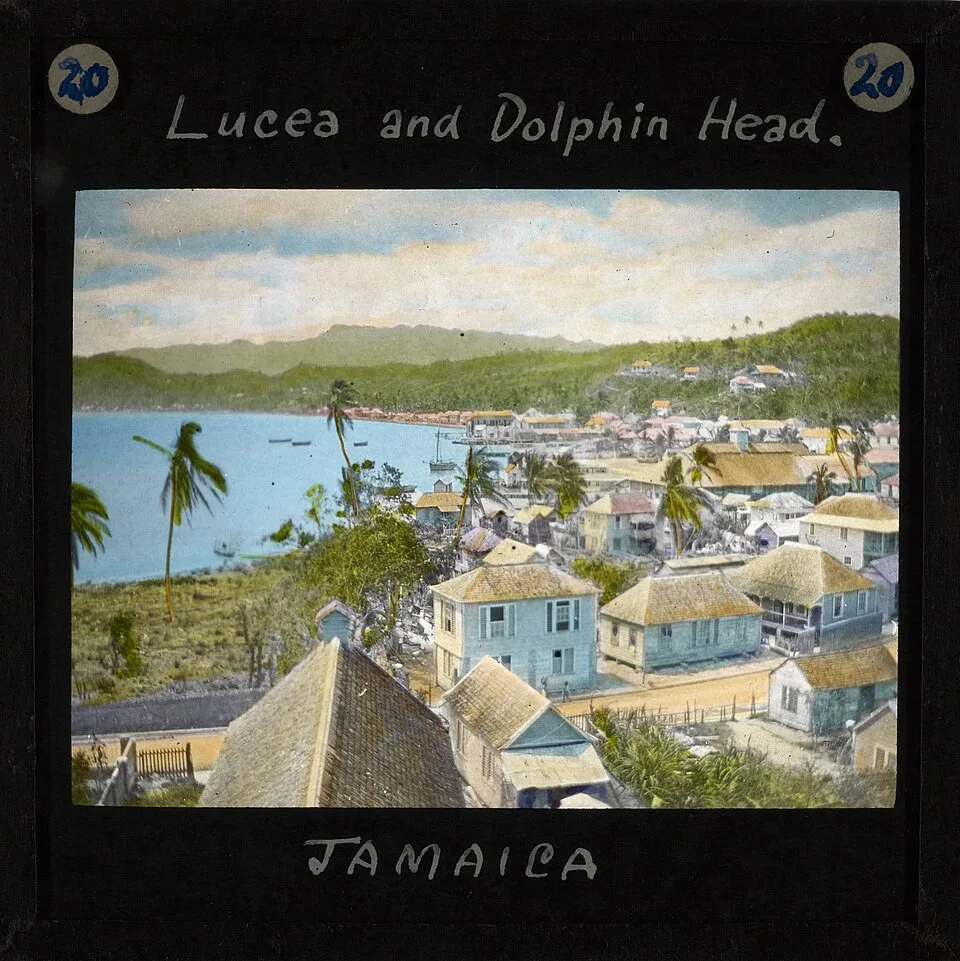
Hand-Coloured Lantern Slide of Lucea. A hand-coloured coastal view appears within a black slide mount inscribed “Lucea and Dolphin Head” and “Jamaica.” The coloured photographic positive exemplifies the luminous imagery carried by glass lantern slides.Unknown authorUnknown author · Public domain · via Wikimedia CommonsView source ↗
Prompt
Transform this image into a Lantern Slide with a luminous photographic positive on transparent glass, delicate hand-painted crimson, amber, and blue washes, and deep translucent shadows. Add a narrow dark slide border, tiny glass dust specks, and gentle projected-light falloff. Keep the original subject and composition.
You see a[transparent glass rectangle]showing apositive image1. The image is often delicately hand-painted with vivid, translucent colours.
Principle
Light shines through adeveloped [photographic emulsion2]on glass. Alens then projects this bright, [enlarged positive image]onto ascreen.
Example
William and Frederick Langenheim: Hyalotype slides of American scenery, 1850.
Try it out
Hold apiece of coloured transparent plastic up to abright flashlight in adark room to project its colours.
Background
Magic lanterns existed long before photography, using fully hand-painted slides. In 1850, the Langenheim brothers invented the hyalotype3. This allowed real photographic images to be printed on transparent glass. Photographic emulsions coated the glass plate, capturing fine details when exposed to anegative. After development, artists carefully tinted the black-and-white positive with translucent paints. An oil or limelight lantern then projected the glass slide. This created amassive, luminous image for large audiences in darkened rooms. These shows became incredibly popular for public education and evening entertainment.
Distinction
Unlike adaguerreotype, which is aunique opaque image viewed directly, alantern slide is transparent and meant for projection.
Aftermath
It demonstrates how combining photographic images with light projection paved the way for modern cinema.
Further examples · 11 images
02Lantern Slides on an Illuminated TableRows of mounted glass images glow on an illuminated viewing table. Light passing through their positive images directly demonstrates the transparency central to lantern-slide projection.Grings1 · CC BY-SA 4.0 · Wikimedia Commons03Industrial Workshop Photographic Lantern SlideA monochrome photograph of a large industrial workshop fills a black-bordered slide with a Tangyes label. The photographic positive in its glass-slide format is a clear example of imagery prepared for lantern projection.Unknown authorUnknown author · Public domain · Wikimedia Commons04Stationary Engine Photographic Lantern SlideA black-bordered glass slide contains a monochrome positive photograph of a stationary engine, labeled “Tangyes, Birmingham.” The transparent photographic image and opaque projection mask clearly display the lantern-slide medium.Unknown authorUnknown author · Public domain · Wikimedia Commons05Industrial Machinery Lantern SlideA mounted photographic slide shows industrial machinery within a rounded rectangular opening and bears a “Tangyes, Birmingham” label. Its positive image, black masking, and bound glass format identify a lantern slide prepared for projection.Unknown authorUnknown author · Public domain · Wikimedia Commons06Full Moon Photographic Lantern SlideA circular photograph of the full moon fills a square, glass-mounted slide bearing a lantern-slide photographer’s imprint. The lunar positive and surviving glass-slide presentation clearly exemplify photographic imagery prepared for lantern projection.Clement Lindley Wragge · Public domain · Wikimedia Commons07Giant Flea Comic Lantern SlideA circular transparent picture in a wooden mount depicts an enormous flea confronting a seated man. The luminous colored image within its wooden slide holder demonstrates the illustrated glass medium used in magic-lantern projection.Published by W. & F. Langenheim · Public domain · Wikimedia Commons08Salute for Three Advertising Lantern SlideA hand holds a black-bordered glass transparency advertising “Salute for Three,” with bright turquoise, yellow, and red areas illuminated from behind. Transmitted light visibly reveals the colored positive image, making this a clear example of a cinema advertising lantern slide.Paramount Pictures · Public domain · Wikimedia Commons09Lantern Slides and Storage BoxesSmall photographic slides in pink and black mounts lie beside worn, labeled storage boxes. The mounted positive images are examples of glass lantern slides prepared for illuminated projection.Service intercommunal d'archivage · CC BY-SA 4.0 · Wikimedia Commons10Tangyes Machinery Cutaway Lantern SlideA monochrome cutaway illustration of machinery occupies a rounded opening in a square mount labeled “Tangyes, Birmingham.” This mounted glass positive demonstrates the use of lantern slides for technical instruction rather than decorative colour imagery.Unknown authorUnknown author · Public domain · Wikimedia Commons11Engineering Diagrams on a Lantern SlideFine engineering diagrams fill the clear image area of a dark, numbered mount labeled “Tangyes, Birmingham.” The diagrams are carried on a lantern slide, whose positive transparency allowed technical drawings to be enlarged for an audience.Unknown authorUnknown author · Public domain · Wikimedia Commons
Question
Why did artists use translucent paints instead of normal opaque paints to colour the slides?
Show possible answer +Hide answer −
Opaque paints block light entirely, which would just create dark silhouettes on the screen. Translucent paints allow light to pass through.