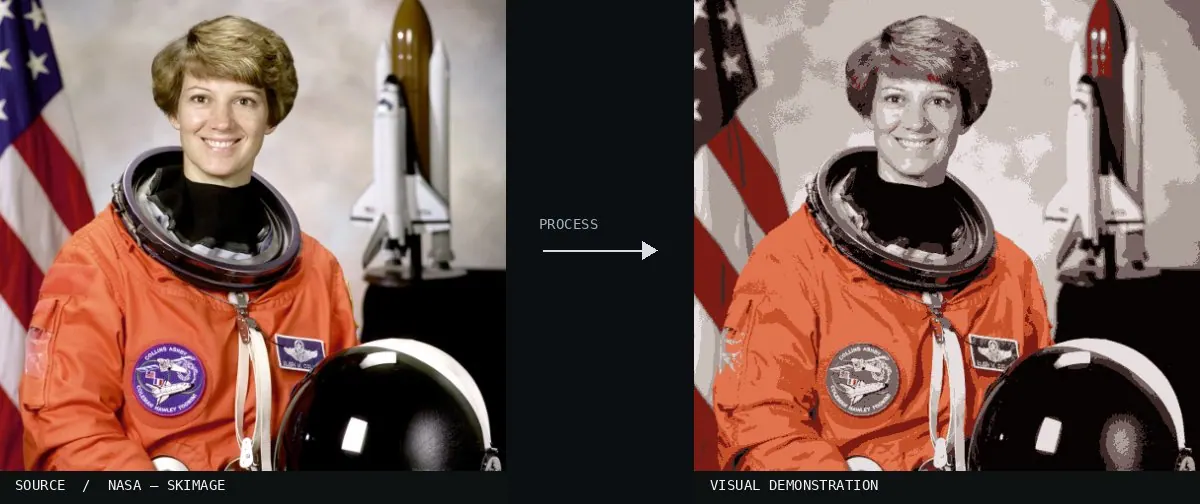
Real-world algorithm demonstration, applied to a NASA portrait.Image: NASA / Eileen Collins · scikit-image (public domain)View source ↗
Prompt
Apply a K-Means Color Quantization effect, reducing the photograph to six representative colors sampled from its existing palette. Replace similar colors with identical flat fills, producing abrupt tonal steps and simplified surface detail while retaining irregular source contours. Avoid dithering and added outlines. Keep the original subject and composition.
02Ada k15 i2A portrait of Ada Lovelace is shown with visible color banding in the background and dress. This iteration demonstrates K-Means clustering where pixels are grouped into 15 distinct color centers, creating flat shaded areas.E.Le Morvan · CC BY-SA 4.0 · Wikimedia Commons03Mandrill-k-meansThe standard mandrill test image is rendered with a reduced color palette. The resulting flat color areas demonstrate how pixels are grouped into a small number of discrete RGB centers.Not specified in SIPI Image Database · Public domain · Wikimedia Commons04AI illustration: A woman in a garden is shown with a limited palette of approximately six A woman in a garden is shown with a limited palette of approximately six colors. This illustrates K-means by clustering complex gradients into distinct, unified flat color regions.Illustration generated for the Atlas (AI)05AI illustration: A still life photograph is processed into flat color regionsA still life photograph is processed into flat color regions. It illustrates K-means by grouping continuous gradients into 24 distinct, uniform color clusters based on pixel proximity in RGB space.Illustration generated for the Atlas (AI)06AI illustration: A close-up of an eye shows jagged boundaries between skin and iris tonesA close-up of an eye shows jagged boundaries between skin and iris tones. The reduction of a photographic source into roughly 12 flat color zones demonstrates algorithmic K-means quantization.Illustration generated for the Atlas (AI)07AI illustration: A cityscape is reduced to a limited palette of neon pink, blue, and dark A cityscape is reduced to a limited palette of neon pink, blue, and dark tones. It illustrates K-means by clustering all pixels into a very small number of discrete color values.Illustration generated for the Atlas (AI)