HDR imaging / tone mapping. Research 1997. Photo editing wave of the 2000s, around CS2 2005.
Typeface · Rajdhani
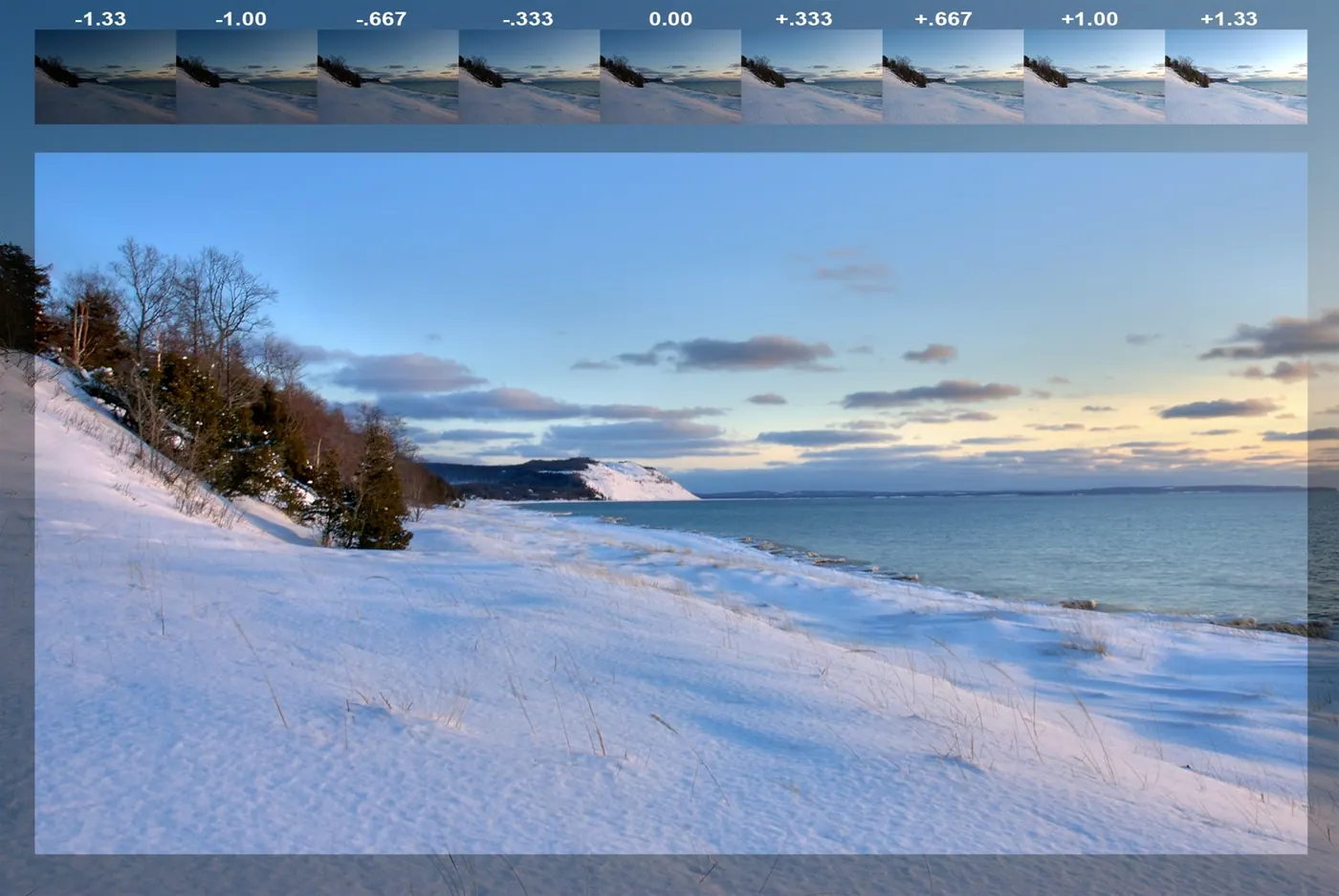
HDR tone mapping: exposure series above, composite representation below: Cody Pope, 2007.Cody Pope. CC BY-SA 2.5View source ↗
Prompt
Apply an HDR imaging effect, recovering visible texture in bright highlights and deep shadows while maintaining luminous whites and grounded blacks. Enhance fine surface detail, cloud definition where present, and local tonal contrast with restrained saturation and minimal edge halos. Avoid uniformly flat lighting. Keep the original subject and composition.
Debevec/Malik: important method 1997. Photoshop CS2: Merge to HDR 2005.
Try it out
Compare normal exposure, natural HDR, and extreme tone mapping. When does shadow information become astylistic device?
Background
Important research work in 1997; particularly visible for photo editing in the 2000s, e.g. Photoshop CS2 (2005).
Several differently exposed photographs are combined to create an image with awider dynamic range. Tone mapping translates this range into adisplayable version. Strong local tone mapping can overemphasize textures and contrast.
Debevec and Malik, Recovering High Dynamic Range Radiance Maps from Photographs (SIGGRAPH 1997); Merge to HDR in Photoshop CS2 (2005).
Regarding the illustration: Example image. Nine exposures capture scene areas with varying brightness. The combined, wide range of brightness is compressed for visual display. This example demonstrates the basis of the HDR look; extreme local contrast enhancement would be apossible additional stylistic choice.
Distinction
HDR data, HDR display, and the popular HDR photo look are not the same thing. Tone mapping can be very subtle. HDR is not a2000s invention and does not automatically result in an over-sharpened HDR look. Capture/reconstruction and display are two separate steps.
Aftermath
Amotif could be shown closer to the wide brightness range of the scene or deliberately hyperrealistically; the technical rescue process became astyle in its own right.
Further examples · 11 images
02Dülmen, Dülmener Sommer, Open-Air-Konzert -- 2018 -- 9701-3A modern building is seen at dusk with bright internal lighting. The image balances the glowing interior details and the dark exterior rocks without losing information in either area.Dietmar Rabich · CC BY-SA 4.0 · Wikimedia Commons03Golden Chapel, Recife, Pernambuco, BrazilThe interior of the Golden Chapel shows complex ornate details and paintings. Tone mapping allows for even lighting across the bright altar and dark corners, preserving detail throughout the room.Wilfredor · CC0 · Wikimedia Commons04Quackenschloss mit Eiszapfen 2140120 HDR-2A limestone cave formation with icicles is shown. HDR imaging captures the texture within the dark cave shadows while preventing the bright outdoor light at the entrance from blowing out.Ermell · CC BY-SA 4.0 · Wikimedia Commons05High-dynamic-range imaging (HDRI or HDR)A tree silhouette stands before a bright sky reflecting in a pool. The extreme tone mapping creates high contrast in the clouds and overemphasizes colors for a stylistic effect.AntanO · CC BY-SA 4.0 · Wikimedia Commons06Anfiteatro de Pula, Croacia, 2017-04-17, DD 49-57 HDR PANThe exterior of the Pula Arena is shown at twilight. The technique ensures the warm stone textures and the deep blue sky are both visible without underexposing the architectural shadows.Diego Delso · CC BY-SA 4.0 · Wikimedia Commons07Mount Pleasant Radio TelescopeA large radio telescope stands under a cloudy sky. The HDR process emphasizes the dramatic clouds and metallic structures, revealing fine details in the dish and the shaded landscape.Noodle snacks · CC BY-SA 3.0 · Wikimedia Commons08Vista de Sagunto, España, 2015-01-03, DD 23-31 HDR PANA panorama of Sagunto shows a city at night under a moonlit sky. The processing translates the extreme variations between city lights and dark hills into a single balanced displayable image.Diego Delso · CC BY-SA 4.0 · Wikimedia Commons09Laboe - Marine-Ehrenmal (tone-mapping)Extreme local contrast and saturation are applied to the sky and structure. It demonstrates the stylized, high-contrast look typical of early 2000s tone mapping where clouds and shadows are heavily overemphasized.Guido Radig · CC BY 3.0 · Wikimedia Commons10Praha - Staroměstské náměstí (tone-mapping)The image shows significant edge halos and high local contrast in the clouds and architecture. This represents the 'hyper-real' aesthetic common in mid-2000s HDR processing using tools like Photoshop CS2.Guido Radig · CC BY 3.0 · Wikimedia Commons11Aschaffenburg - Schloss Johannisburg am Main (tone-mapping)Aggressive tone mapping has created dark halos around the central clouds and increased textural detail in the grass. The saturation and micro-contrast are characteristic of early HDR software presets.Guido Radig · CC BY 3.0 · Wikimedia Commons