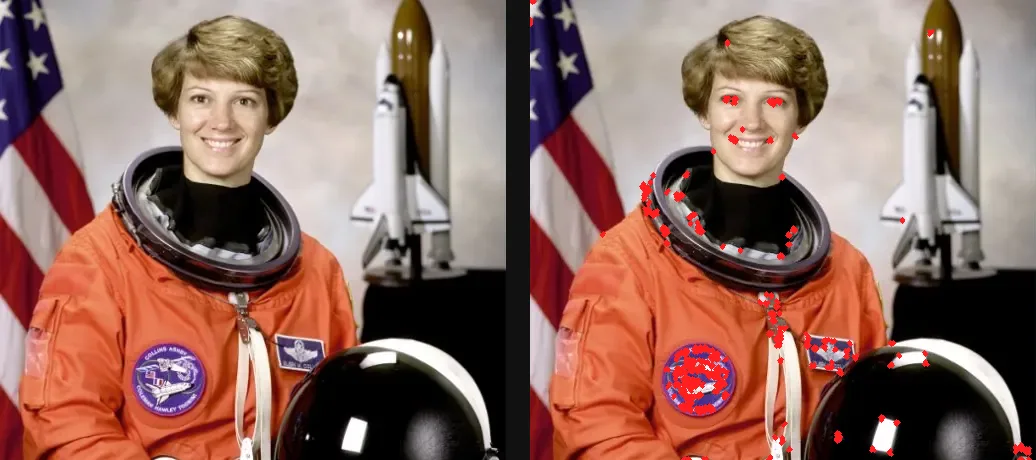
Real-world algorithm demonstration, applied to a NASA portrait.Image: NASA / Eileen Collins · scikit-image (public domain)View source ↗
Prompt
Apply Harris Corner Detection as a technical overlay on the photograph, marking sharp junctions and two-direction brightness changes with tiny vivid red dots. Cluster markers around angular details and textured intersections, leaving smooth surfaces and simple uninterrupted edges mostly unmarked. Keep the original subject and composition.
02Scikit-image CornerDetectionA black field contains white geometric shapes including diamonds, squares, and an ellipse. Red crosshairs mark the vertices, demonstrating the algorithm's precision in identifying points where image intensity changes in multiple directions.MTheiler · CC BY-SA 4.0 · Wikimedia Commons03Harris corners detected on chessboardA chessboard pattern is displayed with red circular markers placed on the intersections. It demonstrates the algorithm's ability to identify discrete points where local intensity changes significantly in two directions.Brian moore81 · CC BY-SA 4.0 · Wikimedia Commons04Writing Desk with Harris DetectorA black and white image of a desk is compared to a version where yellow circles mark detected corners. The visualization illustrates how the algorithm identifies high-intensity gradients in multiple directions to locate points of interest.Writing_desk.jpg: Dvortygirl
derivative work: Kleliboux (talk) · CC BY-SA 3.0 · Wikimedia Commons05Harris Corner Detection, applied to “Courtyard Zappeion Athens, Greece”Red markers highlight the Zappeion courtyard's columns, roofline, and checkered floor. The algorithm identifies intersection points where the image gradient changes significantly in multiple directions.Jebulon (photo); processed for the Atlas · CC0 · Wikimedia Commons06Harris Corner Detection, applied to “Ponte Vasco da Gama 25”Points appear on the structural junctions and pylon tops of the Vasco da Gama bridge. The effect successfully isolates corners despite the low-contrast fog surrounding the architecture.F Mira from Lisbon, Portugal (photo); processed for the Atlas · CC BY-SA 2.0 · Wikimedia Commons07Harris Corner Detection, applied to “Stanford Oval May 2011 panorama”A panorama of the Stanford campus shows red markers along window corners and roof edges. These detected features correspond to areas with high intensity variation in two dimensions.King of Hearts (photo); processed for the Atlas · CC BY-SA 3.0 · Wikimedia Commons