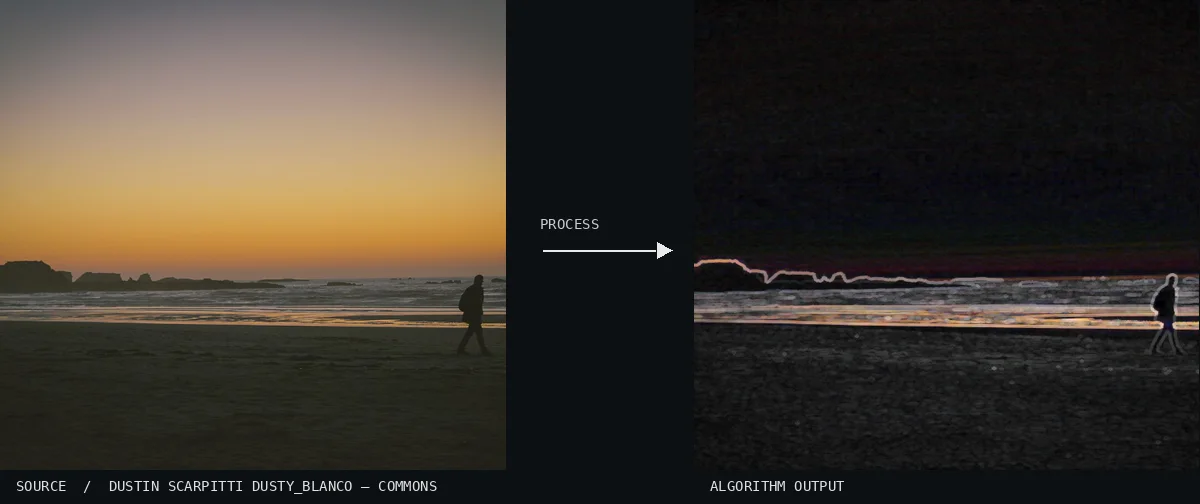
Atlas demonstration: the free source photo and the computed Morphological Gradient. A lone figure walks along a vast beach under a dark sky. The high-contrast outlines of the silhouette and the breaking waves demonstrate the subtraction of erosion from dilation perfectly.Image: Dustin Scarpitti dusty_blanco · CC0 (via Wikimedia Commons), processed for the AtlasView source ↗
Prompt
Apply a Morphological Gradient effect, turning local brightness differences into luminous edge bands against nearly black, uniform regions. Trace object boundaries and fine textures with consistent-width white or pale gray outlines, emphasizing both sides of contrast transitions without directional embossed shading. Suppress broad surface color. Keep the original subject and composition.
[Bright edge bands]trace [object boundaries]and fine textures, while uniform areas stay dark.
Principle
Using aflat structuring element1, dilation2takes each neighborhood’s maximum brightness, while erosion takes its minimum. Subtracting erosion from dilation reveals [local brightness differences]rather than the direction of change.
Try it out
Increase the neighborhood size and watch edge bands widen and nearby details merge.
Classification
Calculated image processing result.
Further examples · 9 images
02Morphological Gradient, applied to “Cater Yang 2017-04-20 (Unsplash)”The interior of a bar is captured with various bottles and glasses lined up on the counter. Every reflective surface and geometric edge is traced with a thin, bright band against the dark void of the flat surfaces.Cater Yang rugeli (photo); processed for the Atlas · CC0 · Wikimedia Commons03Morphological Gradient, applied to “Exploring the city. (Unsplash)”This image depicts a narrow street in a city, filled with signs and hanging lanterns. The complex textures of the urban environment are rendered as a dense network of bright, thin lines that isolate every detail.Andre Benz trapnation (photo); processed for the Atlas · CC0 · Wikimedia Commons04Morphological Gradient, applied to “Bright white building facade (Unsplash)”A modern building facade with a repetitive window pattern is seen from a low angle. The mathematical precision of the grid is emphasized by the white boundaries created through the morphological process.Matthew Hamilton thatsmrbio (photo); processed for the Atlas · CC0 · Wikimedia Commons05Morphological Gradient, applied to “Taking notes with a pencil (Unsplash)”A hand holds a pen while writing on a spiral-bound notebook. The fine details of the metal coils and the pen’s tip are clearly defined by the bright edge tracing that avoids the flat dark regions.Thought Catalog thoughtcatalog (photo); processed for the Atlas · CC0 · Wikimedia Commons06Morphological Gradient, applied to “Vintage piano player (Unsplash)”A pianist's hands rest upon the keys of an ornate upright piano. The computational process highlights the intricate wooden latticework and the sharp edges of the individual piano keys through bright, high-contrast outlines.Darius Soodmand dsoodmand (photo); processed for the Atlas · CC0 · Wikimedia Commons07Morphological Gradient, applied to “Vũng Tàu, Vietnam (Unsplash)”Sheep graze in an open field under a darkening sky with visible clouds. The technique creates a luminous halo around the animals and trees, emphasizing their profiles against the flat, dark planes of the landscape.Phú Nguyễn nguyenphu (photo); processed for the Atlas · CC0 · Wikimedia Commons08Morphological Gradient, applied to “View from the Garden of the Gods Visitor and Nature Center”Clouds float above a rugged mountain range during a sunset. The bright borders successfully define the volume of the clouds and the jagged ridgeline of the peaks against the void of the sky.Ian Baldwin (photo); processed for the Atlas · CC0 · Wikimedia Commons09Morphological Gradient, applied to “Love under setting sun (Unsplash)”Two hands come together to form a heart shape against a sunset backdrop. The luminous glow around the fingers highlights the local brightness differences found along the edges of the form.Mayur Gala mayurgala (photo); processed for the Atlas · CC0 · Wikimedia Commons