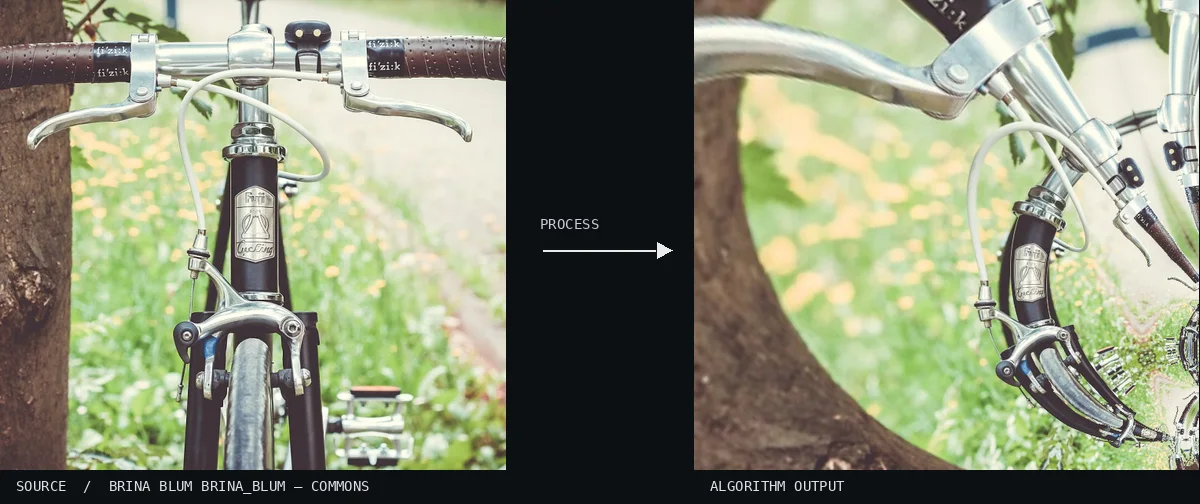
Atlas demonstration: the free source photo and the computed Möbius Transformation. A close-up view of a bicycle's handle and brake system is set against a soft green background. The metallic components are pulled into a sweeping circular warp that creates a dense, repeating floral-like pattern in the lower right corner.Image: Brina Blum brina_blum · CC0 (via Wikimedia Commons), processed for the AtlasView source ↗
Prompt
Apply Möbius Transformation to bend the photograph into sweeping circular arcs, placing enlarged regions beside tightly compressed details. Keep local intersections and fine textures coherent as scale changes smoothly across the image. Avoid rubbery folds, hard seams, and added objects. Preserve the original subject and composition within the transformed image.
The photo bends into [sweeping arcs], with [enlarged regions]beside tightly [compressed details].
Principle
It maps complex coordinates1using w = (az + b)/(cz + d), with ad − bc ≠ 0. Inverse mapping2samples the source photo; the underlying transformation preserves local angles wherever it is finite.
Try it out
Vary the transformation parameters and watch straight edges become circular arcs.
Classification
Calculated image processing result.
Further examples · 9 images
02Möbius Transformation, applied to “Fish in azure water (Unsplash)”Fish swim through clear, shallow water over a sandy bottom. The scene is distorted into a spiraling tunnel, with the fish and ripples shrinking into an infinitely repeating point on the right side of the frame.Milada Vigerova mili_vigerova (photo); processed for the Atlas · CC0 · Wikimedia Commons03Möbius Transformation, applied to “Church of Santa Susanna, Rome, Italy circa 1972”The ornate facade of a classical European building rises against a clear blue sky. The architectural lines are bent into a dramatic, circular arc that pulls the entire street into a localized, compressed vortex.Edmund L. Mitchell (photo); processed for the Atlas · Public domain · Wikimedia Commons04Möbius Transformation, applied to “Callanish Stones 6 January 2015 from Unsplash”Ancient standing stones are positioned on a grassy hill under a vast, pale sky. The horizon line is warped into a sharp curve, causing the megaliths to radiate outward and converge into a spiraling pattern at the edge.Simon Hattinga Verschure webmarbles (photo); processed for the Atlas · CC0 · Wikimedia Commons05Möbius Transformation, applied to “Alley of two buildings (Unsplash)”A narrow alleyway with stone arches and weathered buildings is captured from a low angle. The geometric lines of the stone are transformed into a continuous loop, spiraling inward to create a dizzying tunnel effect.freddie marriage fredmarriage (photo); processed for the Atlas · CC0 · Wikimedia Commons06Möbius Transformation, applied to “Golden gate bridge sunset (Unsplash)”A low-angle view depicts the steel underside of a large orange suspension bridge. The structural beams undergo a radical spherical contraction, spiraling into a dense singularity on the right side of the frame.Denys Nevozhai dnevozhai (photo); processed for the Atlas · CC0 · Wikimedia Commons07Möbius Transformation, applied to “Skyline of Toronto unsplash”A nighttime city skyline is reflected across a dark body of water, featuring glowing office buildings. The lights are warped into concentric circular paths, creating a Droste-like infinite repetition toward the right edge.Juan Davila (photo); processed for the Atlas · CC0 · Wikimedia Commons08Möbius Transformation, applied to “White Brisbane neon (Unsplash)”A crowded public space features a man in glasses and a prominent illuminated sign for Brisbane. The typography and background details are bent into a series of nested, circular iterations that grow increasingly compressed.Jesse Collins jtc (photo); processed for the Atlas · CC0 · Wikimedia Commons09Möbius Transformation, applied to “Cattle In The Pasture (Unsplash)”A long-haired highland cow rests on a grassy hillside under a pale, overcast sky. The horizon line and the animal's form are drastically distorted, wrapping around a central point to create a recursive visual tunnel.Élise Laberge eliselaberge (photo); processed for the Atlas · CC0 · Wikimedia Commons