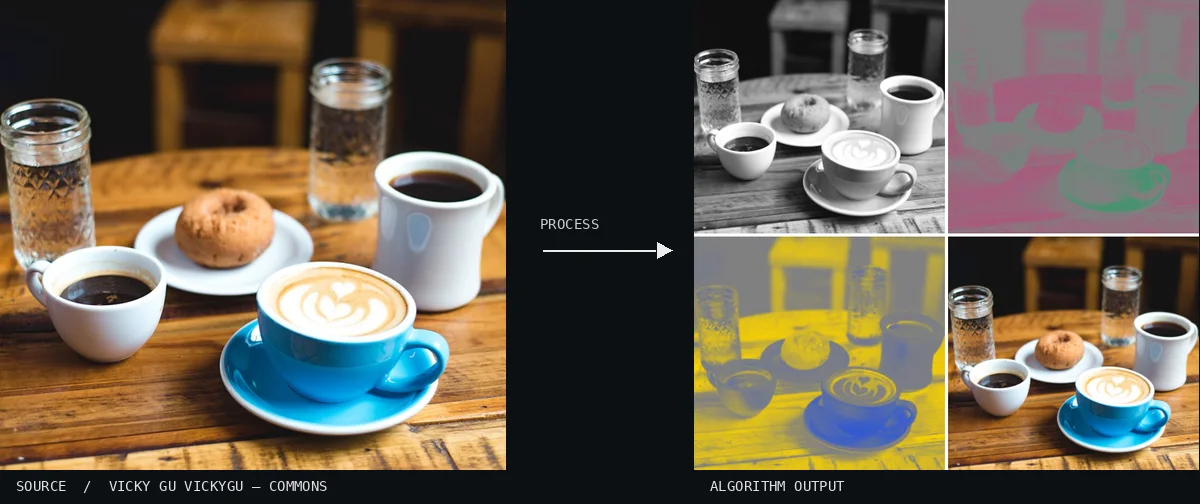
Atlas demonstration: the free source photo and the computed Lab Opponent Channels. Various coffee cups and a donut are arranged on a rustic wooden table. The distinct blue saucer and warm wood tones are perfectly separated into their respective blue-yellow and green-red chroma components.Image: Vicky Gu vickygu · CC0 (via Wikimedia Commons), processed for the AtlasView source ↗
Prompt
Apply a Lab Opponent Channels effect using three equal panels: grayscale lightness, a green-to-red opponent map, and a blue-to-yellow opponent map. Make neutral colors appear midway along each opponent scale, revealing subtle chromatic differences without grain or distortion. Keep the original subject and composition within each panel.
The photograph becomes [channel views]separating lightness from green–red and blue–yellow [color differences].
Principle
The algorithm converts RGB colors to CIELAB1, separating lightness (L*) from two [opponent channels2]: green–red (a*) and blue–yellow (b*). Each channel is scaled for display, revealing tonal structure or color differences.
Try it out
Compare which edges remain visible in the lightness view and which appear mainly in the color channels.
Classification
Calculated image processing result.
Further examples · 9 images
02Lab Opponent Channels, applied to “Brooklyn Bridge, New York, United States (Unsplash DiBu1qTQQ8s)”The Brooklyn Bridge spans across the water at dusk, illuminated by artificial lights. This visualization clearly maps the transition from the golden-yellow lights to the deep blue of the evening sky.Pedro Lastra peterlaster (photo); processed for the Atlas · CC0 · Wikimedia Commons03Lab Opponent Channels, applied to “Gunnamatta Sunset (Unsplash)”A lone figure stands on a beach watching a vivid sunset over the ocean waves. The intense magenta and yellow hues of the sky are vividly rendered within the separate chromaticity channels.Arnaud Mesureur tbzr (photo); processed for the Atlas · CC0 · Wikimedia Commons04Lab Opponent Channels, applied to “Peterborough Cathedral Central Tower Ceiling”A symmetrical view captures the ornate wooden vaulting and heraldic shields of a cathedral ceiling. The decomposition into L*a*b* channels clearly defines the structural highlights in grayscale while isolating the warm wood tones in the magenta and yellow quadrants.Michael D Beckwith (photo); processed for the Atlas · CC0 · Wikimedia Commons05Lab Opponent Channels, applied to “Beach-holiday-vacation-sand (23700013313)”A deep footprint is pressed into the fine sand of a beach, cast in the soft light of late afternoon. The analysis isolates the neutral shadows of the pit from the subtle blue-yellow color balance of the surrounding illuminated grains.www.Pixel.la Free Stock Photos (photo); processed for the Atlas · CC0 · Wikimedia Commons06Lab Opponent Channels, applied to “Fifteenth birthday cake (Unsplash)”A celebratory cake adorned with pink roses and the number fifteen sits prominently before a floral backdrop. The separation vividly distinguishes the intense magenta pigments of the frosting and flowers from the yellow warmth of the ambient lighting.Hanna Pedroza hannapedroza (photo); processed for the Atlas · CC0 · Wikimedia Commons07Lab Opponent Channels, applied to “Setting sun reflection (Unsplash)”The sun sets over a misty body of water, creating a glowing path of ripples across the surface. This technique separates the bright highlights of the sun into a grayscale luminosity map while concentrating the orange hue into high-intensity magenta and yellow channels.Franco Fantuzzi frankye (photo); processed for the Atlas · CC0 · Wikimedia Commons08Lab Opponent Channels, applied to “Iceland (Unsplash XL017h5dLlg)”A small arctic fox sits in a snowy environment beside a weathered wooden post. The isolation of the blue-yellow channel reveals warmth in the dry grass and the cooler shadows of the fox's fur.Jonatan Pie r3dmax (photo); processed for the Atlas · CC0 · Wikimedia Commons09Lab Opponent Channels, applied to “Water sky reflection (Unsplash)”A person stands on a vast salt flat, mirrored by a perfect reflection under an expansive sky. Subtle warm horizons and cool cloud shadows are isolated into distinct color-opponent maps.Ashim D’Silva randomlies (photo); processed for the Atlas · CC0 · Wikimedia Commons