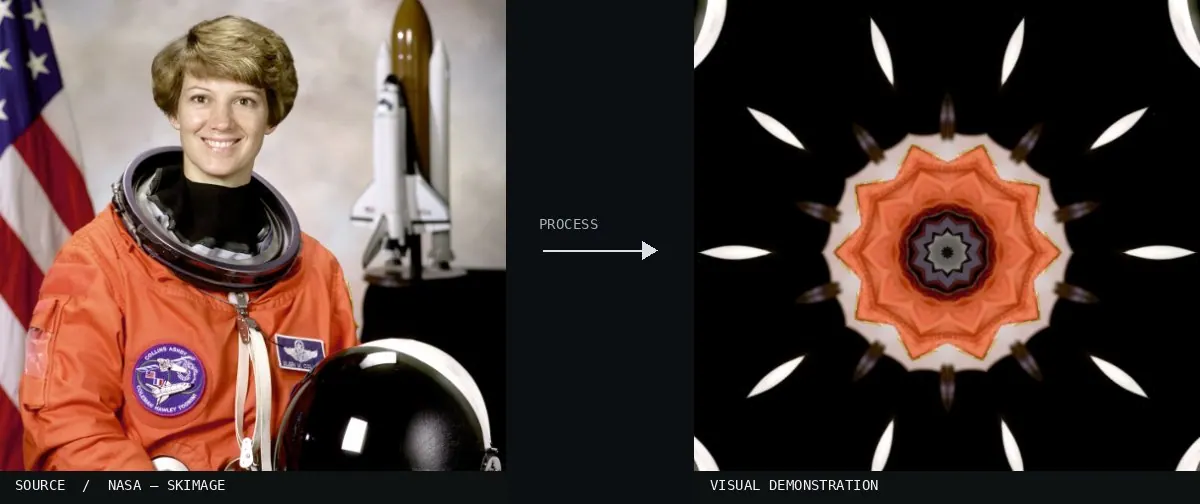
Real-world algorithm demonstration, applied to a NASA portrait.Image: NASA / Eileen Collins · scikit-image (public domain)View source ↗
Prompt
Apply Kaleidoscope Mirror as a restrained optical overlay, repeating reflected angular fragments of the photograph into a radial rosette. Use crisp triangular seams, symmetrical color repetitions, and mirrored texture details, concentrating the pattern around rather than replacing the recognizable central subject. Keep the original subject and composition.
An angular sector2is [reflected and repeated multiple times].
Try it out
Test 5, 8 and 12 segments.
Classification
Calculated image processing result.
Further examples · 11 images
021819 brewster - treatise on the kaleidoscope fig 39-40 (kircher - bradley comparison)Diagrams from a treatise on the kaleidoscope show optical reflections of candles and landscapes between angled mirrors. It illustrates the physical mechanical principles of reflecting a sector to create symmetrical repetitions.David Brewster, Athanasius Kircher, Mr. Bradley · Public domain · Wikimedia Commons03Kaleidoscope-abcA grayscale pattern repeats the text ABC across a grid of equilateral triangles. It demonstrates the tiling effect of mirrors where each triangular segment is reflected to fill the visual field.Koperczak · CC BY 3.0 · Wikimedia Commons04Kaleidoskopeffekt -- 2025 -- 132845Orange and green beads are arranged into a radial pattern with six-fold symmetry. The circular composition repeats a single wedge-shaped sector around a central point like a rosette.Dietmar Rabich · CC BY-SA 4.0 · Wikimedia Commons05Kaleidoskopeffekt -- 2025 -- 131941Many colorful, textured beads form a complex radial rosette with eight-fold symmetry. It exemplifies the digital mirror effect by repeating identical angular fragments to create a balanced, decorative circle.Dietmar Rabich · CC BY-SA 4.0 · Wikimedia Commons06Kaleidoskopeffekt -- 2025 -- 13224Blue, yellow, and purple beads are digitally processed into a twelve-segment radial rosette. This image shows how increasing the number of mirror segments creates a denser and more intricate circular pattern.Dietmar Rabich · CC BY-SA 4.0 · Wikimedia Commons07Kaleidoscope software demonstrationA four-panel grid compares an original street scene with various radial mirror transformations. It provides a direct example of how software calculates reflections from a real-world image to generate symmetry.Downtowngal · CC0 · Wikimedia Commons08Kaleidoskopeffekt -- 2025 -- 132827Light green and orange beads are mirrored to form a six-segment rosette pattern. The radial symmetry is achieved by reflecting a specific sector multiple times around the center.Dietmar Rabich · CC BY-SA 4.0 · Wikimedia Commons09Kaleidoskopeffekt -- 2025 -- 132834A dense collection of beads is reflected eight times to create a symmetrical circular design. It is a clear example of a calculated digital mirror effect using a medium-frequency segment count.Dietmar Rabich · CC BY-SA 4.0 · Wikimedia Commons10Kaleidoskopeffekt -- 2025 -- 131631Red, yellow, and blue beads are arranged into a twelve-fold radial symmetry. The high number of repeated segments creates a complex, kaleidoscope-style rosette from a single angular fragment.Dietmar Rabich · CC BY-SA 4.0 · Wikimedia Commons11Kaleidoskopeffekt -- 2025 -- 131954Large purple beads form the core of a six-segment radial pattern. The image illustrates the kaleidoscope mirror effect by perfectly mirroring specific shapes across defined angular boundaries.Dietmar Rabich · CC BY-SA 4.0 · Wikimedia Commons