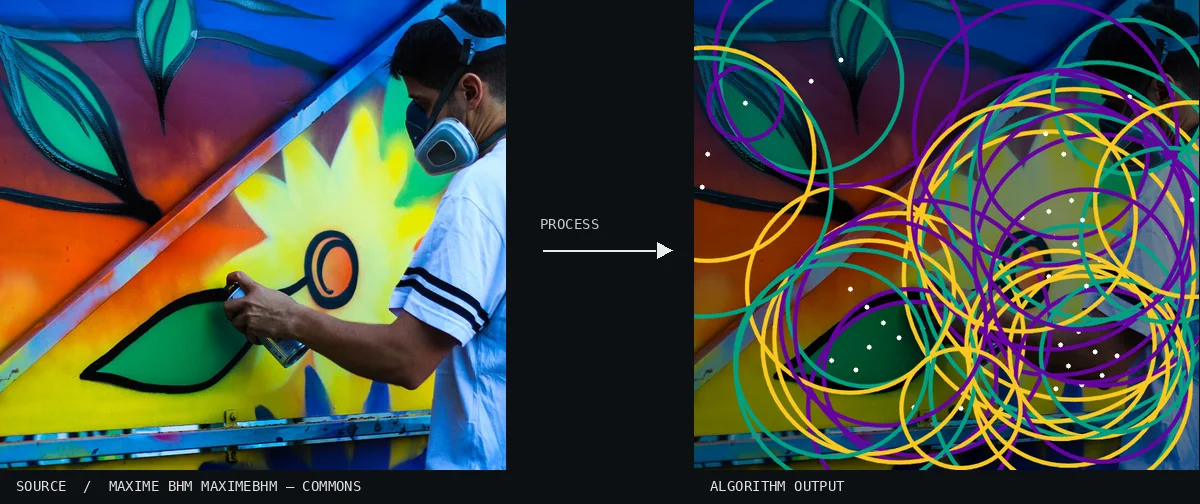
Atlas demonstration: the free source photo and the computed Hough Circle Transform. An artist in a white shirt works on a vibrant mural featuring bold, graphic shapes. The mathematical process generates a dense thicket of primary-colored rings that track the various round motifs and spray-painted curves within the artwork.Image: Maxime Bhm maximebhm · CC0 (via Wikimedia Commons), processed for the AtlasView source ↗
Prompt
Apply Hough Circle Transform as a technical overlay on the original photograph. Trace detected circular features with thin, vivid green rings and tiny red center points, matching each circle's position and radius. Retain photographic colors and textures beneath the precise geometric annotations. Keep the original subject and composition.
You see [drawn outlines highlighting perfect circles]on top of the original photograph.
Principle
The algorithm checks image edges1and lets each [edge pixel2vote]for possible circle center points. If acenter [receives enough votes], the system recognizes it as atrue circle.
Try it out
Change the required vote count to filter out false circles or detect faint rings.
Classification
Calculated image processing result.
Further examples · 9 images
02Hough Circle Transform, applied to “Shadowed man holding a camera (Unsplash)”A photographer is captured in low light holding a camera to their face. The mathematical overlays perfectly isolate the camera lens and circular highlights on the subject's skin and eyes.Stephen Caserta caserta (photo); processed for the Atlas · CC0 · Wikimedia Commons03Hough Circle Transform, applied to “Infructescences (Unsplash)”A cluster of dark berries and green leaves is presented against a neutral grey background. Every individual berry is identified by a series of concentric colored outlines that map their spherical forms.Joanna Kosinska joannakosinska (photo); processed for the Atlas · CC0 · Wikimedia Commons04Hough Circle Transform, applied to “Orange butterfly on violet flowers (Unsplash)”A butterfly feeds upon a round, thistle-like flower head. The rings are clearly visible and concentrated around the spherical shape of the blossom and the spots on the insect's wings.Dominik Scythe drscythe (photo); processed for the Atlas · CC0 · Wikimedia Commons05Hough Circle Transform, applied to “Contrasting Landscapes (Unsplash)”Large sand dunes roll across the landscape under an overcast horizon. The rings trace the curved crests and shadows of the sand, making the mathematical detection process easy to follow.Benny Jackson themightymerlin (photo); processed for the Atlas · CC0 · Wikimedia Commons06Hough Circle Transform, applied to “South Station headhouse at night, January 2017 (Unsplash xKQIz 5XjY)”A historic building with a central clock tower stands illuminated at night behind a busy intersection. Numerous large, vibrant circles overlap across the facade and the street, capturing the geometry of the clock and various light flares.Osman Rana osmanrana (photo); processed for the Atlas · CC0 · Wikimedia Commons07Hough Circle Transform, applied to “Frozen soap bubble behind fir twigs (Unsplash BojuZpqw4zM)”A delicate, translucent ornament rests upon the dark needles of an evergreen branch. Concentric circles in teal, yellow, and purple highlight the spherical nature of the object against the soft bokeh of the background.aaronburden Aaron Burden from Baltimore, Maryland, USA. (photo); processed for the Atlas · CC0 · Wikimedia Commons08Hough Circle Transform, applied to “Bogotá city and street lights (Unsplash)”A modern city tower rises into a dark sky, surrounded by the blurred lights of urban activity. Multi-colored outlines proliferate across the center of the frame, interpreting the building's lights and structure as a series of overlapping circular forms.AltaGamba @altagamba altagamba (photo); processed for the Atlas · CC0 · Wikimedia Commons09Hough Circle Transform, applied to “Cat portrait (Unsplash)”A domestic cat looks directly into the lens, its face filling most of the frame. The transformation identifies various rounded shapes within the feline's eyes and facial structure, marking them with bright concentric paths.Anton Petrov aptrov (photo); processed for the Atlas · CC0 · Wikimedia Commons