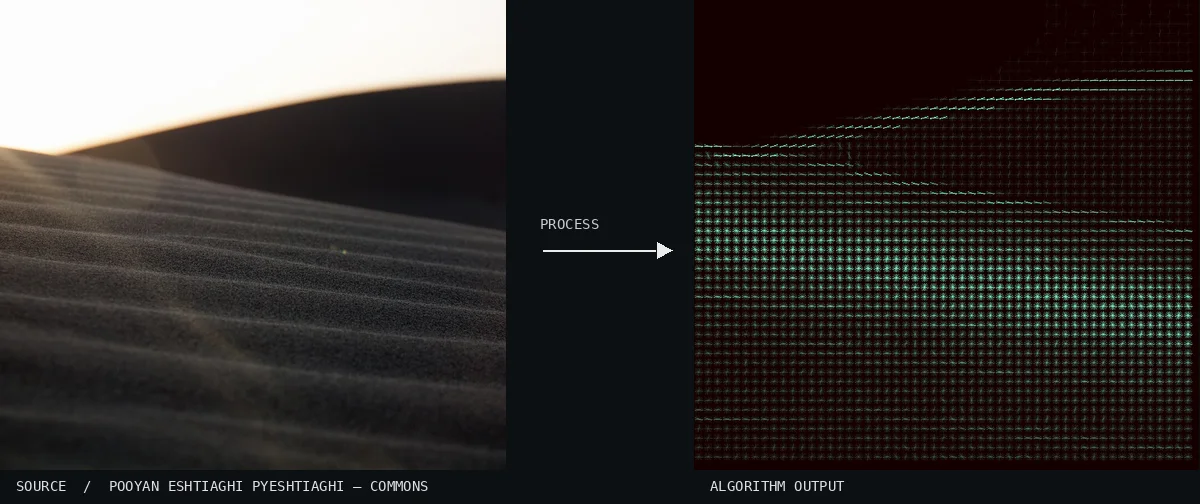
Atlas demonstration: the free source photo and the computed HOG Gradients. A scenic landscape featuring rolling hills is captured in a minimalist style. The varying slopes are clearly defined by the shifting orientation of the small starburst patterns across the dark background.Image: POOYAN ESHTIAGHI pyeshtiaghi · CC0 (via Wikimedia Commons), processed for the AtlasView source ↗
Prompt
Apply HOG Gradients with a regular grid of small square cells over a dimmed grayscale photograph. Fill each cell with thin, intersecting orientation strokes, forming starbursts whose brightness reflects local edge strength. Let these directional patterns collectively describe silhouettes and textured surfaces. Keep the original subject and composition.
The image is overlaid with a[grid of small cells], each containing astarburst pattern of thin, intersecting lines.
Principle
The algorithm divides the image into small blocks and calculates the direction of the [strongest contrast1]within each one. It then draws agraph of these [dominant edge angles2]to represent the underlying shape.
Try it out
Adjust the cell size to see how it summarizes small details versus broad outlines.
Classification
Calculated image processing result.
Further examples · 9 images
02HOG Gradients, applied to “Jackson Street Bridge and Atlanta Night Skyline (Unsplash)”This image depicts a city skyline with multiple skyscrapers overlooking a converging road. The vertical structures and leading lines of the highway are perfectly mapped through the alignment of the vector cells.Joey Kyber jtkyber1 (photo); processed for the Atlas · CC0 · Wikimedia Commons03HOG Gradients, applied to “Your train is arriving (Unsplash)”A full-bodied human figure stands in the center of the frame, perhaps in an interior setting. The verticality of the body and the horizontal lines of the floor are sharply delineated by the gradient markers.Mike Kotsch mike (photo); processed for the Atlas · CC0 · Wikimedia Commons04HOG Gradients, applied to “Smith Mountain Lake redhead (Unsplash)”A close-up portrait of a person wearing a beanie is depicted in a digital, schematic style. The orientation of the facial features and the roundness of the head are clearly mapped by the dense grid of directional lines.Christopher Harris chrisrossharris (photo); processed for the Atlas · CC0 · Wikimedia Commons05HOG Gradients, applied to “Manhattan Bridge + fog (Unsplash)”The image features the distinct architectural silhouette of a bridge with its cables and towers. Strong vertical and diagonal lines perfectly illustrate the structural geometry of the crossing through vector orientations.Antoine Meillet antoinem (photo); processed for the Atlas · CC0 · Wikimedia Commons06HOG Gradients, applied to “Monochrome child castlecrag (Unsplash)”A face is shown in profile or three-quarters view, highlighting the curve of the hair and jawline. The alignment of the small strokes vividly defines the contours and light fall-off across the subject's features.Louis Blythe louisjblythe (photo); processed for the Atlas · CC0 · Wikimedia Commons07HOG Gradients, applied to “Man with long hair and beard (Unsplash)”A human figure is represented as a silhouette against a structured backdrop. The curves of the head and shoulders are identifiable through the dense clusters of directional markers.Alex Sheldon slavewire (photo); processed for the Atlas · CC0 · Wikimedia Commons08HOG Gradients, applied to “Horse in the falling snow (Unsplash)”A bird appears in flight, its wings spread across the upper portion of the composition. The edge detection highlights the jagged profile of the wings against the negative space below.Annie Spratt anniespratt (photo); processed for the Atlas · CC0 · Wikimedia Commons09HOG Gradients, applied to “Old people conversing (Unsplash)”The scene displays a figure standing next to a window or a gridded structure indoors. The contrast between the organic shape of the person and the rigid horizontal and vertical lines of the background is effectively rendered.Cristina Gottardi cristina_gottardi (photo); processed for the Atlas · CC0 · Wikimedia Commons