M 085 / 18304 Print & Ditheralgorithm output

Halftone Dot Screen

dither, printing & texture
Typeface · Oswald

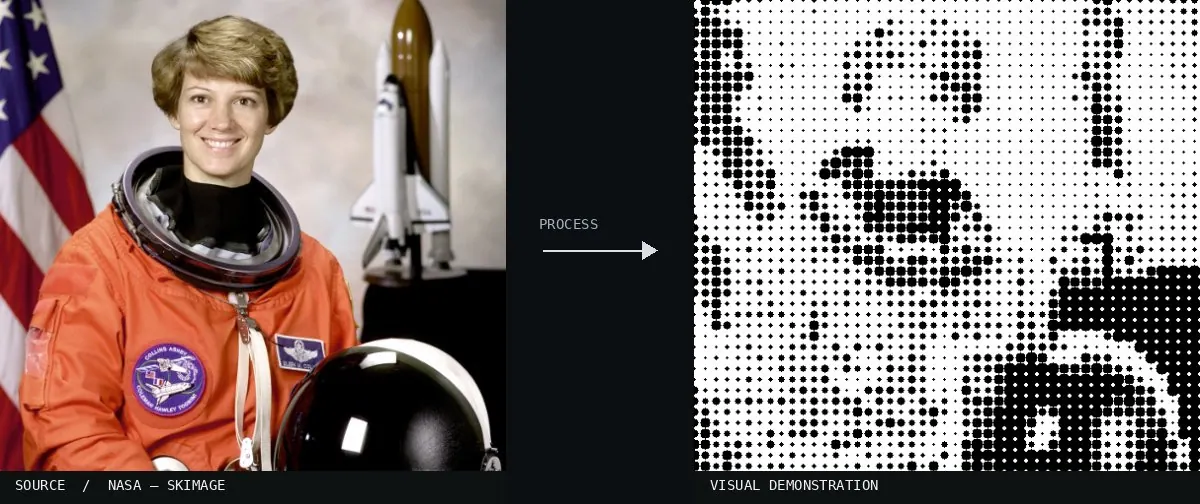
Real-world algorithm demonstration, applied to a NASA portrait.
Real-world algorithm demonstration, applied to a NASA portrait.Image: NASA / Eileen Collins · scikit-image (public domain)View source ↗

Prompt

Transform this image into a Halftone Dot Screen print with black circular dots on clean white paper. Arrange dot centers on a fixed, slightly rotated square grid, enlarging dots in shadows and shrinking them in highlights. Use crisp ink edges and no continuous gray. Keep the original subject and composition.

Identify

Brightness transforms into a dot pattern.

Principle

The dot size corresponds to the local tonal value1 in fixed grid cells2. Try changing the grid size and rotation.

Classification

Calculated image processing result.

Further examples · 7 images

Halftone screen
02 Halftone screenA pattern of overlapping cyan, magenta, and yellow circles is visible on a white background. It illustrates how various dot sizes and rotations in a halftone screen simulate different color tones.Magica · CC BY-SA 4.0 · Wikimedia Commons
Cmyk AM screen
03 Cmyk AM screenA close-up view of a printed cat image shows overlapping cyan, magenta, yellow, and black dot grids. Each color uses fixed grid cells where dot size varies according to local density, creating tonal ranges.Yamo74 · CC BY-SA 4.0 · Wikimedia Commons
Ion Milu colorized
04 Ion Milu colorizedThis colorized portrait exhibits a visible screen pattern of small dots. The local tonal values of the face and uniform are achieved by varying the size of dots within a fixed grid, characteristic of commercial offset printing.CODEX · Public domain · Wikimedia Commons
The Yankee in Quebec (1901) (14580206977)
05 The Yankee in Quebec (1901) (14580206977)A photographic portrait is reproduced using a distinct halftone screen. The image shows how continuous tones in the plants and clothing are converted into a grid of dots to facilitate ink distribution on paper.Internet Archive Book Images · No restrictions · Wikimedia Commons
Test Screens. Halftone process in printing. img 04
06 Test Screens. Halftone process in printing. img 04The image is rendered using a coarse grid of black dots on a white background. It shows how varying dot sizes simulate continuous tones in a landscape photograph through a traditional printing screen.Dmitry Makeev · CC BY-SA 4.0 · Wikimedia Commons
AI illustration: A monochrome portrait uses a uniform grid of black dots on a yellow backg
07 AI illustration: A monochrome portrait uses a uniform grid of black dots on a yellow backgA monochrome portrait uses a uniform grid of black dots on a yellow background. Larger dots create shadows while smaller dots define highlights, accurately simulating the halftone process.Illustration generated for the Atlas (AI)