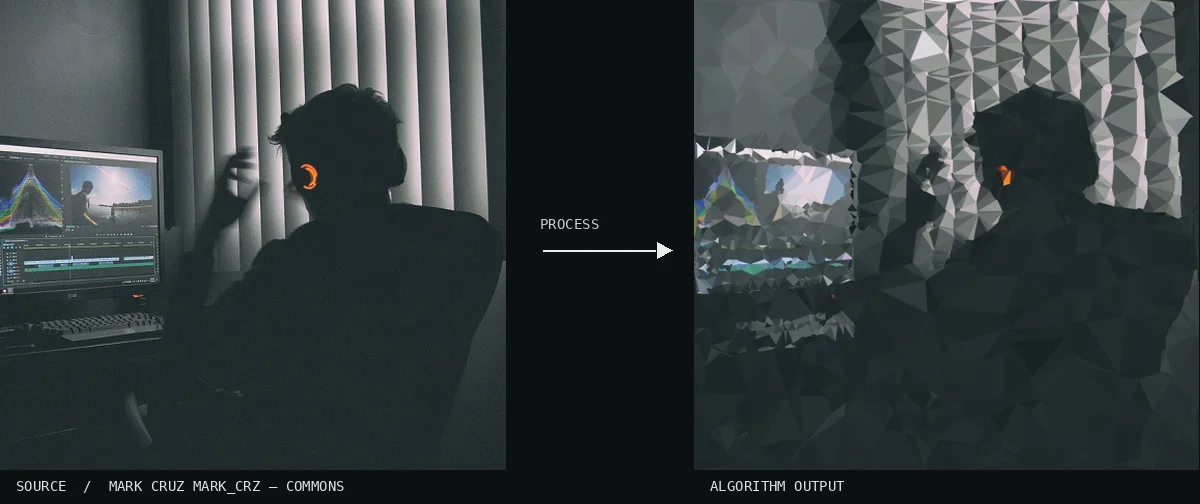
Atlas demonstration: the free source photo and the computed Delaunay Triangle Mosaic. A silhouette of a person sits before a glowing computer monitor in a dark room. The mathematical triangulation is highly apparent, creating a sharp, jagged edge around the figure and the light cast by the screen.Image: Mark Cruz mark_crz · CC0 (via Wikimedia Commons), processed for the AtlasView source ↗
Prompt
Transform this image into a Delaunay Triangle Mosaic of interlocking, non-overlapping triangles filled with flat sampled colors. Concentrate smaller facets along strong contours and use larger triangles across smooth areas. Create crisp shared edges without outlines, gaps, or shading within individual facets; keep the original subject and composition.
The image is transformed into a[continuous mesh of interlocking], solid-colored triangles.
Principle
The algorithm [scatters sample points]across the image, concentrating them along high-contrast edges1. It then connects these points using [Delaunay triangulation2]to form non-overlapping geometric shapes.
Try it out
Vary the total number of points to shift between extreme abstraction and detailed geometric realism.
Classification
Calculated image processing result.
Further examples · 9 images
02Delaunay Triangle Mosaic, applied to “City of bricks (Unsplash)”A perspective view looking down a city street flanked by tall, reddish buildings under a pale sky. Small, dense polygons cluster in the center of the frame to capture the complexity of distant urban details.Daryan Shamkhali daryan (photo); processed for the Atlas · CC0 · Wikimedia Commons03Delaunay Triangle Mosaic, applied to “Horse on wetlands (Unsplash)”The portrait focuses on the side of a person's head, possibly wearing a hat or hood, set against a blurred landscape. Large triangles form the sky and background, while smaller, more intricate shapes define the texture and features of the subject.Idella Maeland idellamaeland (photo); processed for the Atlas · CC0 · Wikimedia Commons04Delaunay Triangle Mosaic, applied to “Black and white conifer forest (Unsplash)”Tall, dark tree trunks stand in high contrast against a bright, foggy forest background in monochrome. The algorithm perfectly captures the verticality of the trees through elongated, interlocking shards of black and grey.Ervins Ellins freakart (photo); processed for the Atlas · CC0 · Wikimedia Commons05Delaunay Triangle Mosaic, applied to “Spacious interior windows (Unsplash)”A low-angle view depicts the structural beams of a ceiling or roof against a light sky. The architectural lines are reconstructed through a dense network of sharp, non-overlapping geometric polygons.Breather breather (photo); processed for the Atlas · CC0 · Wikimedia Commons06Delaunay Triangle Mosaic, applied to “Stormy Desert Sky (Unsplash)”The photograph captures a solitary tree standing in a desert landscape beneath a blue sky. The algorithm has transformed the scenery into a vibrant mesh of solid-colored triangles that define the horizon and foliage.Johnny Chen johnnyafrica (photo); processed for the Atlas · CC0 · Wikimedia Commons07Delaunay Triangle Mosaic, applied to “Breakfast table with pancakes (Unsplash)”This image features a collection of round, textured objects, likely fruit or stones, scattered across a dark surface. Each form is articulated by a complex web of interlocking triangles that capture the varied highlights and shadows.Anthony DELANOIX anthonydelanoix (photo); processed for the Atlas · CC0 · Wikimedia Commons08Delaunay Triangle Mosaic, applied to “Bird At Sunset (Unsplash)”A bird is shown in silhouette, perched upon a slender branch against a cloudy, twilight sky. The triangular mesh becomes larger and simpler in the open sky while growing smaller to define the delicate edges of the bird.Benjamin Balázs brenkee (photo); processed for the Atlas · CC0 · Wikimedia Commons09Delaunay Triangle Mosaic, applied to “Preening Bird (Unsplash)”A pale, organic form lies centered against a dark, textured background. The continuous mesh of triangles creates a striking contrast between the large, light shapes of the subject and the fragmented dark surrounding area.Patrick Brinksma patrickbrinksma (photo); processed for the Atlas · CC0 · Wikimedia Commons