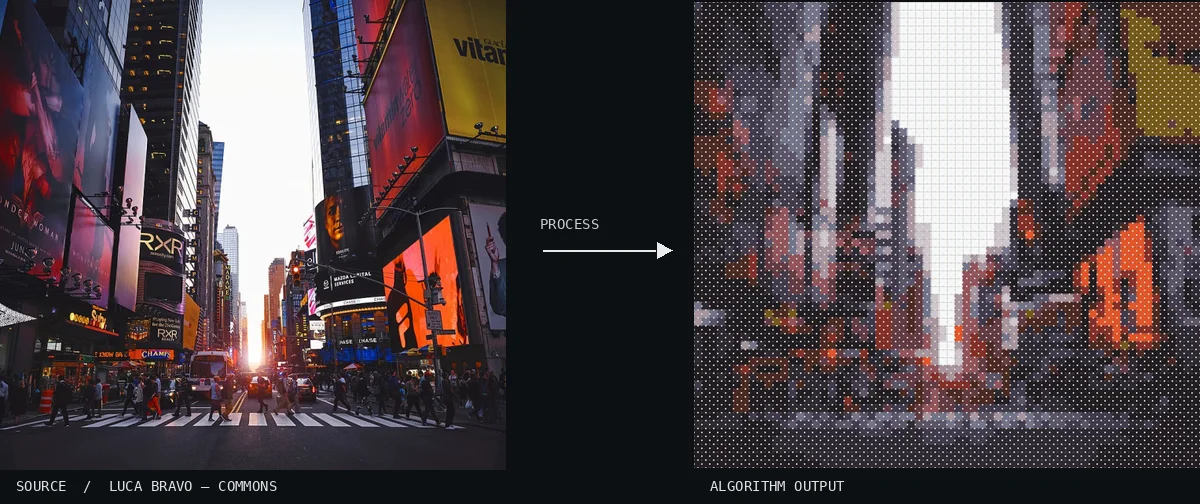
Atlas demonstration: the free source photo and the computed Cross-Stitch Pattern. The photo shows a bustling city intersection framed by towering skyscrapers and vibrant neon signs. The image is rendered entirely through small, intersecting diagonal lines that create a rhythmic grid pattern over every color field.Image: Luca Bravo · CC0 (via Wikimedia Commons), processed for the AtlasView source ↗
Prompt
Transform this image into a Cross-Stitch Pattern composed of evenly spaced X-shaped thread stitches on pale woven fabric. Sample a restrained color palette from the photo, assign one color per grid cell, and leave small fabric gaps between stitches. Show subtle thread texture; keep the original subject and composition.
The photo becomes afield of [X-shaped stitches], with small gaps suggesting fabric between the colored marks.
Principle
The algorithm divides the photo into a[regular grid1]and uses color sampling2to choose arepresentative color for each cell. It draws two crossing [diagonal strokes]per cell, leaving gaps that suggest fabric.
Try it out
Vary the stitch size and watch fine details merge into larger blocks of color.
Classification
Calculated image processing result.
Further examples · 9 images
02Cross-Stitch Pattern, applied to “Jeremy Bishop 2016-09-01 (Unsplash SltlOI33APs)”This image captures close-up greenery and leaves filtered through a vibrant spectrum of lime and forest greens. Each distinct color region is composed of uniform X-marks, leaving tiny gaps between them that mimic the weave of embroidery fabric.Jeremy Bishop tidesinourveins (photo); processed for the Atlas · CC0 · Wikimedia Commons03Cross-Stitch Pattern, applied to “Rocks@sand(byPJrvs)”A serene coastal scene is depicted with sandy tones in the foreground and a hazy horizon line. The transition between colors is managed by the placement of individual colored crosses within a rigid geometric structure.Paul Jarvis (photo); processed for the Atlas · CC0 · Wikimedia Commons04Cross-Stitch Pattern, applied to “Jakob Owens 2017-04-30 (Unsplash)”This monochrome image focuses on a complex mechanical object with varying shades of gray and black. The metallic textures are transformed into a digital embroidery style where every highlight and shadow is represented by a single stitch.Jakob Owens jakobowens1 (photo); processed for the Atlas · CC0 · Wikimedia Commons05Cross-Stitch Pattern, applied to “Ready to Ride (Unsplash)”A bicycle is seen leaning against a textured brick wall with a bright white surface in the foreground. The diagonal overlap of the thread-like marks creates a tactile appearance across both the organic shadows and the straight lines of the masonry.Milada Vigerova mili_vigerova (photo); processed for the Atlas · CC0 · Wikimedia Commons06Cross-Stitch Pattern, applied to “Scaffolding for the Courtyard balcony, construction of the McKim Building”A sepia-toned industrial building is displayed with complex scaffolding and architectural details. The entire composition is broken down into a consistent mesh of crossing diagonal strokes that define the structure's form.Stevens, Edward F. (Edward Fletcher), 1860-1946; McKim, Mead & White (photo); processed for the Atlas · Public domain · Wikimedia Commons07Cross-Stitch Pattern, applied to “Brooklyn Bridge, New York, United States (Unsplash xbusTJ7IUu0)”A dense urban skyline at dusk is captured with skyscrapers illuminated against a dark blue sky. The scene is rendered through a consistent grid of intersecting threads, where each tiny X-shaped stitch maintains the geometric integrity of the buildings.Luca Bravo lucabravo (photo); processed for the Atlas · CC0 · Wikimedia Commons08Cross-Stitch Pattern, applied to “Cappadocia, Turkey (Unsplash jt3DrVBcYy4)”The silhouette of a hot air balloon drifts above jagged mountain peaks against a pale, layered sky. The craft is defined by a meticulous arrangement of black diagonal strokes, creating a textured appearance typical of needlepoint on canvas.emre ergen emree (photo); processed for the Atlas · CC0 · Wikimedia Commons09Cross-Stitch Pattern, applied to “Ol City of Korcula (Unsplash)”An ancient stone fortification sits on the edge of a vibrant blue body of water under a clear sky. Each block of the ruin is represented by distinct color-sampled stitches, making the entire architectural form look like a handcrafted textile.Hilthart Pedersen h3p (photo); processed for the Atlas · CC0 · Wikimedia Commons