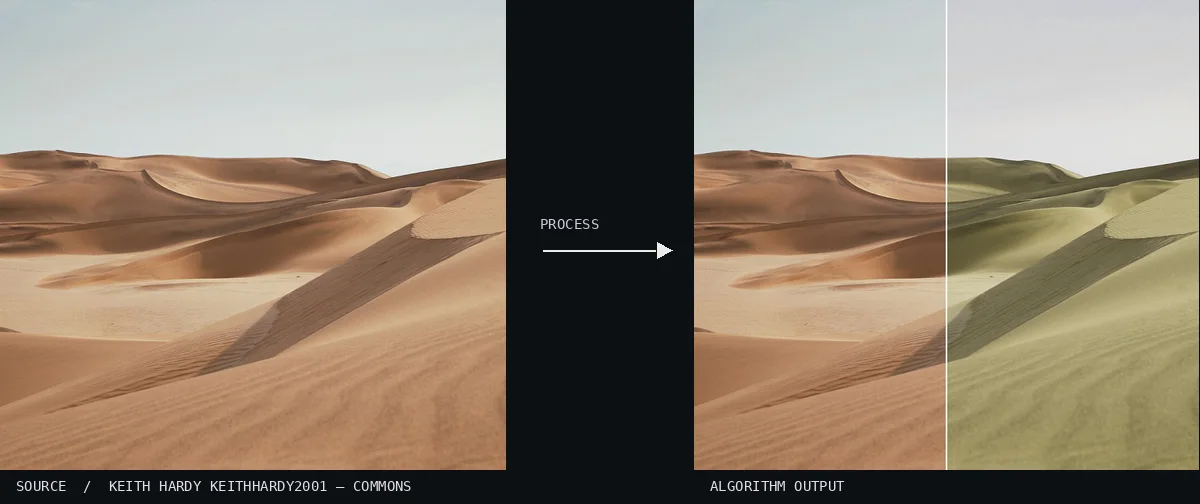
Atlas demonstration: the free source photo and the computed Color-Blindness Simulation. A wide desert landscape features rolling sand dunes under a pale sky. The reddish-brown sands on the left shift to a distinct yellowish-green hue on the right as the long-wavelength signals are omitted.Image: Keith Hardy keithhardy2001 · CC0 (via Wikimedia Commons), processed for the AtlasView source ↗
Prompt
Apply a Color-Blindness Simulation effect using a deuteranopia approximation. Compress red–green distinctions into similar muted yellow-brown tones while retaining clearer blue–yellow separation. Preserve natural brightness relationships, photographic texture, sharp edges, and existing illumination; avoid uniform desaturation or a simple tinted overlay. Keep the original subject and composition.
You see an image where specific colors merge or disappear to match the vision of someone with a[color vision deficiency1].
Principle
The algorithm maps standard RGB colors to aspecialized color space representing human [photoreceptor responses]. It then reduces the signal from [specific cone cells2]before converting the colors back to RGB.
Try it out
Test different deficiency types like protanopia or tritanopia to see which hues vanish.
Classification
Calculated image processing result.
Further examples · 9 images
02Color-Blindness Simulation, applied to “Kangaroos snuggling close (Unsplash)”A wallaby stands on a rocky outcrop amidst a misty forest during a light rain. The vibrant green moss on the rocks transitions into a dull, brownish-yellow color, demonstrating how green light is remapped for the viewer.Joren Aranas sanara (photo); processed for the Atlas · CC0 · Wikimedia Commons03Color-Blindness Simulation, applied to “Street Food Sandwich (Unsplash)”A handheld pastry is filled with white cream and a bright green garnish. The vivid green of the filling turns to a desaturated mustard tone, highlighting the inability to perceive the specific green frequency.Lluís Domingo lluisdomingo (photo); processed for the Atlas · CC0 · Wikimedia Commons04Color-Blindness Simulation, applied to “Kayak on a mountain lake (Unsplash)”A kayaker paddles across a clear mountain lake beneath towering rock faces and evergreen forests. The vibrant orange of the kayak and the rich greens of the trees are dramatically replaced by muted yellows and muddy browns.Nitish Meena nitishm (photo); processed for the Atlas · CC0 · Wikimedia Commons05Color-Blindness Simulation, applied to “Communal Coworking interior (Unsplash)”A modern living room features green botanical wallpaper and a bright yellow pillow on a gray sofa. The lush green leaves are transformed into a desaturated gray, while the yellow accents remain strikingly vivid.Dan Gold danielcgold (photo); processed for the Atlas · CC0 · Wikimedia Commons06Color-Blindness Simulation, applied to “Busy New York City restaurant (Unsplash)”A crowd gathers outside a famous delicatessen at night under a glowing yellow sign and red awning. The intense red of the storefront disappears, merging into a dark olive-green shade that alters the entire street-side atmosphere.Roman Arkhipov lomogee (photo); processed for the Atlas · CC0 · Wikimedia Commons07Color-Blindness Simulation, applied to “Bird in Izola”A close-up shot captures a sparrow standing on green grass near scattered crumbs. The vibrant green of the lawn is transformed into a dull, earthy brown in the right half, demonstrating a clear loss of red and green distinction.Janko Ferlic (photo); processed for the Atlas · CC0 · Wikimedia Commons08Color-Blindness Simulation, applied to “Sashimi at the Tsukiji Markets - Tokyo Japan (Unsplash)”A person holds a tray of fresh tuna sashimi accompanied by a bright green garnish. The vivid pink flesh of the fish becomes a muddy gray-green on the right side, highlighting a complete loss of red sensitivity.Jonathan Forage jonathanforage (photo); processed for the Atlas · CC0 · Wikimedia Commons09Color-Blindness Simulation, applied to “Quaint City Streets (Unsplash)”A narrow European street is lined with historic buildings and patterned cobblestone paving. The warm yellow and red tones of the facades in the distance are replaced by muted greys and olives, illustrating the loss of red cone sensitivity.Eduardo Arcos earcos (photo); processed for the Atlas · CC0 · Wikimedia Commons